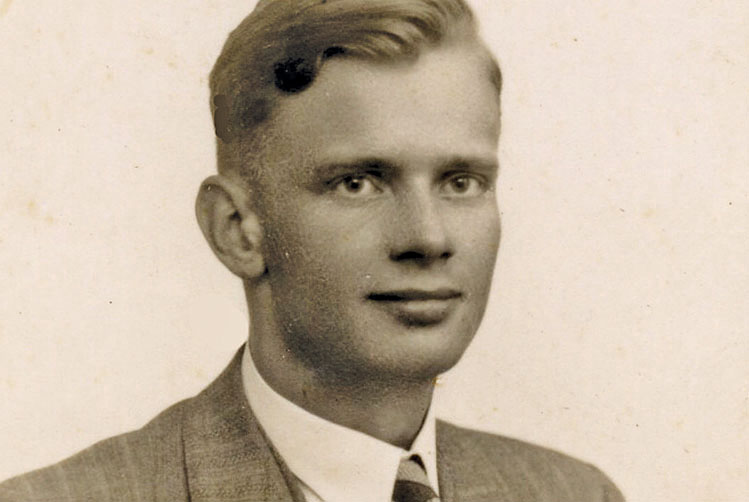
Ulrich Alexander Boschwitz, born in Berlin in 1915, was prompted to leave Germany in 1935 by the Nazis’ antisemitic policies. The outbreak of the second world war found him in England, but he was deported to Australia as an “enemy alien” in 1940, travelling on the notorious voyage of the Dunera. Having received permission to return to England in 1942, he died when the ship he was travelling on was sunk by a German submarine.
Berlin Shuffle, Boschwitz’s first novel, was originally published in 1937 in a Swedish translation. It did not appear in German until 2019, and this translation by Philip Boehm is the first in English. Boschwitz’s second novel was published in translation in Britain and the United States in 1939 and 1940 respectively, and first appeared in German in 2018; a new translation into English (also by Boehm) was published in 2021, under the title The Passenger.
Berlin Shuffle is set in Berlin, sometime in the final years of the Weimar Republic. The action lasts perhaps thirty-six hours, beginning in the afternoon and ending in the early morning two days later. As is emphasised by the novel’s German title — Menschen neben der Zeit, which translates literally as “People Next To Time,” with the neben suggesting that the people are disconnected from their time — almost all the characters are marginalised in some way.
There is the beggar Sonnenberg, a blind war veteran married to a former prostitute named Elsi. Sonnenberg is acquainted with the unemployed Grissmann, and with another beggar named Fundholz, and Fundholz looks after Tönnchen, a man who was traumatised during childhood to the point of imbecility. Two further female characters are Minchen Lindner, the daughter of an ex-convict and the mistress of the aristocratic Herr von Sulm, and Frau Fliebusch, who is unable to cope psychologically with the loss of her husband Wilhelm in the Great War and of her assets in the hyperinflation, and who lives under the delusion that Wilhelm will return one day and restore them to the bourgeois security they enjoyed in 1914.
These characters are introduced at various points in the first half of the narrative, and they come together in an extended episode that takes up the second half, when they all go to a pub called The Jolly Huntsman. Sonnenberg and Elsi go because he earns money by playing the accordion there, and also wants to drink. Grissmann goes because he plans to lure Elsi away from Sonnenberg, Fundholz goes because he too wants to drink, and Tönnchen goes because he follows Fundholz almost everywhere. Minchen goes there to meet her father, and Frau Fliebusch goes because — having misunderstood when she overheard Sonnenberg talking about a pimp known as “Handsome Wilhelm” who frequents the pub — she thinks that her husband will be there.
When the novel concludes in the early morning, Sonnenberg has been fatally stabbed by Grissmann, Grissmann has been detained by bystanders, Elsi is facing a return to prostitution, Fundholz and Tönnchen leave to avoid the police, Minchen goes off with “Handsome Wilhelm,” and Frau Fliebusch departs to continue her search for her husband.
Although the publisher’s blurb says that Berlin Shuffle displays Boschwitz’s “extraordinary talent for capturing Germany’s self-destruction,” I believe that any reader who turns to the novel wishing to discover something about the politics, society or culture of the Weimar Republic will be disappointed.
First, there is little or nothing of substance to be gleaned from the characters’ back stories. Sonnenberg is presented without much elaboration as a blind war veteran, and while Grissmann’s problems began when he was dismissed from his job as a tram conductor, the immediate cause of his dismissal was the suspicion that he had stolen money collected as fares. Elsi turns to prostitution and then marriage, and Minchen turns to prostitution, because they can find no other way of supporting themselves, and Willi becomes a pimp for the same reason. Fundholz has no back story other than a few vague references to how a bourgeois life lay more than ten years behind him, and how his impoverishment was the fault of his ex-wife. Tönnchen appears as a finished product of a trauma which he suffered before the war, and Frau Fliebusch as a finished product of bereavement and poverty.
Of course, all the characters apart from Tönnchen and Frau Fliebusch would be able think about their various social positions in systematic terms, but they are largely preoccupied with satisfying their immediate material needs. Equally, the third-person narrative could generalise from the characters’ experiences but very rarely does so. For example, apart from a handful of minor exceptions, there is no reference to any political party, politician, economic theory, event of public interest, cultural work, cultural practitioner, or any other organisation, person, idea or phenomenon which would give the reader a point of reference from which to analyse the society in which the novel is set.
Admittedly, unemployment or the difficulty of obtaining work are important factors in several characters’ problems, but the causes of the late Weimar Republic’s mass unemployment are discussed only in a single (if lengthy) passage about economic rationalisation, and the numerous prescriptions for restoring employment that were current at the time receive no mention. Similarly, the only person in the novel who talks about politics is an unemployed locksmith called Müller who accosts Tönnchen while he is sitting on a park bench, delivers a diatribe which parodies Nazi conspiracy theories — about how the Jews and Freemasons want to destroy Germany, and how even national heroes such as Goethe and Hindenburg are Freemasons too — and then departs, having elicited no response from Tönnchen, and never to be seen again.
The only time the novel offers something approaching a coherent worldview is in its description of the fight between Sonnenberg and Grissmann, who are characterised as “two men caught under the wheels of life. They were crushed and crippled, physically or mentally. But the wheels lay outside their grasp and beyond their control. Their lives were what they were, and they could do nothing to change that.”
The narrative then declares that the two men fall upon each other “[j]ust as two nations suddenly attack each other for no good reason and let themselves be drawn into a war that only serves the interests of people unknown and unnamed,” before raising the symbolic stakes to the maximum:
To date, the World War and the Inquisition have achieved the greatest success when it comes to large-scale eradication of humanity. It is to be expected that in the coming years, we will experience entirely new episodes of annihilation.
Sonnenberg and Grissmann have undoubtedly been abandoned by their society, and wars are often fought for the benefit of the powerful. And the narrative’s vision of “entirely new episodes of annihilation” is chilling in the light of what Boschwitz knew had happened in Germany in the few years before he wrote the novel, and especially of what we know happened afterwards. But I consider Boschwitz’s suggestion that Sonnenberg and Grissmann — and, by analogy and extension, everyone in the world — can “do nothing to change” their fate to be superficial and alarmingly defeatist.
Many of the German-language novels written by and about Weimar Germany and Weimar Berlin in the 1920s and 1930s are available in English. For a nuanced description of the Berlin underworld, readers can turn to Alfred Döblin’s Berlin Alexanderplatz. For a complex story of political disillusionment, Erich Kästner’s Fabian. For a confronting account of the damage caused to society by the Great War and the hyperinflation, Hans Fallada’s Iron Gustav. For a brilliant psycho-sociological study of a young woman who survives by attaching herself to more affluent men, Irmgard Keun’s The Artificial Silk Girl. With these works — and others such as Vicki Baum’s Grand Hotel and Gabriele Tergit’s Käsebier Takes Berlin — in mind, I found Boschwitz’s Berlin Shuffle rather uninteresting, and rather unrewarding. •
Berlin Shuffle
By Ulrich Alexander Boschwitz | Translated by Philip Boehm | Pushkin Press | $34.99 | 256 pages