Grief is disorienting. A dreadful recognition and a fantastical denial combine unnervingly. Its sheer physicality echoes the dying process. Time and space expand and contract, rendering familiar places strange and routines disorderly.
These shifts in spatial and temporal perception are vividly captured in Siri Hustvedt’s memoir of her anguish after the death of her husband Paul Auster. Ghost Stories begins with a precise statement — the date and time he died in 2024 — and then falls into the disarray of the aftermath.
She sorts and discards his clothing. She gathers up the assortment of drugs that had accumulated during his cancer treatment and has her sister dispose of them. Tidying his desk, she observes his writing habits, his collection of pens and typewriter ribbons and his handwritten notebooks. The busyness of cleaning and clearing absorbs and distracts her.
But then she looks at his chair in the dining room, noticing the marks on the floor made as he moved while seated. Formerly a source of annoyance, she sees them now as “traces of his body’s living weight,” marks of her loss, and she crumples, howling, “I want you back. I want you back.”
Hustvedt observes and describes her fluctuating states of mind as she moves through their home as “cognitive splintering.” One minute she is exploring medical statistics and debates about the effects of environment on genetic inheritance; the next she is struggling with sleeplessness, nightmares, the horror of her husband’s final days of life and the family trauma that preceded his cancer diagnosis.
Hustvedt has written extensively on the interplay between mind and body, drawing on her intellectual interest in the sciences of the mind – psychiatry, psychoanalysis, neurology and psychology. In her non-fiction book The Shaking Woman, Or a History of My Nerves she analysed her experiences of the interplay between involuntary seizures, fear, distress and an uncanny ability to continue speaking as if her “self” was distinct from the “shaking woman.”
She has also examined the ways that migraine affects perception and can induce disorienting and disabling physical reactions. Not surprisingly then, while she acknowledges Paul’s smoking as a probable contributor his inoperable lung cancer, she surmises that the deaths of his son and his baby granddaughter the previous year had induced mental responses that contributed to his illness.
Paul Auster’s son, Daniel, died of a drug overdose days after his arrest for the manslaughter of his infant daughter, who had died after ingesting fentanyl and heroin. These events, which Auster called “the horrible things,” haunted the last year of his life, but he was insistent that “the story be told.” Hustvedt recounts their anguish over the son’s drug addiction and the traumas it wrought. Like Auster, she had written fiction drawing on Daniel’s troubled life that reveals their concern over a long period. While Paul held out hope for his son’s future, Siri withdrew in response to the “lies, thefts, and betrayals.” She acknowledges it was easier for her because she was a stepmother, but the tragedy of the baby girl’s death shattered Paul’s faith Daniel would change.
Insisting that “the wondrous and the horrible mingle,” Hustvedt juxtaposes her brief account of these two deaths with the happiness at the birth of a grandson to their daughter Sophie and son-in-law Spencer in 2024. Paul Auster wrote long letters to his grandson during his illness, aware he would not live to see him reach adolescence. These letters provide familial stories of the sort that might be told to a child about their parents and forebears — the events of 11 September 2001, when Miles’ mother could not be contacted; the farm in Minnesota where his grandmother Siri grew up — documenting “the unbroken generations of love.” In Ghost Stories they are interspersed with Siri’s letters to friends during her husband’s illness and treatments, her diary entries and her reflections on death and grief as human mysteries.
Paul Auster’s novels have often been described as postmodern, defying conventions of plot trajectory and authorial voice. Several, considered “autofiction,” incorporate people from his life as characters and include versions of events he experienced.
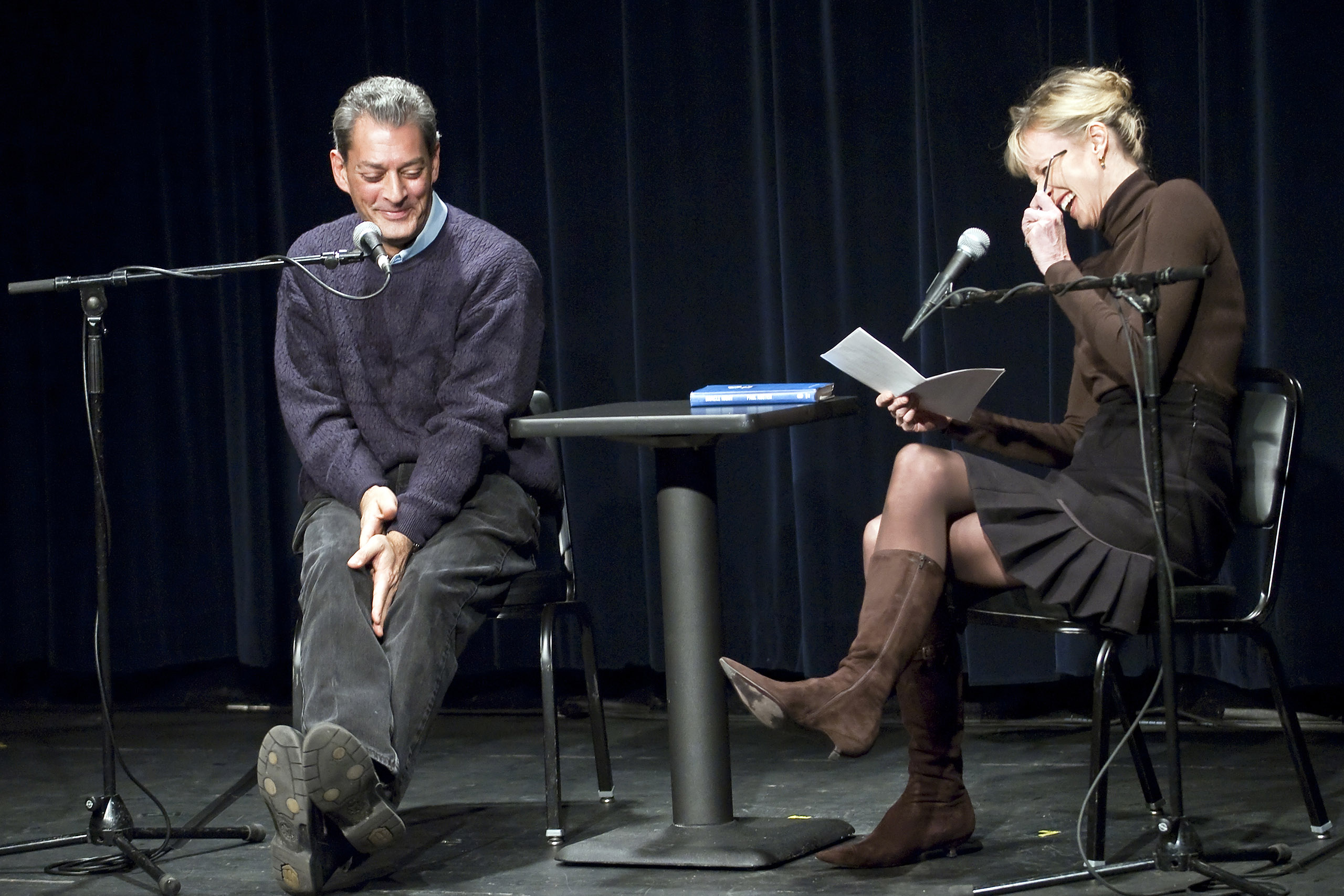
Hustvedt writes more conventional novels, but this memoir is decidedly postmodern in its fragmentary form and disrupted narrative. It chronicles their relationship over its forty-three years, from when she was a graduate student writing a thesis on Charles Dickens and Paul was yet to publish The New York Trilogy, which brought him international fame. It is the story of a companiable marriage that provided the ground for mutual flourishing as writers.
In some respects, and understandably, the marriage is idealised, to the point where I was surprised when, well into in the book, she mentions arguing at the dinner table. But the account of his cancer treatments and her care of him over the last six months of his life creates a vivid picture of their intimacy and its transformations over the decades.
Paul’s death is the annihilation of their unity as a couple. Recalling the ways they became increasingly similar over the years, she sees that he took to the grave “my words, my touch, my ideas, my books, and my humour, all the changes in him wrought from living with me over four decades.” She gropes for visceral metaphors that capture the injury of loss — amputation, a phantom limb, “a gaping hole in my torso.” The “splintering” of her life in the wake of his death means her own body is the site of loss, grief and dislocation, but as a writer she is also the detached observer and analyst of her emotional states.
And just as Paul embodied changes wrought by Siri, she has incorporated elements of his life as part of herself. She captures the physicality of grieving — the “aches and electric jolts and mouth sores,” blank insomnia, “soldiering on” through sickness and suffering.
When the funeral is over, she returns home, dines with visiting relatives, and then lies on her bed, sleepless. She experiences the ghostly presence of Paul “taking the last two steps up to the third floor, just beyond the open door. He crossed the landing, walked into the room, and stopped at the side of the bed.” He had said he wanted to return as a ghost, and she is convinced he is there to comfort her: “his invisible, adoring concerned presence flooded me with a dense, plump, happiness.” At other times, his presence manifests as the smell of smoke from his small cigars, and she feels this regular olfactory hallucination as “a sensual trace of my past with Paul.”
Grief memoirs typically deal with the irrational, bizarre ways mourning can simultaneously recognise the loss and engage in denial. Joan Didion called this “magical thinking” when she documented her response to her husband’s death. She refused to throw away his shoes in case he returned. Like Hustvedt, C.S. Lewis used the metaphor of amputation in A Grief Observed, elaborating the complex emotions of suspense and fear as irrational expectations of an event that can’t possibly occur — the return of the dead beloved. Hustvedt claims her experience of smelling Paul’s cigars as symbolic but material, her sense of his step on the stairs as “the ineffable feeling I longed for… briefly restored to me. I got him back.”
Hustvedt also retrieves her husband by describing his habits, his relationships with family and friends, his literary fame and the moral and aesthetic impulses that inspired his writing. In many respects Ghost Stories is a eulogy, giving biographical details and memories of their daily interactions, describing his generous affection for various family members. He was effusive in his admiration for his wife’s writing and boasted about the achievements of his singer/songwriter daughter Sophie and her husband Spencer, a photographer. His letters to his grandson reveal an almost naive pride in their parental accomplishments.
The text switches back and forth — back to their first meeting, their wedding day, and how both their careers flourished in the decades that followed, forward to the grieving. Her role in the “Siri-AND-Paul” entity is conveyed through the literary device of commentary on three letters she sent him in the early phase of their relationship. These intimate disclosures, written when she was very young, are balanced by the reflections on her feelings decades later. By her account, the deep love they express for each other was embedded in a creative collaboration of support, commentary and critique.
Ghost Stories invites comparison with other memoirs of grief, especially those by authors whose partners were also writers. Didion, Lewis, and more recently, Geraldine Brooks have all written about the shock and disbelief at the death itself and its shattering of their sense of self. Didion and Lewis grapple with their trauma in eloquent, almost detached, philosophical language. Brooks and Lewis narrate how they eventually come to terms with loss and anguish, each invoking religious or spiritual traditions.
By lacking resolution Hustvedt’s story captures the chopping and changing as life continues. “There are moments when NOW obliterates grief,” she writes, including the maddening bureaucratic necessities that accompany death: changing banking details, closing accounts, managing the literary estate. And there are the simple pleasures of sunny days and enjoying seeing a growing grandchild. This openness, and the spontaneity of diary entries, emails to friends and her letters, is balanced by careful observations and contemplation of her husband’s illness and death.
The Hustvedt–Auster household was clearly well-organised, with file boxes on each family member. Hustvedt uses these archived documents — letters, diaries, fragments of stories, recollections — to reconstruct different points in their lives. She has always introduced stories from her life into her fiction, often in ways that make the “truth” hard to distinguish from the imagined. In Ghost Stories there is no haziness. Mourning is a cruel process, and she is relentlessly candid in describing it. •
Ghost Stories: A Memoir
By Siri Hustvedt | Sceptre | $34.99 | 303 pages