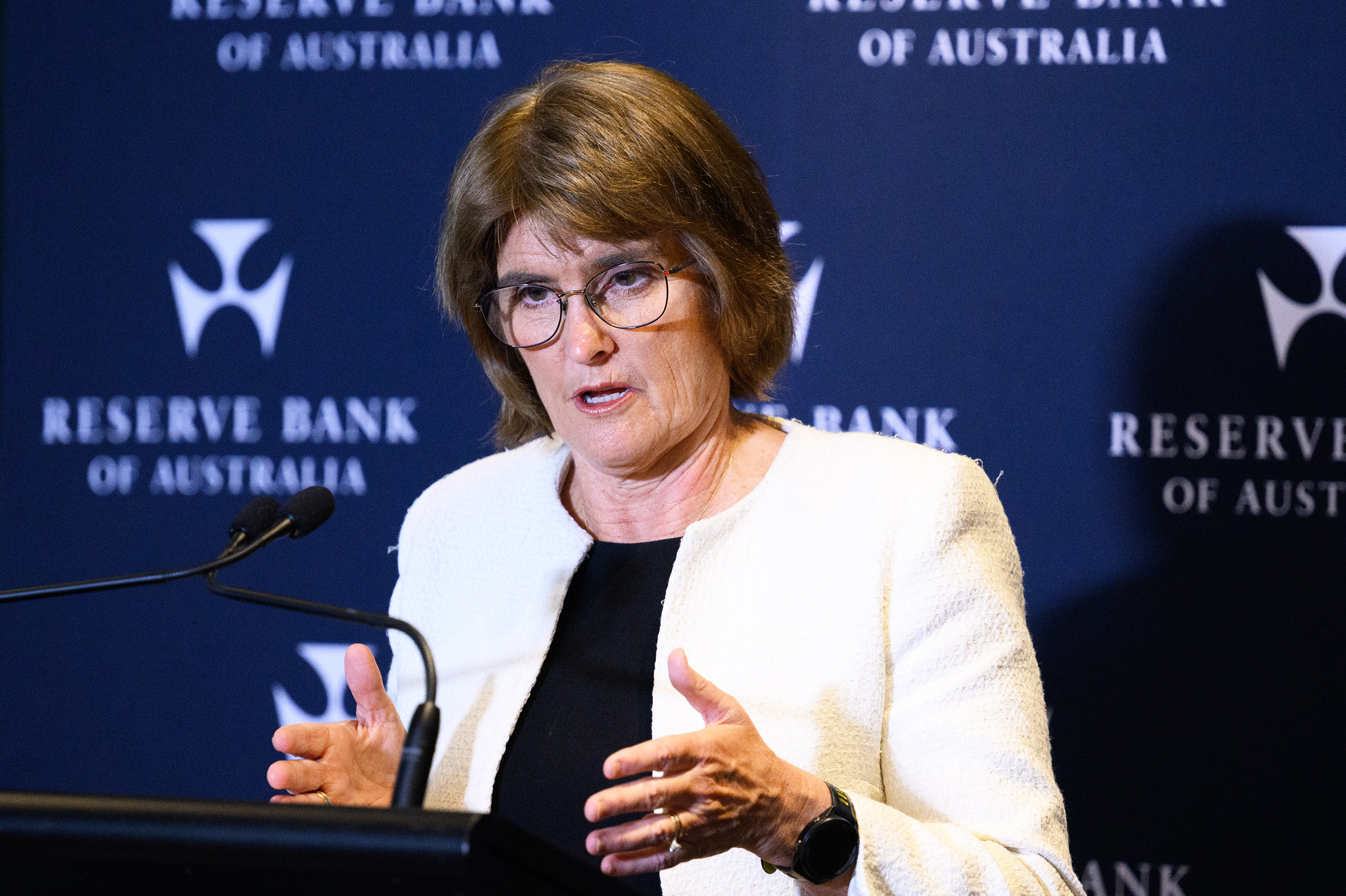
As universally expected, today’s Reserve Bank monetary policy board meeting decided (unanimously) to leave the cash rate unchanged at 3.60 per cent, where it has been since August.
But the Board’s post-meeting statement was less “hawkish” than many other economists had anticipated. In particular, it doesn’t give any indication it is contemplating a possible lift in rates next year (to which the financial markets are now assigning a 100 per cent probability).
No indication, that is, beyond the usual concluding sentence declaring it “will do what it considers necessary” to achieve “price stability and full employment,” although governor Michele Bullock did reveal at her post-meeting press conference that the board “discussed the possibility” it might need to increase interest rates. Presumably the minutes of this week’s meeting, to be released on 23 December, will shed more light on that discussion.
While acknowledging inflation has “picked up more recently,” the board judged that “some of the recent increase” in inflation “was due to temporary factors” and, moreover, that “there is uncertainty about how much signal to take from the monthly CPI [consumer price index] data given it is a new data series” (although it is not as if the preceding data for the September quarter was a whole lot more comforting).
Against that, the board’s post-meeting statement also acknowledged “some signs of a more broadly-based pick-up in inflation, part of which may be persistent and will bear close monitoring.”
It also referenced three factors: the strengthening in private demand (evidenced in last week’s September quarter national accounts), which it said had been “stronger than anticipated”; the continued tightness in the labour market (evidenced, it said, by the “significant share of firms… experiencing difficulty sourcing labour”; and the continued strong growth in “broader measures of wages” (such as the national accounts measure of average hourly earnings) and unit labour costs. In her press conference, Governor Bullock cited the strength of the recovery in private sector spending as potentially signalling that further reductions in interest rates are “not needed.”
The board’s statement concluded by recognising that “the risks to inflation have tilted to the upside” but also asserting that “it will take a little longer to assess the persistence of inflationary pressures.” That doesn’t sound like it is laying the groundwork for an increase in interest rates any time soon.
As I said after the release of the higher-than-expected October inflation data, for the Reserve Bank to contemplate lifting rates any time soon (having recently lowered them three times) it would need to be persuaded that the recent upturn in inflation represents the beginning of a new upward trend — as opposed to it being evidence that the “last mile” of getting inflation down from its 2022–23 peak is proving more difficult than previously anticipated.
It will take time to draw a conclusion, one way or the other, on that point. There doesn’t appear to be any evidence that a new upward trend in inflation has begun in any other comparable country, in the way there was in the early stages of the inflation cycle following the Covid-19 pandemic. Indeed, except in the United States — where progress in reducing inflation has been hampered by the effects of the Trump regime’s tariffs (and where there is no official data beyond September) — “underlying” inflation is either close to central bank targets or (as in Britain and New Zealand) heading in that direction.
So, for now at least, I remain of the view that the Reserve Bank isn’t going to raise rates next year and there is still a reasonable probability it will cut again, although in all likelihood only once, and not until May at the earliest. •