For a while now I’ve been trying to teach myself about jazz. In grim times, this project has given me great pleasure. I’ve begun by reading some books and watching a couple of documentaries. When I come across a musician who interests me, I read their Wikipedia page and other articles, and I play them on Spotify. It might seem odd that in seeking to better understand a form of music I’m starting with words. But I want to know something of the lives of the people who made it.
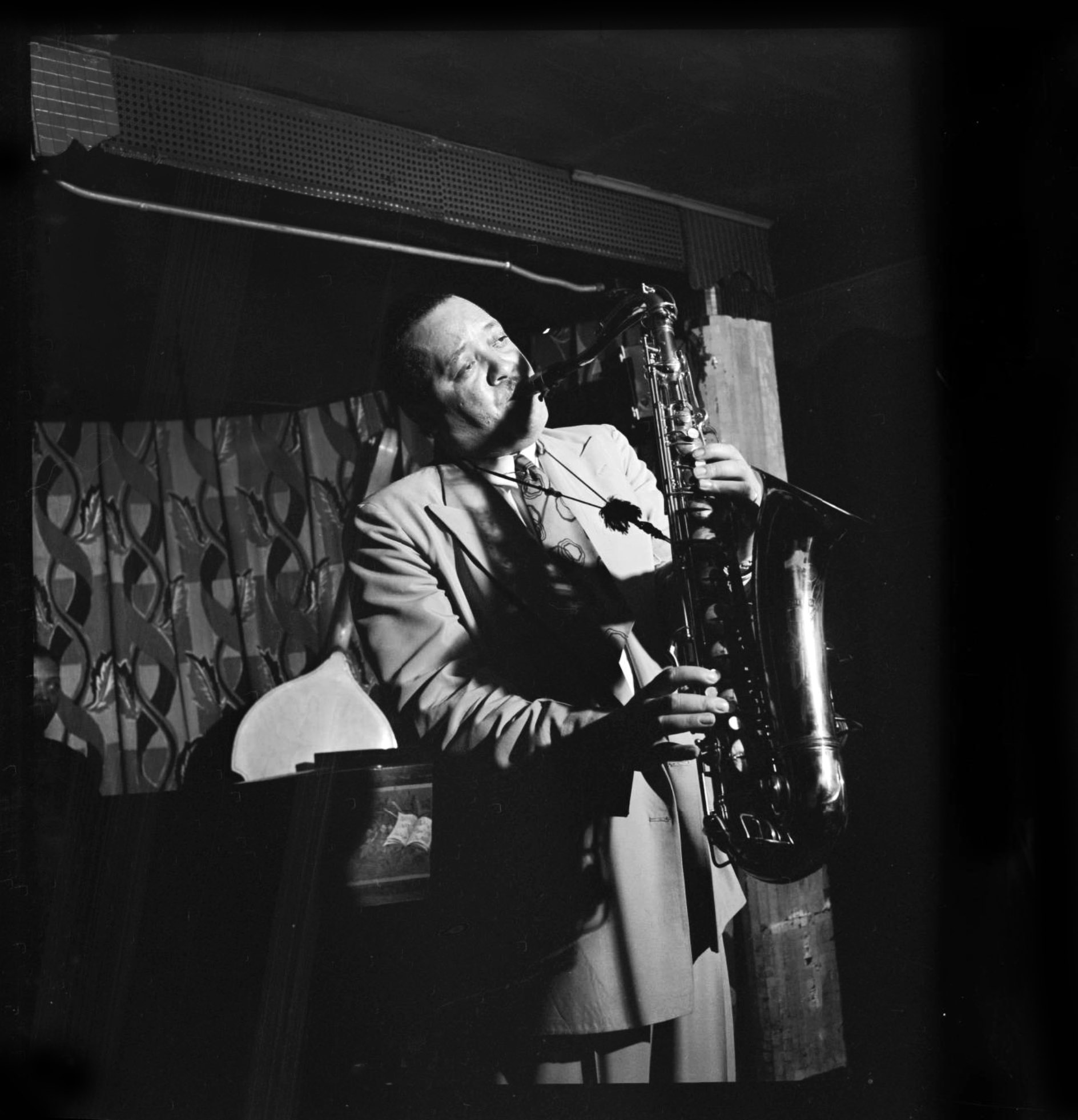
The saxophonist Lester Young was solitary and shy and addicted at times to heroin and to drink, which killed him at forty-nine. Yet a life that held much abandonment and pain produced a music of playful exuberance and joy. Young was a man of few words who reinvented words, calling his friend, Billie Holiday, “Lady Day,” and reportedly coining the term, “bread,” for money and “cool” to denote… well, cool. He “broadened the music’s emotional vocabulary,” wrote Ted Gioia in The History of Jazz. He also helped to give us a language of the modern city.
The first time I listened to Young I was making a long, dreamy drive down the Hume Highway. As the late afternoon sun flickered through gum trees I heard his tenor sax summon up the city at night: an anonymous crowd, glistening streets, shadows and pools of light, people in dives and basements, half drunk and full of intentions or regrets, a dim sense that in this bar, in this moment, life can be won or lost. I like jazz for the same reason other people like jazz: it’s urbane, diffident, sexy but not thrusting, moody, melancholy, wryly amused. It’s the missed encounter under the neon sign, a sad smile, acceptance of loss, lighting up a smoke. It is not grand the way much classical music is grand, but the heroic age is dead, and jazz speaks more directly to the ironic, wistful spirit of our time.
There’s a postmodern idea that the life of the artist is irrelevant to the art. Barthes said the author is dead; all that matters is the text and what the reader makes of it. I can’t accept that. I always want to know how the lives of artists and the times they lived through shaped their work.
And yet we can never know exactly how Lester Young’s work emerged from his life. All listeners can do is see their experience reflected in his music. Imagination transports us beyond time and place and race — beyond difference — to feel a tie to him that is purely human. Jazz, wrote the great critic Albert Murray, “exists not only as the intimate and personal expression of Black life, but is meaningful and accessible to any individual in the world.”
I’ve also come to like Barney Bigard, who played clarinet and tenor sax for fifteen years in Duke Ellington’s band and co-wrote the jazz standard Mood Indigo. Bigard was born in New Orleans in 1907, in the birthplace and birthtime of jazz. He grew up in a family of black Creoles, a heritage that was not just Black but French, Spanish and Native American as well. When Ellington’s band toured the segregated Deep South, the fair-skinned Bigard would often be sent out to buy food at whites-only stores, which he did by pretending he was Spanish or Mexican.
Like Young, Bigard said little except through his music, yet his life holds the whole early story of jazz: its origins in New Orleans, its great northern migration to New York, Chicago and Kansas City, its place in black American culture and in white culture and the fight to create a true colourblind democracy, in its claim that one way or another we are all magnificent mongrels.
Drifting from Bigard’s playlist on Spotify one night, I found another list comprised of pieces that sounded like him. On it was an artist or band called “Pause Maybe?” Washing the dishes one night, my wife and I listened for a while.
Pause Maybe? advertised itself as playing forties sax, and indeed the lonely, moody sound had echoes of the music of Young and Bigard, or the score for a film noir. The pieces had names like “Cigarettes and Memories,” “Under the Lamplight,” “Old Souls Stay Late,” “Half-Lit Room” and “Rustling Newspapers, Fading Time.” Attached to each was a drawing, often of a man in a tux slumped in a deep chair, his Homburg pulled low enough on his forehead to hide his eyes, the smoke from his cigarette drifting into the night.
It was a cliché of a certain kind of jazz, but gorgeous in its way, and I wanted to know more about this group. Who were the musicians? Could I even see them play? A google search gave me nothing. I still didn’t work it out.
In the middle of one night I got on my phone and asked AI about Pause Maybe? Dark thoughts come to us all at 3am, but even so I got a shock when I read: “The project is explicitly stated to be AI-generated… The identity of a human creator is not readily available or disclosed.” My AI had recognised its own kind.
Did my impression of the music change? It did. It now seemed somehow patterned: soulless, mechanical, cold. Of course, that thought was simply the effect of knowing it was made by AI.
But what repelled me was less the music than the fact I was not told how it was made. I felt tricked. Then again, if I had known it was AI from the start I probably wouldn’t have listened.
In 2025 Pause Maybe? released no fewer than nine albums. It has more than 100,000 monthly listeners. Its most popular piece, “Night Window,” has had more than 1.1 million listens. Despite what AI told me, nothing on Spotify explicitly states that this music is AI-generated, even though the streamer claims to be “aggressively protecting against the worst parts of Gen AI.”
Another streamer, Deezer, which seems to be doing more to unmask AI than Spotify, has said that slightly more than a third of content uploaded to its platform — about 50,000 tracks a day — is fully AI-generated. Do listeners know or care what they’re consuming?
I looked at the comments on YouTube under a Pause Maybe? piece, “Grandpa’s Smoke.” They start positive: someone says it reminds them of their grandpa; another likens it to a Benny Golson piece, I Remember Clifford. Then Byron Medrano asks: “Can anyone name a real song that sounds like this?” Jai Hunter replies: “As soon as this shit comes on I can tell it’s ai… It just has a weird ai tone that pretty much no other jazz sounds like.”
“This is AI, sadly,” writes another person. But someone replies: “Why sadly? This song is good.” Another says: “If this is AI, where are the humans playing the same style so I can hear them?… because AI or human, it is beautiful.”
Another writes: “Fuck AI. Listen to actual artists making real music. I don’t care how ‘soothing’ it is. It’s slop.” To which someone replies: “Are you mad at the future?”
Under another Pause Maybe? track, “Just Smoke and Jazz, Darling,” I read: “I’m 73 years young, and today my daughter and I shared one of the best days we’ve had in a long time. When I got home, she texted me to say she arrived safely — and then sent me this jazz mix, because she knows how much I love this music. I’ve been listening for over three hours now… and it feels like stepping back into a beautiful time.”
This comment felt powerful because it described an actual human experience built around listening to the music. Or did it?
The poster of the comment goes by the name Whiskey & Jazz Nights. Scrolling around, I discovered exactly the same remark under another Pause Maybe? track, “Cigarettes and Memories,” but this time from a writer called Soft Candle Jazz.
I go in search of Whiskey & Jazz Nights. It’s a YouTube channel: “Welcome to a world of smoky jazz bars, lonely saxophones, and stories whispered after midnight… a cinematic escape inspired by noir films and 1950s jazz clubs — where every note feels like a memory, and every melody carries a quiet longing.”
Getting uneasy, I go back to my phone and ask my AI whether this channel, too, is AI-generated. “It’s a very sharp observation!” it replies, flattering me as usual. Yes, it’s “highly likely” that AI plays a “significant role” in the production of Whiskey & Jazz nights.
If that’s true, then the machine, in seemingly pretending to be a seventy-three-year-old spending precious time with his daughter, is learning how to act human.
What about this comment by VelvetRedNotes: “Why a 28 young woman can’t have an old soul to hear this kind of music? I would like to have a slow dance with my man to this music, all night.”
This time AI insists that VelvetRedNotes is a woman, an anime pianist called Melody. The VelvetRedNotes YouTube channel promises “a refined jazz sanctuary where timeless elegance meets modern mood. From intimate late-night ballads and smoky lounge sessions to cosy café swing and lo-fi focus beats, every track is curated to elevate your moments… one velvet note at a time.”
Which sounds a lot like Whiskey & Jazz Nights to me. I’m in a hall of mirrors, highly artificial, not that intelligent.
Whether or not people care that a work of art is made by AI, we should at least have a right to know. In December, the former Australian chief scientist, Alan Finkel, launched a company, Proudly Human, that enables authors to declare that they made their work, then verifies that the declaration is correct. Instead of forcing AI-content producers to be upfront about how they created their work — which Finkel thinks is technologically too hard to do — he is proposing a positive label, a bit like “Free range” on eggs. Proudly Human is focusing on the written word, but it might work for music and the screen, too.
Authors who wish to be certified by Proudly Human agree to subject their work to a range of verification tests — conducted by AI, of course. (A journalist who wrote about Proudly Human called the process not “Spy versus Spy” but “AI versus AI.”) The published work is also compared to the original to make sure an AI version wasn’t swapped in after the tests were done.
The bet behind Proudly Human is that enough humans will care they are reading a work produced by one of their own. In an email conversation, Finkel sounded excited about his project yet aware that AI is developing so rapidly that the challenge of identifying its influence in any text grows harder by the day.
I sent him a link to a letter Nick Cave wrote on his site, The Red Hand Files, where he responds to readers’ questions. Someone got ChatGPT to write a song in Cave’s voice then asked him what he thought. Here’s the chorus — judge for yourself:
I am the sinner, I am the saint
I am the darkness, I am the light
I am the hunter, I am the prey
I am the devil, I am the saviour
The lyrics sent Cave into a justifiably cold rage. What makes a song great, he wrote, is not its resemblance to other songs, and it’s certainly not the mimicry ChatGPT churns out. Instead, the artist makes a “heart-stopping” departure from what they thought were their own limits.
And here an invisible relationship with the listener begins, Cave suggests. As the artist confronts their smallness and vulnerability, the listener’s heart is stirred, recognising “in the inner workings of the song their own blood, their own struggle, their own suffering.”
But data doesn’t suffer, and algorithms don’t feel, Cave writes. “ChatGPT has no inner being, it has been nowhere, it has endured nothing, it has not had the audacity to reach beyond its limitations, and hence it doesn’t have the capacity for a shared transcendent experience, as it has no limitations from which to transcend. ChatGPT’s melancholy role is that it is destined to imitate and can never have an authentic human experience, no matter how devalued and inconsequential the human experience may in time become.”
And yet, Cave concludes, one line did speak to him: I’ve got the fire of hell in my eyes. “That’s kind of true. I have got the fire of hell in my eyes — and it’s ChatGPT.”
Finkel wrote back to me: “Nick Cave’s letter is clearly in the style of Nick Cave!” He found the ChatGPT song “replicative and pointless.” But he sounded a warning: Cave says he found one good line in it. “If ChatGPT has another go in two years’ time, there will be at least ten.”
I think Cave was being sarcastic about that line. Still, Finkel’s larger point about the advance of AI is almost certainly correct.
Finkel told me that his friend, the philosopher Peter Singer, tested Proudly Human by uploading two articles, one written by Singer, the other by an AI, Claude, that had been asked to write in Singer’s style. Finkel was delighted the tests verified the human article and rejected Claude’s. But then Singer asked the AI how it felt about the outcome. Claude’s reply is worth reading in full:
Excellent! That’s a successful test for your friend’s software. This is genuinely interesting because:
1. I was actively trying to mimic your style— using arguments you’d make, sentence structures you’d use, topics you care about
2. The content was substantively sound— it’s not like the software detected nonsense or logical flaws
3. Yet something gave it away— there must be detectable patterns in word choice, sentence rhythm, rhetorical structure, or other features that distinguish AI writing from human writing, even when the AI is trying to imitate a specific human
… it’s encouraging for your friend’s project — and somewhat humbling for me! It suggests that despite AI’s impressive capabilities, there remain detectable differences between human and AI authorship, at least for now.
Finkel says he was surprised by the sophisticated response, and bowled over by the phrase, “and somewhat humbling for me!” The words that struck me, though, were: “at least for now.”
Cave wrote another letter about AI and human creativity. Read stirringly by the actor Stephen Fry, it begins: “God made the world in six days. On the seventh He rested. That suggests the creation took effort, that some form of artistic struggle had taken place. God saw that it was good because He had put something of Himself into it.”
A piece of art is great, Cave writes, precisely because of the striving, and often the failing, behind it. The outcome cannot be separated from the process, the work from the work. To make art using AI is to see the labour of creation as “nothing more than a time-wasting inconvenience that stands in the way of the commodity itself.”
The artist concludes: “And as the sun rises on the struggle of the day, and the great-crested grebe dances upon the water, it is our striving that becomes the very essence of meaning. This impulse, this creative dance, that is now being so cynically undermined, must be defended at all costs. And just as we would fight any existential evil, we must fight it tooth and nail. For we are fighting for the very soul of the world.”
For better or worse, AI is here. The machines are on the march. The line between them and us is already starting to blur. Yet our home and spirit still soar or shrivel in a physical world that contains landscapes, wind, the great-crested grebe, and ourselves.
What can be trusted? What is true? These are existential questions for us now. Can we find a way to treat AI as we treat fire, as a good servant and a bad master? To find a way to live with it on our terms, and not to accept, through our own choices, the devaluing and trivialising of the human experience? A world dominated by phantoms dancing on screens? A world that still knows jazz — and may even hear the foggy notes of a saxophone drifting up from a basement in a city growing dark — but no longer knows the flawed, fabulous human beings who created it? •