The noisy, all-around-us, ceaselessly moving media environment we inhabit today prevents us from remembering how things once were. It would be easy, for example, to think that no one has shot themselves in the foot as deftly as Donald Trump did when he launched his war on Iran in February.
Despite commanding the world’s most powerful military, Trump looks like achieving, at best, the agreement Barack Obama secured with Iran — the one Trump tore up in his first term on the ground that it was the worst deal ever. Consider the cost in human lives, to the world’s economy and to the vestiges of Middle East stability of his reckless aggression.
In her new book Done in a Day, Elisa Tamarkin wants us to remember how badly an earlier war, in Vietnam, went for the US — not to mention for the millions of Vietnamese killed and injured — and how little politicians, and the public, seem to have absorbed its lessons.
Tamarkin brings an interesting dual perspective to her task. She is a professor of English at the University of California, Berkeley, and she is the daughter of Bob Tamarkin, a foreign correspondent with the Chicago Daily News. Her family arrived in Vietnam early in January 1975 and her father was on the last helicopter out of Saigon on 30 April. Elisa, then aged four, had been evacuated with her mother to Hong Kong on 10 April.
Tamarkin has both real affection for journalism of the kind her father practised and a critical awareness of its shortcomings. Her book is richly illustrated with photos showing the innards of news work: the reams of telexes, the telegrams between her father and his editors, the final front pages of more than twenty American newspapers between 1978, when the Chicago Daily News closed, and 2025.
There is nostalgia in this and also, remembering the word’s Greek roots, pain (álgos) as Tamarkin recalls the proud history of the News’s early, deep commitment to reporting foreign news. As long ago as 1901 the newspaper’s publisher, Victor Lawson, had set up bureaus in Tokyo, Peking, Egypt, South Africa, Latin America, Australia and various cities in Europe, pioneering the comprehensive surveilling of world affairs that took grip during the twentieth century.
Lawson wanted a “man on the spot” (and they were almost all men) in each of these cities, living in foreign capitals rather than flying in and out. That way they would learn the local context, cultivate local contacts and anticipate events, equipping them to recognise a real scoop when it came their way. By the first world war, the paper had thirty resident reporters covering events from the front lines.
All this cost a lot. But it yielded other dividends: apart from strong coverage of breaking news, the News specialised in what one of its correspondents called “side-light stories” — “the unexpected, incidental angles on events that you could never drop in to find.”
By the time the paper closed in 1978, the amount of foreign news carried by it and its fellow American papers was in decline. In 1970, Tamarkin reports, foreign news occupied 11 per cent of the “news hole” in daily newspapers. By the time the Vietnam war ended the figure had dropped to 6.3 per cent. A decade later, after big companies began buying up newspapers in individual cities and consolidating them into chains, the figure had fallen even further to 1.8 per cent. Today, only the most resilient of the world’s legacy media, like the New York Times, can afford to run foreign bureaus.
Foreign reporting is not without its problems: newspaper publishers’ interests, whether ideological or commercial, are often aligned with their government’s foreign policies, as Tamarkin shows was the case with Lawson. Foreign postings were keenly sought after in newsrooms, leading to a certain arrogance among the species. As a character in Tom Stoppard’s 1978 play Night and Day remarks: “A foreign correspondent is someone who flies around from hotel to hotel and thinks the most interesting thing about any story is the fact that he has arrived to cover it.”
From the vantage point of 2026, it is also clear something has been lost. Ideally, foreign correspondents go out into the world, get to know other places and people and then translate what they find for their audience at home. They are an inoculation against the kind of news and opinion silos created and then cemented by the digital age.
Tamarkin’s book is carefully researched and genuinely thought-provoking, but it is also dense and allusive. Five extended chapters each cover several meaty topics with digressions into, say, Thomas A. Harris’s 1969 book about transactional analysis, I’m OK — You’re OK, or an early twentieth century “cine-poem,” The End of the World Filmed by the Angel of Notre-Dame.
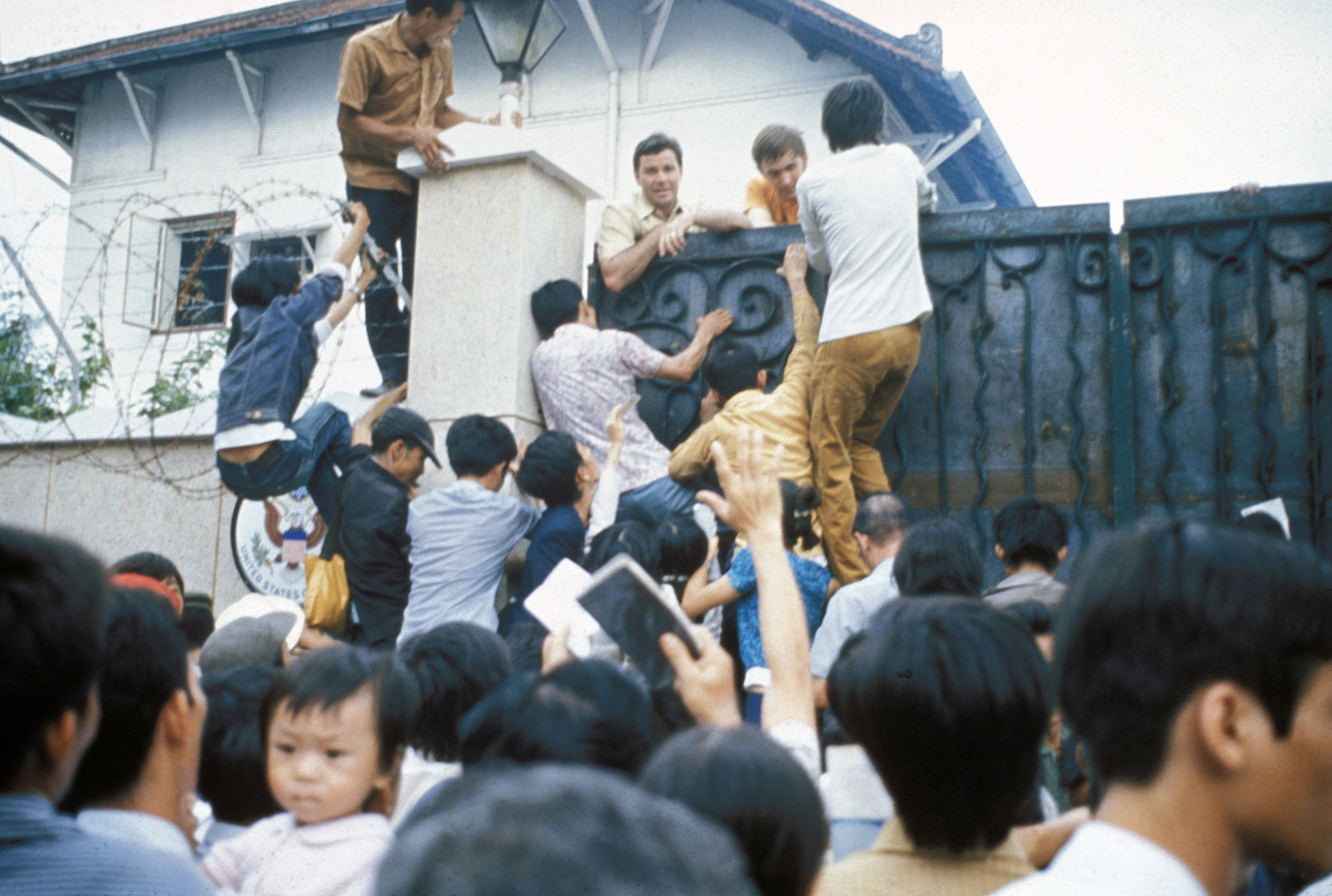
That aside, the most important theme of the book for me was Tamarkin’s complicating of the history of the Vietnam war. She begins by focusing intently on the final days of a conflict that had begun as a civil war in 1955 and ended in 1973 with the signing of the Paris Peace Accords. Saigon’s fall to North Vietnamese forces prompted the largest evacuation by helicopter of Americans and selected foreign nationals from the US embassy, though not, sadly, many of the Vietnamese who had fought with and supported the Americans.
How the war ended, though, is just the starting point for the author’s meditation on how political leaders think about wars and how the public’s perception of war is shaped by the news media.
Done in a Day also reaches beyond most media history by asking how the interaction between political leaders and the public shapes what each did next, especially after it became blindingly clear to anyone paying attention that the war was going disastrously for the Americans yet the nation’s political leaders kept it going for year after year.
Tamarkin points to Daniel Ellsberg’s famous leaking of the Pentagon Papers to the New York Times in 1971. Ellsberg had been among the authors of a secret forty-seven-volume history of America’s political and military involvement in Vietnam since 1945, which had been commissioned by defense secretary Robert McNamara.
Although the New York Times published only part of the 3000-page narrative, writes Tamarkin, it was more than enough to make clear how the public “had been deceived by four presidents who knew from the start that the war would never end until it was lost, even as they continued to drop millions of tons of bombs.”
Even by 1970, before Ellsberg’s leak, there had been no shortage of information about the war’s disastrous progress in news reports and in books by journalists who reported from Vietnam, among them Frances Fitzgerald (Fire in the Lake, 1972) and David Halberstam (The Best and the Brightest, 1972).
Ellsberg lamented the “endless, escalating stalemate” that first the Johnson and then the Nixon administrations allowed to continue. In his 1972 book, Papers on the War, he argued that members of the executive branch of government and in congress “had neglected totally to unlock and study its own copies” of the history of the war.
Ellsberg had tried in 1970 to persuade the secretary of state, Henry Kissinger, to skim the study or assign it to an assistant to read it for him, to which Kissinger replied, “Is there really much to be learned from that?” Tamarkin comments: “We know now there probably wasn’t much for Kissinger to learn, since he had been striding toward failure all along with a realist’s resolve, eyes wide open, hoping just to hold it back until… the next election.”
Ellsberg had also revealed parts of the secret history to a Senate foreign relations committee, but with little impact, and later in 1970, presenting a paper at an academic conference, he saw that even political scientists were largely unaware of its contents. As he acidly remarked, “An expert — I once heard — is a man [sic] who has read a book that no one else has read.”
Meanwhile, as Tamarkin notes, another million ton of bombs had been dropped, and hundreds of thousands of people in Vietnam, Cambodia and Laos had died, along with 10,000 Americans. She quotes Hannah Arendt, writing in the New York Review of Books in 1971: “The public had access for years to material that the government vainly tried to keep from it,” which underscored the news media’s power but also a willingness to turn a blind eye for more than two decades “as though a fact is safely removed from the world if only enough people believe in its nonexistence.”
It is hard to ignore the present-day parallels. I can’t be the only person to have noticed that the news media’s rush to quote Donald Trump’s latest utterance about the war in Iran doesn’t exactly meet the definition of news — reporting something new — but instead underscores how easily the convention of seeking the views of those in power can be gamed by politicians.
Nor can I be the only one to have noticed that journalists reporting for the ABC’s metropolitan stations here in Australia don’t seems to have been listening to the first hour of Radio National Breakfast when various experts have been saying for months that the American president’s war in Iran was ill-conceived, ill-informed and illegitimate.
Either the journalists are not doing their job properly or their deference to power is growing, despite all their protests to the contrary. When the role of journalism is under multiple threats — many of them aggressively shaped by Donald Trump — we don’t need more deference to power, not least because those in power, like Trump, are abusing their positions and damaging so many in the process.
If it is dispiriting to see how easily and thoroughly the lessons of history are erased or forgotten, it is welcome, and bracing, to have them put before us so carefully and thoughtfully as Elisa Tamarkin has in Done in a Day. •
Done in a Day: Telex from the Fall of Saigon
By Elisa Tamarkin | University of Chicago Press | $46.95 | 300 pages