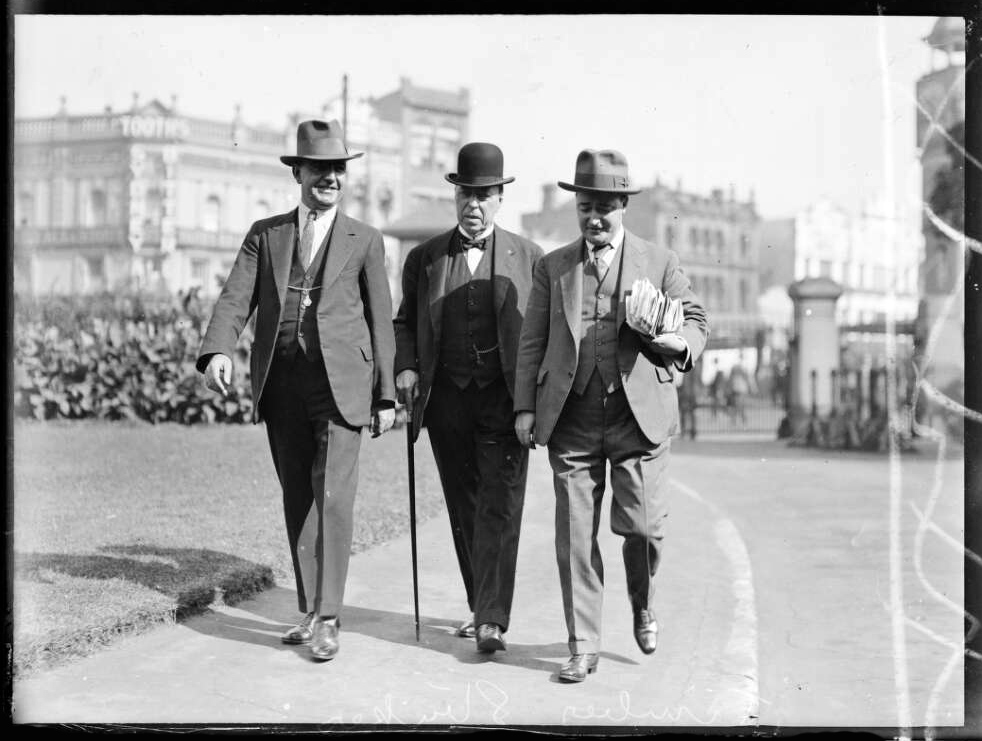
Earlier this week Frank Bongiorno launched Inside Story contributor Patrick Mullins’s new book, The Stained Man, at Canberra’s Paperchain Bookshop. This is a lightly edited version of his speech…
In The Stained Man Patrick Mullins recounts a story of a man, George Dean, who in the mid-1890s poisoned his wife in an unsuccessful effort to kill her, and of a celebrity lawyer — as we’d now say — who had Dean’s confession but couldn’t resist using his eloquence to arouse public opinion in his favour. That was also, of course, the public opinion Meagher would use to advance the political career he had already begun in the NSW parliament.
This is a story of ambition and vanity. It is a story of tragedy and suffering. At its heart is a man who was one of the great thrusters of Sydney town, a bombast of Botany Bay.
The era was one of famous scandals and affairs. Frederick Deeming’s murder, in Merseyside and Melbourne, of two of his wives and four of his children — his method of concealment was to bury them under the family home — had produced a frenzied public hatred, as had the Frances Knorr case: the baby farmer, as she was called, who was essentially a child-minder turned child-killer. Such scandals and affairs — so widely and sensationally reported in the press — lived on for a time as melodrama, stories in which observers believed that villains and innocents could be readily distinguished at a glance.
They were good stories for a society founded on the violence and dispossession of Indigenous people, a convenient means of avoiding the qualms and ambiguities that came from living on stolen land drenched in blood. The villains and the innocents were harder for colonists to distinguish on the frontier.
Of course, one of the most sensational of the era’s stories seemed almost ready-made for melodrama: that of the “Breelong Blacks,” as the Governor brothers were called in the newspapers. The Chant of Jimmie Blacksmith, Thomas Keneally’s 1972 novel, would explore the ironies of a federal nation being made against the background of their axe-murdering exploits and the manhunt they provoked.
That nation-making moment also sits behind Patrick’s story of the Dean scandal, and it gives it an additional poignancy. The hint is that we are gaining a view of the national soul, not merely an unflattering portrait of a few men on the make.
Many of us encountered Richard Meagher for the first time in Cyril Pearl’s classic 1958 tale, Wild Men of Sydney. One of the most memorable of the scenes was when Meagher took to Truth proprietor John Norton in the street with a horsewhip; Norton responded by firing a revolver at him, as you do.
Patrick combines Pearl’s skill as a storyteller with the meticulous research of a first-class historian and biographer. His gift is to see the big themes in the individual biography or story. Who knew that one could learn so much about Australian political culture from the story of one of the country’s least successful and least liked prime ministers, William McMahon (subject of Patrick’s Tiberius with a Telephone); or that the censorship of a single Philip Roth novel, Portnoy’s Complaint (The Trials of Portnoy), could open up the 1960s and 1970s to renewed scrutiny and understanding? Here, again, Meagher’s story extends our understanding of a lot of things we half-understand but can now see all the more clearly.
To name a few: there is the uncertain place occupied by Meagher as a man of Irish-Catholic heritage in a social order where respectability and Protestantism were considered the more natural bedfellows. Your average Orangeman would have seen in Meagher’s corruption the ordinary working out of the instincts of blood and belief. This was a society in which religious sectarianism was alive and well.
There is the even more uncertain respectability of a working-class woman — Dean’s wife and victim, Mary — and her mother. These women were shadowed by the suspicion that they had somehow connived at George’s downfall, that for reasons of their own, they wanted to see him hanged. Public opinion fell in favour of the innocence of George Dean, who many considered a salt-of-the-earth Sydney ferryman. Monster meetings in support attracted thousands. Mary, on the other hand, still suffering the effects of her poisoning, received vilification, as if she were the vector of the toxin.
Patrick also provides new insights into the entanglement of law and politics. The courtroom, like the parliament and the hustings, was theatre and a man such as Meagher understood that the emotional backing he aroused as a defence barrister, supposedly fighting for justice, could be readily put to work for a political career.
Patrick is, among other things, a historian of the public emotions. In The Stained Man, these often seem easy to arouse. The majesty of the law and the rationality of politics both seem rather fragile in this account. Waves of public feeling, as in our own times, often seem to matter more. It was the era that gave us words in English such as “jingoism” and “mafficking.” Patrick revises our understanding of the political and legal cultures of those times, but his story also has insights to offer into our own — where democracy can often seem vulnerable to populist performativity and the overflow of emotion.
He is always inviting us to reconsider what we think we know about our culture. Australia as a utilitarian, practical political and legal order where materialism reigns supreme? Maybe, but not if those wild men of Sydney — and their passionate supporters — had anything to do with it. It was not the price of eggs, or the prospect of a new bridge or road, that arouses their fervour in these pages.
Meagher’s indiscretions saw him barred from the legal world, but that was no barrier to his success in democratic politics. Beginning as a Protectionist, he eventually rode the Labor wave in parliamentary politics before succumbing to the sin of conscriptionism in the first world war and therefore suffering expulsion from the party. But for some time afterwards, the idea of his readmission to the Labor Party remained alive, and nor would he let go of the law, campaigning for decades to be readmitted to practice.
Patrick narrates that long journey with skill and compassion. Eventually, parliament provides a remedy. Restored to the rolls, Meagher once again flourishes in the law. He dies a moderately wealthy man. The journey to success had been a broken one, but Australia is the land of the second chance — for some, at least. This is indeed a very Australian story, and perhaps also a very Sydney one.
Patrick is superbly equipped to tell it. You do want to know what is going to happen next. Protagonists such as Meagher, Dean, Meagher’s legal partner and fellow-politician Paddy Crick — none of these blokes are likable, but we do come to care what happens to them. As we share Meagher’s long campaign to be forgiven his sins, and to gain vindication, it’s difficult not to identify with him and his predicament, even to sympathise. “He’s not such a bad cove,” one comes to think. “There but for the grace of God go I.” We all want to be treated with compassion even in our follies. Can we each be sure that we would staunchly resist the temptation to which Meagher gave in: to get a guilty man, one facing the hangman’s noose, off a charge and then use the success to help along one’s career? Isn’t winning what barristers are supposed to do anyway?
Are you for William Windeyer — that is, on the side of the judge who found Dean guilty — or are you for Meagher and Dean? Of course, this is just another way of expressing that much larger, more potent, identity-defining Australian cultural question. Are you for Redmond Barry or Ned Kelly? (Patrick is a Barry man, I reckon, but with just a dash of Kelly.)
Of course, he is too good a historian, too sophisticated a thinker, and too skilled a writer, to pose our choices as crudely as that. He shows: he doesn’t advocate. Happily, his job is not that of a barrister, and he is rarely the judge — and never a hanging one.
He’s the historian with what Manning Clark called “the eye of pity.” He sees those little details that tell the larger story. There is a telling passage about Meagher’s marriage in a book that is so largely concerned with another man’s effort to kill his wife. Meagher was with his wife Alice, who suffered from severe rheumatism, for an official event in Daceyville. “The official party trooped easily to the top of a sandy knoll for a ribbon cutting,” Patrick reports, but behind them Alice baulked. Meagher took her arm and held her steady. Then they climbed to the top, step by step, together’.
To use a definition of the historian’s role borrowed from Iain McCalman, you can see why he is one of the best storytellers of the Australian tribe. •