In the wake of the Port Arthur massacre in April 1996, newly elected prime minister John Howard worked with state and territory governments to implement tougher gun regulations. One of the strongest advocates was Walter Mikac, whose wife and two daughters had been murdered by the Port Arthur gunman, Martin Bryant. “As you know,” he told 3000 people gathered in the Sydney Domain, “three months ago to this day, I lost the entire reason for my existence.”
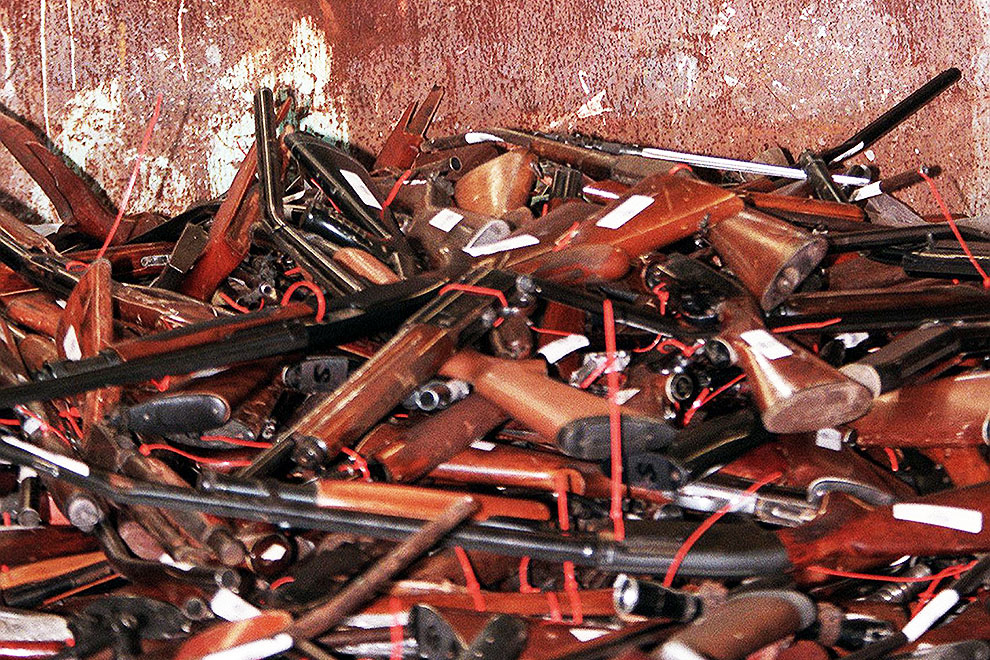
To make sure the tougher rules actually reduced the number of weapons, they were accompanied by a buyback program. From mid 1996 to mid 1997, anyone could take a gun to a local police station and the police would pay its fair value. In total, nearly 650,000 weapons were handed in.
While some were newly illegal weapons (pump-action shotguns and semi-automatic rifles), many people seem to have simply taken the chance to “clean out the closet” by handing in weapons (such as .22 rifles) that were legal if the owner had an appropriate licence. In the Northern Territory, police even paid compensation for a set of second world war aircraft cannons. According to one survey, the proportion of Australian households that had at least one gun dropped from 15 per cent to 8 per cent.
Did the buyback save lives? I’ve always been interested in finding out, but the public debate has seemed frustratingly simplistic. Some anti-gun campaigners described firearms owners as “gun nuts,” and seemed to have difficulty understanding how anyone could enjoy gun collecting, target shooting or hunting. Conversely, gun-rights advocates would say things like “guns don’t kill people, people do,” which doesn’t take the debate very far, given that the same can be said for fragmentation grenades, poison gas and surface-to-air missiles.
With Christine Neill, an expatriate Australian living in Canada, I set about analysing the buyback data. One result was rock solid. In the decade before the gun buyback, Australia averaged more than one mass shooting per year (a mass shooting is where five or more people are killed). Between 1987 and 1996, a total of ninety-four victims were killed in mass shootings. Apart from Hoddle Street and Port Arthur, there were also mass shootings in the Top End (Northern Territory and Western Australia), Canley Vale (New South Wales), Queen Street (Victoria), Oenpelli (Northern Territory), Surry Hills (New South Wales), Strathfield (New South Wales), Terrigal (New South Wales), Cangai (New South Wales) and Hillcrest (Queensland).
In the decade after the laws were changed, there was not a single mass shooting in Australia. The chance of this change being due to luck alone is less than one-in-a-hundred. Judged by whether it prevented mass shootings, the Australian gun buyback was an unmitigated success. Yet impressive though this is, the number of people killed in mass shootings has never been particularly large. Even during the worst period for gun massacres, the odds of being killed in a mass shooting were about as large as the chances of being killed by a lightning strike.
Neill and I then set about looking at other types of gun deaths. We learnt that the person most likely to kill you with a gun is yourself. The next most likely person to kill you with a gun is your spouse. The next most likely people to kill you are household members, relatives and acquaintances. You are least likely to be killed by a complete stranger. So we decided to look at the impact of the gun buyback on overall rates of firearm homicide and firearm suicide.
We approached the question in two ways. First, we looked at national trends. We found that – notwithstanding the mass shootings – gun homicide and gun suicide rates had been steadily falling for nearly two decades before the buyback. Some fancy statistical analysis seemed to suggest that the buyback had caused the firearm homicide and suicide rates to fall a little faster, but it was difficult to be sure, so we tried another approach.
In some states, the number of firearms per person that were bought back was larger than in other parts of Australia. We asked the question a little differently: did places with more gun buybacks experience a larger drop in gun homicide and suicide? The answer turned out to be a resounding yes. For example, the greatest reduction in weapons occurred in Tasmania, which was also the jurisdiction that saw the biggest drop in firearm suicide. Meanwhile, the smallest reduction in firearms per person was in Canberra, which also had the smallest drop in the firearm suicide rate. We did not find evidence of a corresponding increase in other forms of homicide (such as knife killings) or suicide (such as self-poisoning). Overall, we estimated that the Australian gun buyback saved at least 200 lives per year – mostly suicides.
But the buyback had been expensive. Around half a billion dollars in compensation was paid to gun owners. Was it worth it or would Australia have been better off putting the money into other lifesaving measures, such as safer roads or better hospitals? To answer this question, we need a way of valuing gun deaths in monetary terms. For non-economists, this can seem a ghastly exercise: how can we put a dollar figure on a life? But for economists, having an estimate of the value of a statistical life helps us decide when a life-saving measure is cost-effective. By looking at how much people are willing to pay for healthcare and safety measures, economists are able to come up with a figure for the value of a “statistical life.”
The value of a statistical life most commonly used by Australian policy-makers is $2.5 million. On this basis, the economic value of saving 200 lives a year is around half a billion dollars, which means the economic value of the gun buyback every year is about the same as the one-off cost paid in 1996–97. Since it was implemented, the gun buyback has paid for itself more than ten times over. And the vast bulk of the benefit came not from reduced mass shootings, but from an entirely unexpected source: fewer gun suicides.
While relatively few people die from mass shootings, the fear generated by the Port Arthur massacre should not be ignored. It is true that Australia probably lost as many people to road accidents in the week after the Port Arthur massacre as died on that tragic Sunday. But that simple analysis ignores the fact that fear of crime imposes a real cost on the community.
It was the nineteenth-century philosopher Jeremy Bentham who first argued that crime might have an impact on non-victims. A violent crime, Bentham suggested, did a “primary mischief” to its victim but it also caused a “secondary mischief.” As reports circulated, people would go out of their way to avoid the spot where it happened. Some might spend money to protect themselves. Others could be too scared to leave their homes at all. Bentham reminded us that the ripples of crime spread out well beyond the event itself.
Fear of crime isn’t always proportional to the risk of crime. For example, women tend to be most fearful of violent crime, yet men are most at risk. We probably all know friends whom we think are too worried about crime. Perhaps because people’s worries don’t always match the true danger, the economics of crime has largely ignored fear. •
This extract from The Economics of Just About Everything: The Hidden Reasons for Our Curious Choices and Surprising Successes (Allen and Unwin) was first published in Inside Story in 2014.