Donald Trump betrayed his panic about the 2026 midterm elections last week when he vented at Dan Bongino, formerly the number two official at the FBI and now a podcaster, about his baseless conspiratorial thoughts on immigrants and voting. After glazing his “landslide” 2024 victory (in which he defeated Kamala Harris by a 1.5 per cent popular vote margin), he asserted: “You’re never going to have that again if you don’t get these people out. These people were brought to our country to vote, and they vote illegally.”
He complained about his party’s handling of election laws: “Amazing that the Republicans aren’t tougher on it. The Republicans should say, ‘We want to take over.’ We should take over the voting in at least — many — fifteen places. The Republicans ought to nationalise the voting.”
Trump’s call for a partisan takeover of the electoral apparatus understandably triggered reciprocal panic in Democratic circles about voter suppression and outright vote stealing. Considering how far Trump was willing to go to steal the 2020 election — from disparaging mail ballots to pursuing dubious litigation to egging on an unruly mob hellbent on obstructing the Electoral College count — every American committed to free and fair elections must remain on the highest alert until Trump has fully left the political sphere.
But what Trump precisely said, how the White House is cleaning it up, and what congressional Republicans are doing, suggests less of a coordinated plan to commandeer the midterms and more of a Republican Party in disarray amid a rising Blue Wave. It doesn’t mean that Democrats should be overly sanguine about MAGA’s capacity to disrupt the midterms. A tragic imagination is helpful in these times. But both the current state of the Republican Party’s vote-suppression efforts and, importantly, its past failed attempts are well worth keeping in mind.
Parsing Trump’s verbiage may be a fraught exercise. But to my ear, it is notable that Trump didn’t tell Bongino he wanted to take over voting in fifteen states, but rather that the Republicans — presumably Republicans in Congress — should do so. That’s not plotting, that’s just complaining. That’s not taking ownership, that’s passing the buck.
The day after Trump made the “nationalise the voting” comment, White House press secretary Karoline Leavitt was asked what Trump meant. “What the president was referring to is the SAVE Act,” Leavitt replied, “which is a huge commonsense piece of legislation that Republicans have supported, that President Trump is committed to signing into law during his term. And he spoke with the speaker directly about that yesterday, about the need to get that bill on the floor for a vote because it provides very commonsense measures for voting in our country, such as voter ID.”
Leavitt’s answer may have used misdirection to avoid acknowledging Trump’s democracy-killing fantasies. Yes, the SAVE Act requires photo identification for voting. It also requires proof of citizenship — such as a passport or birth certificate because a driver’s licence wouldn’t cut it, for voter registration. (A Senate version of the bill also requires proof of citizenship for voting.) It threatens election officials with prison if they mistakenly register someone to vote without the necessary paperwork. It revokes states’ right to hold universal vote-by-mail elections. It requires election officials to conduct voter-roll purges every thirty days, even if they’re just before elections. As the Brennan Center for Justice notes, the bill would “block millions of American citizens from voting,” “inject chaos into election administration,” and “place a massive unfunded burden on state and local election officials.”
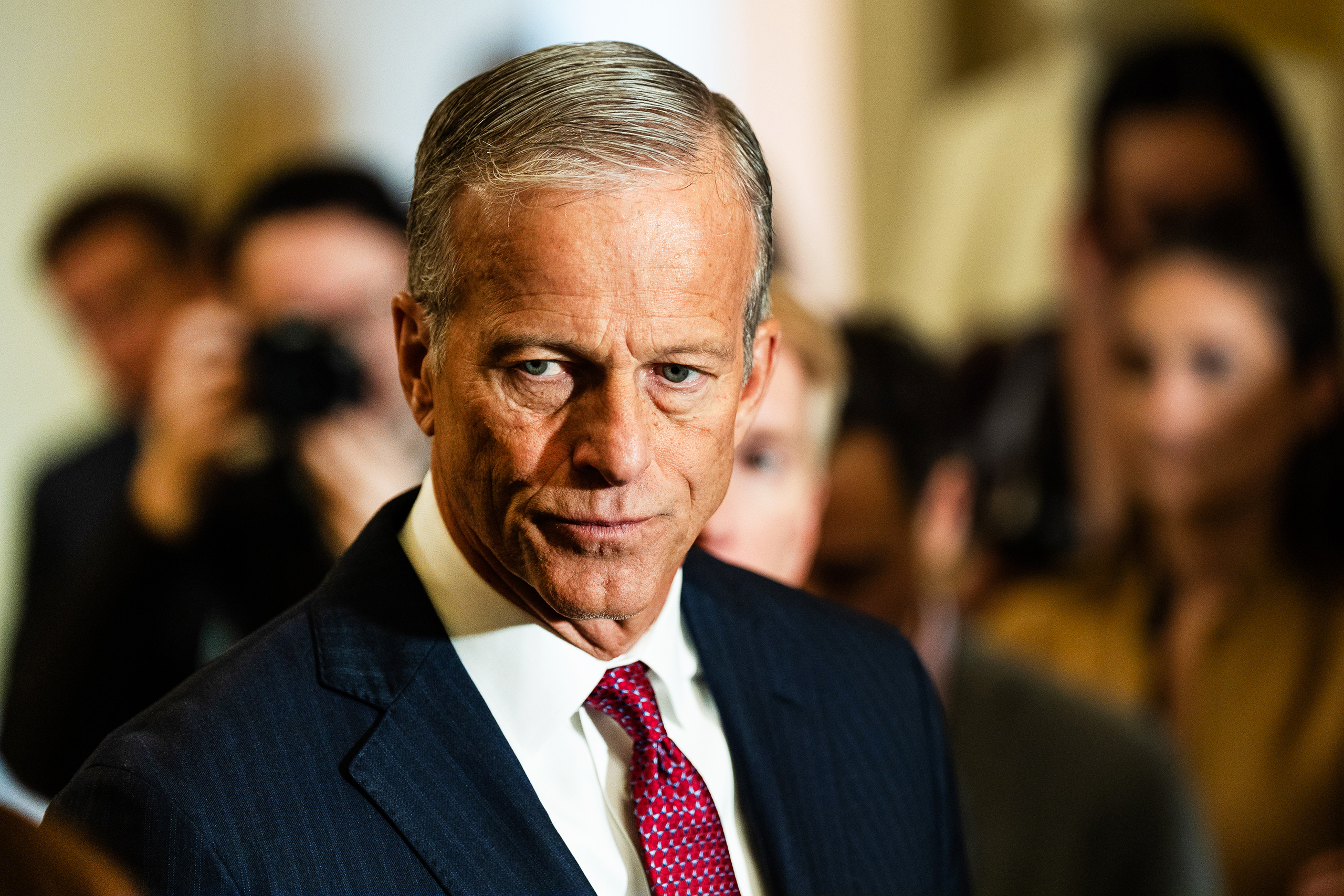
Here’s the other thing about the SAVE Act: it’s never going to become law. At least, not without scrapping the filibuster, which Senate majority leader John Thune, the South Dakota Republican, has long ruled out. Much like how Democrats sniped at each other in 2021 when they couldn’t get a voting rights bill through the Senate, the prospect of failing to secure this voter suppression bill is prompting Republicans to form a circular firing squad.
The House passed a version of the SAVE Act last spring, but it has yet to receive Senate consideration. Last month, different versions were introduced in each chamber, and advocates have been ramping up pressure on Thune.
Earlier this week, some House Republicans, led by Representative Anna Paulina Luna of Florida, briefly withheld their votes on the bill to keep the government open. They relented once they received “assurances” from the White House that the Senate would vote on the SAVE Act and that Thune would consider allowing an old-school “standing” or “talking” filibuster process, in which a filibuster lasts as long as at least one senator can keep talking on the floor. Once the voices have given out, the bill can pass with a simple majority.
Despite lingering misconceptions, as I explained in 2021, no rule change is needed for the Senate majority leader to require senators to speak on the Senate floor to sustain a filibuster. The downside is that unlimited, indefinite talking prevents any other business from reaching the Senate floor. And Thune expressed that very concern last week, fretting that action on other bills would stall and name-checking pending legislation on housing, cryptocurrency, permitting, agriculture, highways and Russia sanctions. He said his promise to SAVE Act proponents was only to discuss the standing filibuster option with his Republican conference, not necessarily to use it.
Thune’s hesitation is riling SAVE Act advocates like Luna and Senator Mike Lee of Utah, who recently said on X that the talking filibuster is “almost certainly” necessary to pass the bill.
Has Senator Lee walked across the aisle and met Bernie Sanders? Cory Booker? Plenty of Senate Democrats would love nothing more than to filibuster a Republican voter suppression bill from February to November and call more attention to Trump’s attempts to destroy democracy.
More rational Republicans, like Thune, likely recognise that the best way for the party in power to mitigate the usual midterm election losses is not by trying to suppress the vote but by enacting legislation that voters want, which they can’t do if Democrats refuse to relinquish the floor.
But why — aside from respect for democracy — should Republicans refrain from voter suppression tactics? Because, as I detailed for the Washington Monthly four years ago, twenty-first-century voter suppression tactics have been repeatedly shown to flop.
An academic study analysing ten years of strict voter identification laws found that they had “no significant negative effect on registration or turnout, overall or for any subgroup defined by age, gender, race, or party affiliation.” And we have anecdotal examples of Democrats cannily exploiting attempted voter suppression by Republicans to galvanise base turnout.
Look at President Barack Obama’s 2012 re-election or Senator Raphael Warnock’s 2022 re-election in Georgia, which came one year after the Republican-controlled state government enacted a flurry of restrictive voting policies, prompting Democratic outrage that was wisely channelled into get-out-the-vote efforts.
Whether the particulars of the SAVE Act would work any better for Republicans is moot because it’s never going to pass. But a SAVE Act stuck on the Senate floor, subject to ongoing filibuster, would be a gift to Democrats, helping them raise alarm about the erosion of democracy among left-leaning constituencies that are not always easy to motivate, especially in a midterm when turnout is almost always lower than in years with a presidential contest.
Having said that, we cannot be sanguine about what the Trump administration will do on its own regarding the midterm election.
Last March, the president issued an executive order imposing restrictive voting rules on states. The justice department has been trying to piece together a national voter database from unredacted state voter roll data, which the Brennan Center says is an “attempt to force states to remove voters from the rolls based on incomplete and likely inaccurate information.”
Last week, FBI agents, with director of national intelligence Tulsi Gabbard creepily looking over their shoulders, seized 2020 voting records from Fulton County, Georgia. Trump, based on what he told Bongino (“you’re going to see something in Georgia”), is planning to use the records to further his gaslighting claims that Joe Biden stole the election in Georgia when we have plenty of evidence that Trump was plotting the theft.
And considering how Trump has already abused his power with National Guard and ICE deployments designed to punish Democratic-run cities, we can’t discount the possibility that he will try to send armed agents to election sites with the intent of intimidating voters.
But, as with any bully, these real and potential acts of force and intimidation mask underlying weakness. A president simply doesn’t have the power to take over a constitutionally designed, decentralised, fifty-state-managed election system. And as with any bully, the way to respond is to have your eyes wide open, but also have no fear.
That’s what we’ve been seeing. Most states aren’t turning over their unredacted voter data. Trump’s Justice Department has sued twenty-four of them, and last month, federal judges dismissed the cases involving California and Oregon. Also, last month, attorney-general Pam Bondi tried to pressure Minnesota governor Tim Walz to turn over the data, suggesting that compliance would end ICE’s Operation Metro Surge, but Walz has not budged. In Georgia, the Fulton County government has sued to recover its voting records.
Trump won’t be able to send the National Guard to states where they are not wanted after the Supreme Court ruled in December that the federal government cannot legally use the military to enforce state laws. (Trump then pulled the National Guard out of Democratic states, tacitly acknowledging that, with all his bluster, even he can’t ignore the highest court.)
Ahead of the election, Trump could try more extreme methods that push constitutional bounds, such as invoking the Insurrection Act to justify a new round of armed deployments. But he flinched from doing so last month after floating the idea, seemingly recognising the likelihood of political blowback. Former Trump aide Steve Bannon threatened on his podcast, “We’re going to have ICE surround the polls come November.” But this is both stupid — ICE agents, who are incredibly unpopular, can’t intimidate citizens eligible to vote and would be walking advertisements for Democrats — and perhaps illegal, as ICE agents are empowered to enforce immigration laws, not patrol election sites.
Also percolating in the far-right fever swamps, as Salon and Democracy Docket have covered, is wishful speculation that Nicolas Maduro, the captured Venezuelan leader languishing in federal jail in New York City, will “confess” to having helped throw the 2020 election in exchange for lesser charges. Could the Trump justice department pressure Maduro to make such an obviously false admission? It sounds almost too fantastical to believe. But it’s the kind of beyond-the-pale scenario Democrats must consider as they try to game out what lengths Trump would go to in order to affect the 2026 midterms.
Still, keep in mind that such a development would serve Trump’s conspiracy theory narrative about the 2020 election but would have no direct impact on the ability of the fifty states to properly administer the upcoming elections.
Sure, Trump could use a false confession as a fig leaf to justify some extreme action. But we still have a constitution and we still have laws. As awful as the Supreme Court has been, it didn’t roll over for Trump when he tried to steal the 2020 election. We can retain hope that there are some lines the justices won’t let Trump cross. Already, lower court judges have prevented Trump’s executive order from being implemented.
Moreover, Democratic state and local officials aren’t letting their guard down. The Bulwark’s Laura Egan reported, “Democratic governors in states that Trump could target have been huddling with their teams to game out how to handle potential interference from the White House. ‘We have to plan to safeguard the ballots and ballot equipment against federal seizure. We have to plan for the potential spectre of armed, masked men roaming our streets and scaring people away from the polls,’ said Shenna Bellows, Maine’s secretary of state who is running in the Democratic primary for governor.”
Trump should pay heed. His executive order imposing national election rules was challenged in court and sidelined. His legislation imposing national election rules can’t clear the Senate and is turning Republicans against each other. His national voter database can’t get off the ground. The nationalise-elections well is dry.
And a deployment of armed agents would just dig the hole deeper. His militarisation of immigration enforcement has already backfired on Republicans, and any armed presence around election sites could easily do the same at the worst possible time. The number of energised and determined voters could easily outdo the number of intimidated voters.
Thune, by highlighting his legislative to-do list, is subtly reminding Trump there’s another way to survive the midterms: get stuff done. Serious action on building housing, generating domestic energy, and helping distressed farmers (who are hurting under Trump’s tariffs) could prompt a reassessment from swing voters who, right now, see Trump as narcissistically out of touch with their struggles.
After all, how did Biden and his Democrats enjoy a relatively successful 2022 midterm, with a one-seat gain in the Senate and better-than-average nine-seat loss in the House? They pivoted to legislative compromise, notching bipartisan victories on infrastructure investment, semiconductor manufacturing, gun safety, Electoral College ratification, and Ukraine aid. Biden also cut a budget reconciliation deal with conservative Democrat Joe Manchin on healthcare and energy.
Outside the legislative arena, Biden kicked off the autumn 2022 campaign with a stirring speech warning of “MAGA Republicans” who are “election deniers” that would “undermine democracy itself.” Come November, the swing state Republican candidates for governor and secretary of state who had promoted the fiction that Trump really won the 2020 election lost their races. Voters may care about their bank accounts first and foremost, but preserving democracy is still a high priority for them.
Trump is pursuing the exact opposite strategy from Biden’s 2022 strategy: a fixation on insisting the 2020 election was stolen from him and a lack of interest in legislation that would help economically anxious voters. Trump may be loath to take a page from his predecessor, but his own instincts didn’t serve Republicans well in the 2018 midterms, when they lost 40 House seats and the speakership, and nor did they serve him well in 2020 when he lost re-election and Republicans coughed up the Senate.
Trump’s political instincts have only served him well when out of power, not while in office. And to quote Jerry Seinfeld, “If every instinct you have is wrong, then the opposite would have to be right.” •