The vengeful, divisive streak in contemporary American politics has prompted a stream of books scrutinising the social disruption and thwarted expectations associated with the rise of Donald Trump. Former political adviser William Galston’s contribution, Anger, Fear, Domination, explores anger as a defining feature of politics in his troubled homeland, focusing on the power of angry rhetoric to mobilise action and capitalise on the vulnerabilities of liberal democracy.
Galston and his recent predecessors in the field — historian Robert Schneider and sociologist Arlie Russell Hochschild among them — have set out to explain why this is so. Schneider, whose The Return of Resentment I reviewed in 2023 for Inside Story, provided not only a history of theories of resentment but also an account of the development of the “resentment paradigm,” which attempted to capture the psychological disposition that could give rise to far-right sentiment. Mid-century thinkers concluded that the economic and communal breakdown in interwar Germany provoked the humiliation and anguish — the resentment paradigm — on which Hitler drew. Hence the adoption by postwar Western democracies of Keynesian managed prosperity, facilitating relatively equal life chances and keeping resentment at bay.
Eventually, however, a backlash against redistributive justice arose among those who had benefited most but now felt put upon by the demands of the enabling state. Richard Nixon led the charge, evoking a “silent majority” who feared the benefits accrued through what they perceived as their own enterprise were under threat. Ronald Reagan’s “compassionate conservatism” initially kept the tide at bay, but then Clinton- and Bush-era neoliberalism’s failure to deliver prosperity, fairness and choice galvanised a renewed sense of resentment, with the anger of those left behind eventually given a focus by Trump’s mobilising rhetoric.
Hochschild’s Stolen Pride: Loss, Shame, and the Rise of the Right (2024) took the reader into the heart of disadvantaged communities and the lives of workers after the jobs that had made life meaningful were swept away, profoundly disrupting their families, communities and ability to exercise responsibility. By capturing first-person accounts Hochschild made vividly apparent the wrenching experience of humiliation, shame and loss that opened people up to the idea that metropolitan elites had stolen their pride and fuelled their demand for redress. And it was redress that Trump promised.
Until others can understand this experience and share the moral outrage that such heedless diminution provokes, said Hochschild, there is no way to reach out for collective solutions. It is this exercise of empathy she demanded of her readers.
These are books about emotions: the passions that drive action or reaction. For Schneider, the dominant emotion is resentment; for Hochschild it is shame. Does Galston’s emphasis on anger take us any further? He reminds us that each of us can experience anger when our wishes are thwarted or our jealousy and envy provoked. The dark passions, always present, may especially be triggered in liberal democracies when the wishes of many are intentionally constrained in the name of fairness or orderliness.
Galston identifies how those constraints create the five vulnerabilities of liberal democracy he deems conducive to destructive anger. Democratic deliberation may be protracted, with the wishes of many held in abeyance as the concerns or rights of minorities are considered. It demands tolerance of views and ways of life that many might oppose. It requires us to distinguish between civic identity and individual or group identity. It depends on a willingness to compromise. And it is entangled in the balance between equality and freedom, with the passion for equality potentially overcoming the commitment to liberty or, conversely, the pursuit of more expansive individual freedom ignoring a legitimate concern for equality.
Any one of these constraints can become the focus of an angry conflagration. In times of uncertainty or threat, people can demand fast decision-making rather than the slow negotiation of consensus, let alone attention to minorities. They might support groups whose views suit their predilections rather than a wider civic identity. They might turn on those whose behaviour seem at odds with convention or practice. They might demand purity of conviction rather than compromise. They might fight furiously to defend personal liberty at the cost of equality.
The centre of Galston’s argument, however, is that democracy is more likely to perish from within than at the hands of external enemies. Demagogues — using public dissatisfaction with democracy’s vulnerabilities to mobilise popular passions in pursuit of power — come up against democracy’s myopic defenders, unable to revive an almost-forgotten ameliorative rhetoric.
And why is it almost forgotten? Because the promises of postwar liberal regimes began to be broken. Managed postwar prosperity no longer quelled outbreaks of ethnic warfare; a world of globalised free markets and expanded opportunities generated an extraordinary increase in inequality; democratic guardrails proved no defence against the global financial crisis; the language of redistributive justice, no longer fit for purpose, gave way to depictions of an elitist “deep state.” Together, these factors created the platform for the performative politics of demagogic power.
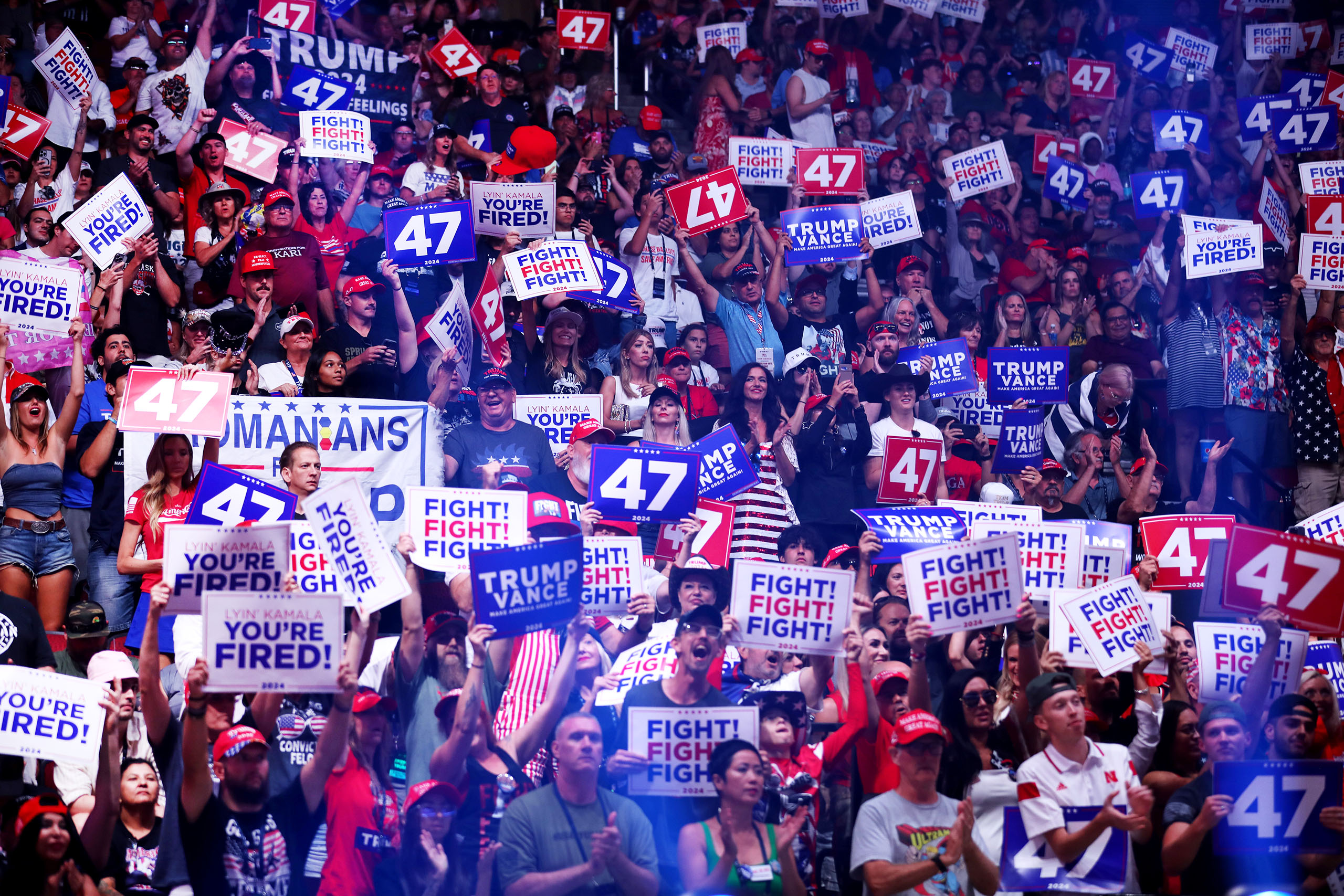
Galston draws a parallel with the proverbial contest of two great classical Athenian orators: “When Aeschines spoke his listeners said, ‘How well he spoke.’ But when Demosthenes spoke, they said, ‘Let us march.’” Galston goes on: “When I watched a Trump rally for the first time, my first response was horrified fascination. But this quickly gave way to the realisation that I was watching democratic politics in its purest from — a man using speech to mobilise a multitude to act as he wishes them to.”
Trump was tapping into the anger of decades in which some regions benefited while others were allowed to fall behind and leaders seemed indifferent to the pain of those who were losing out. “This indifference added the humiliation of invisibility to the pain of loss,” writes Galston. This point is also emphasised by Schneider and Hochschild and explains what propels the loyal MAGA base. But what about all the others who voted for Trump?
Galston, having incisively demonstrated the power of political speech to mobilise anger, turns back to an earlier instance of persuasive political rhetoric. For him, Franklin D. Roosevelt’s 1933 “fireside chat” to the American people amid that decade’s economic crisis is the classic example of positive explanatory rhetoric. FDR, he argues, tackled the fear of uncertainty head-on. He appealed to reason, common sense and civic virtue. His tone was calm, unifying and inspiring. He treated his listeners as fellow citizens, capable of exercising agency, not as the passive subjects of public policy. FDR’s fireside chat implied a conversation among equals. He transmuted the restoration of confidence into a shared national project.
But Galston must concede that the power of persuasive exposition alone couldn’t lead to success. FDR’s rhetoric was reinforced by decisive policy action: support for anti-monopoly movements, significant legislation to regulate banking and a vast expansion in government spending.
In contrast, Trump’s is not a shared national project but a means of domination, an intentionally divisive process of creating targets against which can be directed often extreme expressions of hatred. Anger can flare up and abate and sometimes be appeased; hatred can’t be appeased, only opposed. Thus, it feeds the intensifying polarisation that cripples the compromise on which living together with others in a democracy depends.
With Anger, Fear, Domination Galston joins Schneider and Hochschild as a thoughtful analyst of the contemporary American predicament. As he suggests, more can be said about the export of contemporary Trumpist demagoguery to other democracies. Certainly, the appeal to divisive resentment could be seen in Australia, for instance, during the campaign against the Indigenous Voice to Parliament.
Lest one thinks these works, though each is historically informed, are largely about the present historical moment, it is useful to be reminded that the BBC’s American correspondent, Gavin Esler, wrote compelling about “why Americans hate Washington,” “the angry society” and “angry politics” in his 1997 book The United States of Anger. Much earlier, in 1905, Henry Adams, scion of a famous political family, described politics as “the systematic organisation of hatreds,” and in the 1930s fellow American Harold Lasswell nominated hatred as the leading political emotion. Is the degree of individualism characteristic of the pioneering US settler society perhaps more prone to pitch each against all than the more social democratic varieties of liberalism prevalent in some other democracies?
Finally, to return to my earlier point: why were people who are far from disadvantaged so suffused with anger? Not only members of the middle class but also those other angry men, the multi-millionaires and billionaire “Tech bros” who funded Trump’s campaign and fought for his attention. Surely this latter group in particular, fighting to defend obscene wealth, manifest a disastrous failure of market economics? Despite Galston’s and Schneider’s historical and philosophical sophistication and Hochschild’s moving accounts of disadvantage, all three authors seem unable to contemplate just how radical a correction may be demanded.
They have forgotten Karl Polanyi’s discerning account of the great transformation following the second world war, in which he concluded that unless economic cycles are regulated, market economies will repeatedly fail to deliver the conditions for decent lives. And they seem heedless of recent economic histories, even bestsellers such as Thomas Piketty’s empirically based demonstration in Capital in the Twenty First Century (2014) that extreme inequality in the distribution of capital will again (mirroring Polanyi) generate extreme discontent, threatening democratic values. So, here we are. •
Anger, Fear, Domination: Dark Passions and the Power of Political Speech
By William A. Galston | Yale University Press | $51.95 | 161 pages