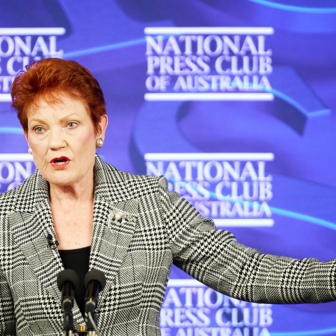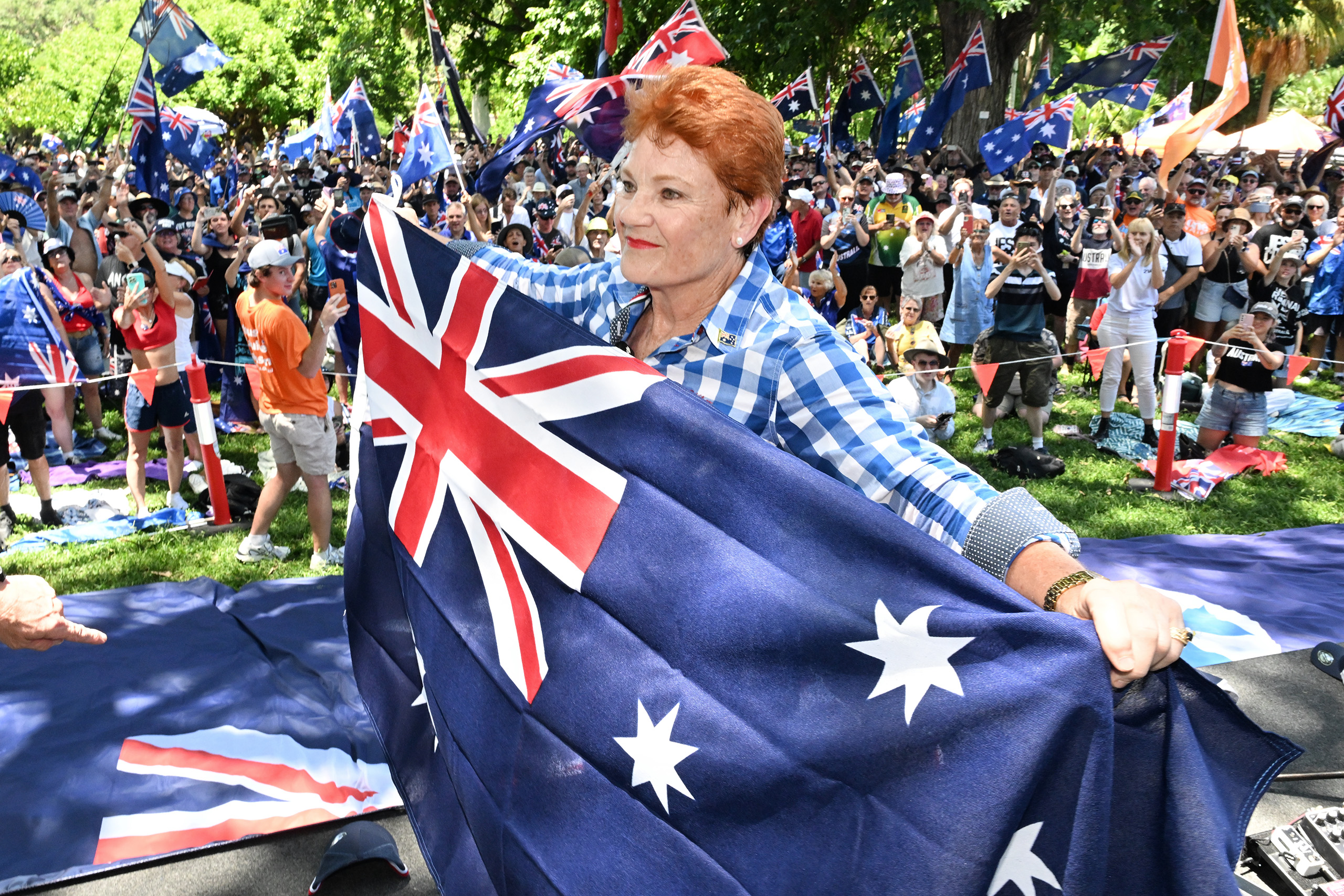
With the rise and rise in support for Pauline Hanson’s One Nation, the polls have created one of the most extraordinary moments in Australian politics. In December, across seven polls, support for One Nation ranged from 14 to 20 per cent. The week before the Coalition split, on 22 January 22 — and acting as catalyst for the split — support for One Nation across five polls ranged from 18 to 24 per cent. In the week after the split, support in three polls ranged from 22 to 25 per cent.
One Nation’s support has not only jumped to a level hardly imaginable at the May 2025 election, where it secured just 6.4 per cent of the vote; in three of the polls, it drew level with — or even eclipsed — the combined support recorded by the parties that until recently made up the Coalition. Having failed to pick up a single seat at the last election, One Nation could pick up quite a number from the Liberal Party and the National Party especially, plus a few from Labor as well.
All of this raises two sets of questions. One is about the polls: are their readings of the electorate entirely independent of each other? Assuming they are, are they all exaggerating One Nation’s support? And even if they are not, would support for One Nation be anything like as great if an election had been held in January not just a series of opinion polls?
The second set of questions is about Australia’s electoral system, which combines compulsory voting with the exhaustive allocation of preferences. Is it conceivable, as many who celebrate Australia’s electoral system seem to assume, that compulsory voting means support for One Nation is lower than it would otherwise be? Even if voting were not compulsory, might exhaustive preferential voting ensure that a party such as One Nation has much less impact on the allocation of seats than it otherwise would?
First, the polls. Pollsters are unlikely to be indifferent to what other pollsters have reported. Newspoll, the poll with the best track record, was the first to report support for One Nation (at 22 per cent) had notionally eclipsed support for the Coalition (21 per cent). Resolve, published on the same day (19 January) and in the field at the same time (12–16 January) had quite different figures, 18 per cent (One Nation) to 28 per cent (Coalition). But Newspoll, with the best track record, is the most-watched poll. Subsequent polling, showing One Nation either not far behind the Coalition or ahead if it, was closer to Newspoll’s than to Resolve’s.
Newspoll’s founder, Sol Lebovic, was fond of saying that voters who appear to favour small parties in opinion polls are simply “parking” their vote while deciding between “the majors.” Whether he was right or not, this far from an election — the next is not due until May 2028 — the polls aren’t much of a guide to the likely outcome; lots of Labor, Liberal and National voters may also be “parking” their vote.
Close to an election, polls haven’t always overestimated One Nation’s support. True, One Nation did perform slightly less well than the pre-election polls predicted in 2025 and 2019. But in 1998, 2001 and 2022, it did as well or slightly better than they predicted. In 1998, in the Queensland state election, One Nation, newly formed, secured 22.6 per cent of the vote and did better than the published polls (Newspoll) predicted. In 2001, in Western Australia, it secured 9.6 per cent of the vote from another standing start, again doing better than Newspoll’s surveys predicted.
The impact of compulsory voting — and of exhaustive preferential voting — is more complicated. Compulsory voting has been a feature of national elections in Australia since 1924. It has long been part of the electoral architecture in the states as well, with South Australia being the last jurisdiction to introduce it in 1942. Once introduced, it has never been repealed. Not so with exhaustive preferential, which requires voters to put a number, in order of preference, next to the name of every candidate. It has been repealed from time to time. In Queensland, for example, the 1998 election required voters to number only as many squares as they wished: optional preferential.
Does compulsory voting encourage turnout among voters in the “centre” with little interest in politics who would otherwise stay at home — or does it perhaps encourage political entrepreneurs such as Hanson to get rebellious voters to turn out for parties on the extremes?
One way of thinking about the question is to look at countries where parties on the extreme right have fared well but where voting is not compulsory. For example, in Germany, the Alternative für Deutschland lifted its vote from 10.4 per cent in 2021 to 20.8 per cent in 2025; in France, Rassemblement National lifted its vote from 13.2 per cent in 2017 to 18.7 per cent in 2022; and in Britain the latest polls have Reform UK lifting its vote from 14.3 per cent at the 2024 election to somewhere between 24 and 33 per cent.
Comparing these figures with One Nation’s, now and in some of the earlier contests, you might be excused for concluding that compulsory voting doesn’t make a lot of difference.
In Australia, however, the idea that compulsory voting provides a bulwark against parties on the extreme right (or extreme left) has become the received wisdom. When Judith Brett, for instance, in her engaging history of Australia’s electoral system, From Secret Ballot to Democracy Sausage, concluded that “compulsory voting tempers the impact of the passionate and committed voters of the base with the votes of the moderate and indifferent,” ensuring “Australian elections are won and lost in the centre,” her declaration appeared to go unchallenged. Few would have been able to cite any real evidence for it, but no one seemed to doubt it. In celebrations of Australian democracy, with its lessons for the rest of the world, compulsory voting now occupies pride of place.
But Brett was also at pains to point to a countervailing consequence of compulsory voting. Without compulsion, she argued, “many disillusioned voters would turn away from politics altogether and stop voting.” Forced to turn out, “disillusioned voters… have to find someone to vote for,” and so “new contestants, many from outside the established political class, enter the fray to pick up their protest and offer an alternative.”
One Nation was one of the parties Brett had in mind. “[T]he great bulk of [Hanson’s] voters” were not “extreme” or “racist,” she wrote, but “had been left behind and were ‘outsiders’ in a generally prosperous nation.” Forcing these voters to the polls “encourages the major parties to modify their policies to try to win back some of their erstwhile supporters, as Labor is doing with the Greens and John Howard [from 1998] did when One Nation began to take votes from the Coalition.”
Writing in 2019, Brett thought the entry of One Nation, other parties such as the Greens, and independents, “a very good thing.” What might she have said had she been confronted by evidence, derived from the Australian Election Study, or AES, showing the key issues distinguishing those who voted for One Nation were their attitudes to Aboriginal Australians and immigration? In economic terms, they were not insecure; they had not been “left behind.”
Responding to the rise of One Nation, Howard might have “shifted too far… especially with his harsh treatment of asylum seekers,” Brett concedes. But unless we assume Howard did think these voters “extreme” or “racist,” his shift is difficult to explain. Publicly, Howard chose his words carefully. Too savvy to describe these voters openly as “deplorables” — Hillary Clinton’s mistake — he simply said he wasn’t (openly) “branding [Hanson] and her supporters as extreme and racist.” That’s not the same as saying he didn’t think of them as “extreme” or “racist” and seek to pander to their priorities.
How many of those proselytising for the Australian electoral model would want to carry the message that compulsory voting was good because, in encouraging parties such as One Nation, it challenged parties of the “centre”? While compulsory voting might encourage parties of the “centre” to moderate their positions, as Howard did, it might also — and for the same reason — encourage small parties to take extreme positions.
For compulsory voting to act as a firewall against parties or individuals on the political extremes, one of two things Brett notes would need to be true. Either those in the “centre” would be more inclined than those on the political extremes to abstain from voting if it were voluntary because they are more likely to hold fairly tepid views about their party or have less interest in electoral politics. Or those in the “centre” would be less inclined than those on the political extremes to abstain from voting because those on the extremes have less trust in the system as it presently operates and are not particularly hopeful their vote will change anything.
What does the evidence say? One of the opinion polls conducted in January asked respondents whether they would vote at the next federal election if voting were “voluntary, rather than compulsory”? Three-quarters of respondents said they would either “definitely” vote (58 per cent) or “probably” vote (20 per cent). The poll (with an effective sample size of 1038) was conducted online by a new polling firm, Fox & Hedgehog.
Those who said they would “definitely” vote included 62 per cent of intending Labor voters and 62 per cent of intending Coalition voters. But it also included 59 per cent of those planning to vote for the Greens and 65 per cent of those planning to vote for One Nation — parties sitting either well to the left of Labor (the Greens, which secured 12.2 per cent of the vote in 2025 and 14 per cent in this poll) or well to the right of the Coalition (One Nation, which secured 21 per cent of the vote in this poll). The difference between a low of 59 per cent and a high of 65 per cent is not significant in either a statistical sense (given the size of the sample) or in a substantive sense (given the size of each party’s vote).
If we take their answers at face value, the only respondents for whom a switch to voluntary voting would have had a disproportionately large impact were those who fell into either of two groups: those who said they intended to vote for an independent or much smaller party than One Nation or the Greens (only 44 per cent of whom said they would “definitely” vote if it were not compulsory) or those who professed to be “undecided” about how they would vote (just 29 per cent of whom said they would “definitely” vote).
If we add to the “definite” voters those who said they would “probably” vote, the pattern of response is much the same. Among both Labor and Coalition voters, 84 per cent said they would “definitely” or “probably” vote; so too did 77 per cent of the Greens, 80 per cent of One Nation voters, and 67 per cent of Others, though only 37 per cent of the “undecided.”
The poll also asked whether “the Australian political system is fundamentally broken.” Half the respondents either agreed (28 per cent) or “strongly” agreed (23 per cent) it was. Among Labor voters, 8 per cent “strongly” agreed, as did 17 per cent of Coalition voters, 18 per cent of those intending to vote for the Greens, and 18 per cent (though not reported) of the “undecided.” For those intending to vote for One Nation, the figure (51 per cent) was much higher. At 37 per cent, it was also higher for those voting for some other party or an independent (again, these categories weren’t separated).
If we add in those who agreed but not “strongly,” the pattern doesn’t change much. Among Labor voters, 35 per cent said the system was “fundamentally broken”; so, too, did 52 per cent of Coalition voters (a difference that no doubt owes something to the fact that the Coalition is not in office), 46 per cent of the Greens, and 47 per cent (though not reported) of the “undecided.” For One Nation the figure jumps to 75 per cent and for “Other” voters to 63 per cent.
On these figures, rates of abstaining (if compulsory voting were to be abolished) appear unrelated to levels of political alienation. Those who said they would currently vote for One Nation were the most likely to be alienated from a “political system… fundamentally broken,” but they were just as likely as the least alienated to say they would “definitely” or “probably” vote even if they didn’t have to.
While media attention has focused on shifts in voting intention reported by the best-known polls — the more dramatic, the better — other polling worthy of consideration has gone underreported or not been reported at all. Since Fox & Hedgehog is not commissioned by anyone — let alone by the Australian (Newspoll) or the Age and Sydney Morning Herald (Resolve) — its report has been ignored. This is a pity — not because its figures on voting intention are especially interesting (they are not) but because some of the other questions it asked should be of interest, especially those on voluntary voting and on views of the political system.
If Australia’s system of compulsory voting guarantees the political battle is decided in the middle — with those who vote for parties on the extreme having to allocate a preference to one of the parties of government — this is not because everyone must vote. Rather, it is because all those who do vote, whether forced to or not, must ultimately cast a preference for one or other of the parties of government.
If we dumped compulsory voting but retained exhaustive preferential voting, we could still have a system that favoured the middle. But in thinking about this, we need to be cautious, for preferential voting — with or without compulsory voting — doesn’t favour the middle as a matter of course; everything depends on how many votes insurgents can muster and, short of enjoying a majority in any seat, how the established parties (or their supporters) choose to direct or allocate their preferences.
In Queensland in 1998, when One Nation picked up eleven seats (out of eighty-nine), voting was compulsory but the marking of preferences was not. All the One Nation candidates who won seats either topped the first preference vote (in five seats) and would have won in a first-past-the post system or came second (in the other six). With vote shares ranging from 29.9 to 43.5 per cent, none of them won an absolute majority; all depended on preferences from other parties or independents.
The preferences that got One Nation candidates over the line came mostly from National Party voters who preferred One Nation to Labor, and in one or two cases from Labor voters who (perhaps for tactical reasons) preferred One Nation to the Nationals. In almost all the seats where National Party preferences were decisive, the runner-up — the other party to which voters might have directed their preferences — was Labor. The key point: given a chance to safeguard the “centre” by voting Labor, Nationals voters — ostensibly from the centre — preferred One Nation to Labor. They preferred the party on the extreme over the party in the “centre.”
One opinion poll, of course, is just that. But there have been others. Since 1996, after each election, the AES has asked respondents whether they would vote if voting weren’t compulsory. It has asked how much interest respondents have in politics, and how they feel about each of the parties, including One Nation (though only between 1998 and 2004) and the Greens. Since 2019, it has also included a series of questions about party images — though only about Labor and the Coalition (treated as if the Coalition was a single party): is it “united or divided” and is it “capable of strong government”; is it a party that “keeps its promises”; is it a party respondents “like” or “dislike”?
This quarry of data has been mined to see whether ending compulsory voting would favour Labor or the Coalition. But it has yet to be mined to see whether it adds to our understanding of the impact of compulsory voting on the grip of the “centre.”
In mining it, consideration would need to be given to how representative the AES samples are and what it is that the AES questions are really measuring. After Malcolm Mackerras and Ian McAllister attempted to use the 1996 AES to measure whether ending compulsory voting would favour the Coalition, their colleague, political scientist Simon Jackman, pointed to three problems: those who choose to participate in such surveys are more interested in politics than those who don’t; respondents may be inclined to exaggerate the likelihood they would vote if voting weren’t compulsory; and, if they do dissemble, respondents may be more likely to be affected by the social norm that valorises voting — hence, perhaps, more likely to vote Liberal.
Australia is not the only country with compulsory voting, though it is the only country where national elections combine compulsion with exhaustive preferential voting. (Nine other countries also use compulsory voting and enforce it.) It might pay to examine the rise of extremist parties in some of these countries too.
The Fox & Hedgehog poll suggests compulsory voting may not be the bulwark many think it is. The turnout of voters in the “centre” might not be dependent on it; but nor, it seems, might the turnout of voters at the political extremes — those who intend voting for the Greens or the much larger number who intend voting for One Nation. On the face of it, this suggests, though it certainly doesn’t prove, that the conclusion one might draw about the impact of compulsory voting on the rise of the far right being minimal, here and abroad, is correct. •