Towards the end of seven years’ researching and writing about a great-uncle who had been a prisoner in Italy during the second world war, English historian Malcolm Gaskill was asked by a friend: “Are you obsessed or what?” Gaskill doesn’t share with his readers the answer he gave, but the friend was also a history obsessive, so the conversation probably ended with mutual grins and shrugs. It takes one to know one, as they say.
This great-uncle was an unlikely subject for a seven-year obsession. Gaskill never met Ralph Corps (pronounced “Corr”), who died in 1980. Ralph and his wife Flo had no children, and memories of them had dimmed within the family. Their surviving relatives, principally Gaskill’s mother Audrey and her cousin Pauline, didn’t even much like the couple. Ralph and Flo, it seems, were not very nice people.
A chance conversation with Audrey in 2017 fired up Gaskill’s curiosity. Audrey had had a dream about her uncle Ralph in which he “stepped out of the shadows and held me by the arm — as if pulling me back.” Back to where she was not sure, but she and Gaskill sensed this was not random flotsam of the unconscious but more like a haunting or a visitation: the past calling on the present, as he puts it.
The little Gaskill knew about Ralph, gleaned from his grandmother, was that he had been a military policeman in North Africa who, as a POW in Italy, had punched an Italian officer, breaking his nose. He knew of a wildly improbable story that Ralph had made an escape through the floor of a train using just a knife and fork, and was later hidden in a hayloft while a local family nursed him to health.
Added to these scraps of family lore were the war comics, the old films and playground wargames Gaskill remembered from his childhood. A seed of curiosity was sown but remained dormant. As an academic historian, Gaskill made the social history of the sixteenth and seventeenth centuries, not the second world war, the focus of his career.
However, he tells us, in that field he explored inner lives and extracted emotion from the archives, and this kind of attentiveness might have been what heightened his sensitivity to his mother’s dream and sent him on a journey to learn more. The result is a very fine new book, The Glass Mountain: Escape and Discovery in Wartime Italy.
Gaskill’s title is inspired by W.G. Sebald’s novel Austerlitz. Borrowing Sebald’s image of a glass mountain as a cloudy prism, he continues:
You can know the past, the mountain promises, but only imperfectly. Nothing on the other side remains intact, and it’s up to us to find the pieces, in the dim light and in the darkness, and make from them a story that in good conscience feels real.
Gaskill won’t therefore be following Leopold von Ranke’s famous dictum that the writing of history should show the past “as it actually was.” That is impossible because history is “locked in time’s glacier, a frozen shower of distorted fragments.”
Locating and piecing together these fragments is what gives this book its very considerable narrative drive. It swings back and forth between the present and the past because discovery matters as much for Gaskill as the wartime events revealed. He finds himself “sitting in far-flung libraries and archives, hiking up rocky hillsides, splashing through autumn mud, sheltering from storms.” He visits old barracks and remote farms, and meets Italians with long memories who share their stories.
Slowly he learns that Ralph, a South Yorkshireman born in 1914 and a police officer in civilian life, was captured in Libya in one of the western desert battles of 1942 and transported to Italy, where he was imprisoned initially at Camp 65 Gravina, near the town of Altamura in southern Italy.
There he met and formed a deep friendship with a fellow prisoner, Royal Air Force pilot Charlie West. In March 1943 the pair plotted and effected an escape, only to be recaptured and returned after a few days. In May they were among a group of prisoners transferred to Camp 52 Chiavari in the north of the country, close to the coastal resort town of that name.
After Italy’s surrender to the Allies in September 1943, a cohort of Camp 52 prisoners including Ralph and Charlie were packed onto a train bound for Germany. But the indefatigable escapees had their own plans. As the train came to a halt near the town of Dolcè, twenty miles northwest of Verona, they managed to lever up the rotting floorboards of a wagon using — yes — a knife and fork. Each man dropped through the hole onto the track below and rolled down an embankment to freedom.
What “freedom” actually meant for Ralph and Charlie was twenty-one desperately dangerous months, until the war ended in May 1945, evading the German forces occupying northern Italy, assisted by Italian fascist collaborators.
Thus far, Gaskill had been guided in his research by a memoir Ralph made (which had ended up in the possession of his mother’s cousin, Pauline) describing his experiences in Camp 65 and Camp 52. He supplemented this with a thorough immersion in the published and archival sources on POWs in Italy, and these camps in particular. The result is several chapters examining the organisation, economic life, politics and psychology of the camps, and the privations, sufferings and (occasional) joys and creativity expressed by the men held in them.
The memoir peters out before Ralph and Charlie’s escape from the train, forcing Gaskill to piece together the rest of the story from myriad official and personal records held in archives in Italy, Britain and the United States. Gradually he comes to understand the web of relationships in the towns and villages around Lake Garda where Ralph and Charlie found shelter and safety during the latter part of the war.
Shortly after their escape the two men decided to go their separate ways. Charlie eventually joined bands of partisans operating further north near Monte Baldo on the eastern side of Lake Garda. Ralph, meanwhile, found himself near the village of Paitone, west of the lake. Sick, exhausted and starving, he would probably have met his end right there except for the courage and generosity of several local families who opened their doors to him. He did briefly live in a hayloft while he recovered; that part of the story also turned out to be true.
Ralph saw out the rest of the war at Paitone, shedding his identity as a British soldier and becoming “Rodolpho,” a contadino, a peasant. He wore the clothes, adopted the loping gait and, in addition to fluent Italian, learned the local dialect of the region. Here also, in relative tranquillity, he wrote his memoir of his experiences in Camp 65 and his arrival at Camp 52, using three exercise books pilfered for him by a local schoolteacher.
Malcolm Gaskill’s claim that discovery is as important as the events discovered puts him and his relationship with his great-uncle very much at the heart of this book. In essence, it follows the writer’s ardent commitment to understanding another human being. No source is left unexplored: not just traditional library and archival material but also family history sites, Google maps, Facebook, conversations with informants, anything. The prose is vivid, lit up with the warmth of Gaskill’s own personality. I enjoyed it from the first word to the last.
The friend who queried Gaskill’s obsession was Domenico (Dom) Bolognese, an Italian man living in Altamura, three miles from the site of Camp 65. Dom’s father had been a POW and he has made himself a local expert in the camp’s history. Malcolm and Dom made contact through Facebook but had to wait until Covid restrictions had lifted before they could meet. By then Gaskill was all impatience to get to Italy, to walk the ground, to feel, imagine and deploy “the archive of the feet.” Dom eventually became his guide, interpreter and companion during this and all Gaskill’s subsequent visits to Italy.
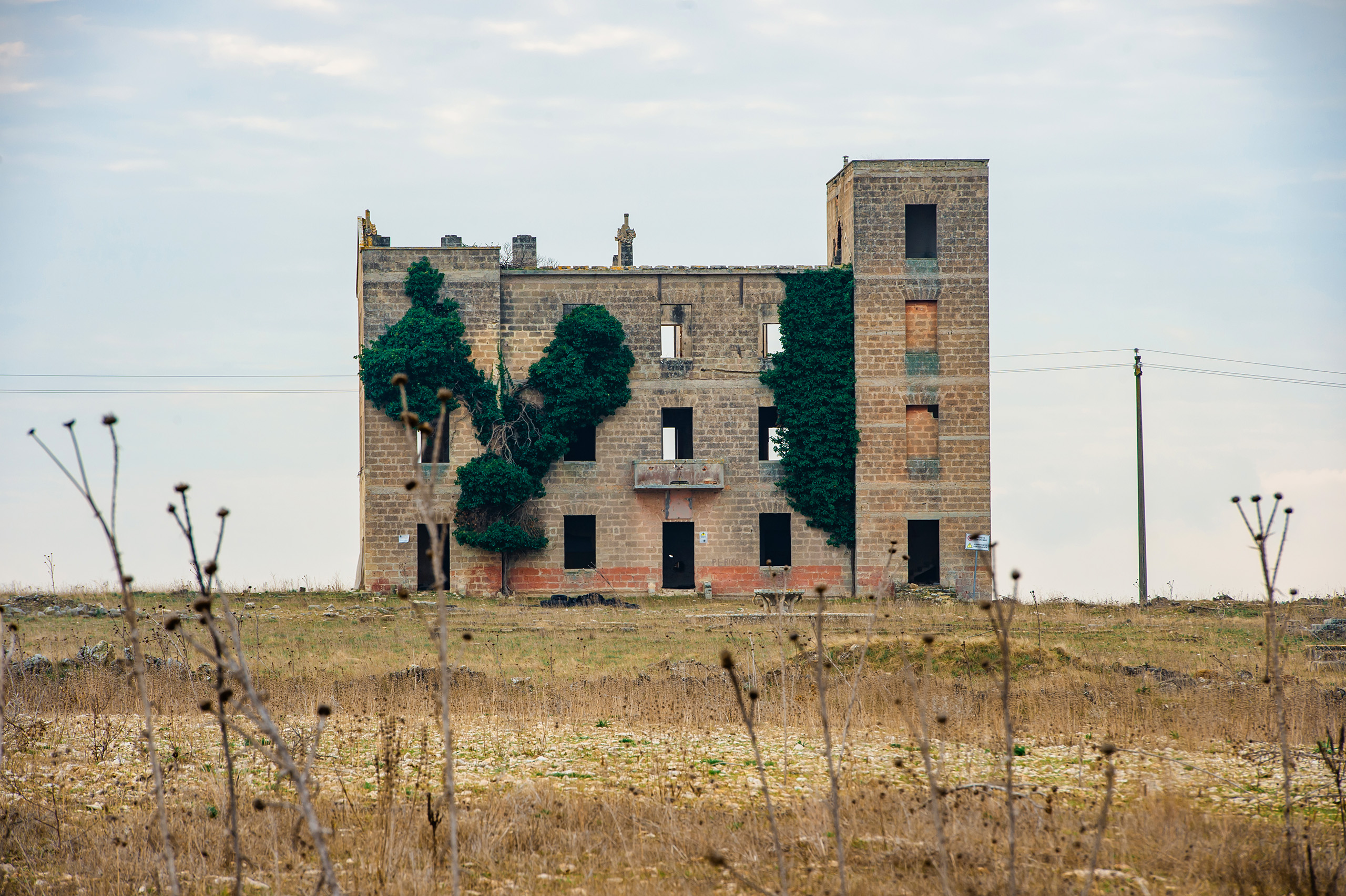
For his first visit to Camp 65, however, Gaskill needed to be alone. Stepping onto seventy acres of dusty ground, thistles and ruined buildings was like “landing on a barren planet and discovering the ruins of a failed colony.” The sun was ferocious, he was dive-bombed by insects, he had not brought enough water. (I’d like to think that no Australian historian would make this elementary mistake.) But he got what he came for — the ghostly “frisson” of the prisoners who had been there before him. Standing where Ralph and Charlie had stood made Gaskill’s spine “tingle.”
In a later expedition Malcolm and Dom visit Camp 52 in the north, although they knew that all remnants have been removed from the site. They go anyway, as eager as ever to carry their “present-centred lives into someone else’s past.” Here they admire the beauty and verdancy of the landscape compared the arid plain on which Camp 65 had been built. Even without fences and crumbling huts, at Camp 52, “phantoms” still thronged in the “thick air.”
Gaskill is extraordinarily sensitive to the “affective” power of archives, artefacts and places. “Affect” in this context refers not just to emotion, but an emotional reaction felt in the body. Many historians (and biographers especially) experience it even if some are leery of admitting it in print. Not Malcolm Gaskill. His spine tingles, the hair on his neck prickles, he gets butterflies, he longs to put his body where Ralph’s had been so he can see and feel with him. When cousin Pauline lets him borrow Ralph’s memoir, he feels its “radiant presence” on the front seat of his car on the way home and is gripped with “spooky anticipation” as to what it might reveal.
An extension of this is Gaskill’s capacity to obtain the trust of his informants: descendants, usually, of Italian families who had harboured Ralph. Instead of putting his phone in front of them and subjecting them to an “oral history” interview, they sit down for a meal together and enter into the fellowship that was once extended to Ralph. “All this,” says Dom on one occasion, looking around at the company eating and chatting. “This is what Ralph felt. Incredible.”
Was it what Ralph had felt? We can’t say, and Gaskill knows this. Even with his visceral responses to evidence of the past, he maintains his core professional objectivity with Ralph. He is strongly aware of his relatives’ dislike for Ralph and Flo, but his own duty as a historian is to contextualise their lives and understand the choices that had been available to them. He judges Ralph to have been ambitious but reserved and unemotional; a man too fond of exercising authority (when he had any) and, later in life, maintaining his status in the eyes of others, to be a good leader.
Pauline went further. Ralph and his wife Flo were a pair of cold fishes: snooty, upper-crust and fake. “You could be writing a book about a very gallant man,” she told Gaskill. “But he wasn’t one.” Furthermore, she said, the war didn’t change him. The character he was before the war was the character he came back with, she believed.
Gaskill could see beyond this to the tough, brave side of Ralph’s character that the war had brought out, and knew there was a softer, romantic side too. He knew also that Ralph had been a tender friend to Charlie and was deeply respected (if not quite loved) by his Italian saviours. “I neither liked nor disliked Ralph,” he concludes, “nor did he disappoint me.”
In the family papers kept by Pauline he found a letter from his grandmother to Flo, saying that “the boy” — Malcolm himself — was thrilled to hear about Ralph’s war. It was a heart-stopping moment for him to learn that he had always been there, right in the heart of the archive. After all his journeying, he had returned to where it all began. “Tutto torna,” as his friend Dom liked to say: everything returns to its beginning. •
The Glass Mountain: Escape and Discovery in Wartime Italy
By Malcolm Gaskill | Allen Lane | $55 | 416 pages