When I was growing up there was always a copy of our local morning paper — the Hobart Mercury — fresh every day in our house. I can’t remember if we had it delivered, or if someone fetched it early from the local shop, or if my father picked it up later and brought it home. Certainly in their later years my parents had the paper delivered, and strolling out to the front gate to get it was one of the routines that kept their days ticking over.
My father read the paper pretty thoroughly, focusing on the political and general news, the letters to the editor, the cartoons and, especially on Saturdays, the classified advertisements. Cars and real estate interested him the most, but he often glanced through the personal ads and rarely failed to find something to tickle his funny bone.
Until the internet arrived to suck newspapers dry of these “rivers of gold,” the classifieds section of any daily paper heaved with vivid little glimpses of the lives of our fellow citizens. Buying, selling, leasing, proclaiming, persuading, searching, celebrating, grieving: even the tiniest one- or two-line ad had a human story behind it.
Hilary Mantel, a dedicated reader of newspapers, ignored the news and features entirely in favour of the small ads. In a local paper in Norfolk she once saw for sale three bridesmaid’s dresses, identical, to fit sizes 24, 26 and 10. Ever since, she wrote, “I have been imagining the photographs from the original wedding, and wondering if such bridesmaids ever occurred for a second time, or if the dresses are still hanging in the closet.”
This was in a piece she wrote for the Guardian in 2009 titled “Where Do Stories Come From?” She could make a national paper last two hours, she said, after which it looked like a drunk had been making paper hats with it. She was coy about whether she worked any of this material into her fiction, though. Perhaps not, and yet how comforting for a writer to know such slivers of inspiration are right there for the taking.
I often chuckle over Mantel’s bridesmaid’s dresses, so perfectly offered up for the reader to fill in story from their own imagination. And it occurs to me that there would be plenty of material for a historian as well if only we are willing to let go of some of our habitual efficiency and purpose and instead follow Mantel’s example and read a newspaper simply to absorb the ebb and flow of life.
Such an approach runs counter to current practice now that newspaper research is so easy, at least in Australia where so many digitised newspapers can be read online for free through the National Library’s digital repository, Trove. The site’s search capability to deliver astoundingly granular results in seconds encourages what I think of as an “arthroscopic” approach to research.
What I mean is that with each of our searches, we seekers of historical evidence equip ourselves with our arthroscope (in real life a tube with a tiny camera on the end, often used by surgeons to diagnose joint problems) and insert it into our source: a newspaper. We probe deeply until we get what we came for, or what we think we came for, and we ignore everything else.
I use this keyhole technique constantly myself, usually chasing names and addresses. Anything could be significant when you research people whose lives are otherwise barely visible in the historical record, and it’s not just about who married whom, and the names they gave their children. You can trace a family’s slide into poverty by the addresses you find for them, for instance, or the number of times the father or mother appear before a magistrate.
Some of these quests have stayed with me. I once found a snippet about a twelve-year-old “sickly looking little girl” who, having been found wandering the streets in Sydney, was arrested and charged under the Destitute Children’s Act and sent to the Industrial School at Parramatta. I already knew exactly who she was — Clara Mabel Stace, an older half-sister of Arthur Stace, “Mr Eternity” — but this sad little fragment added significantly to my understanding of how this family eventually disintegrated under the weight of poverty and trauma.
I doubt this kind of outcome would have been possible in the age of analogue newspaper research. Still, as with any new research methodology, there are gains and losses.
Once, researchers relied on secondary sources and their own persistence, ingenuity and sheer stamina to scour newspapers for evidence, and you might have to scan almost an entire issue to get what you wanted. Quickly you learned how to identify the different parts of each edition — whether the classifieds would be at the front or the back, which page would feature the main news of the day and which the editorial, the social news, the weather or the sport. The eye might catch on bits and pieces not germane to the task at hand but perhaps providing enriched context or even offering whole new paths to follow.
Now, on Trove at least, an item is illuminated on the screen and the rest of the page greyed-out. It only takes a few clicks to bring up the entire page but I generally don’t, so strong is the temptation ignore the greyed-out section and click back to the next result on the list, and so on.
So this time I thought it might be fun to sit down with just one issue of a daily metropolitan newspaper and give it a slow read from beginning to end. It could be any issue from the glory days of twentieth century Australian newspapers, and yet I found myself unable to pick completely at random. I thought back to my father’s daily newspaper habit and fell to wondering if he had inherited it from his parents.
My grandparents had moved from Brisbane to Hobart in 1936 so my grandfather could take up a job with the Postmaster-General’s Department. George and Kitty had no relatives or friends in Hobart — they were starting life afresh — so surely they would turn to the local paper to help them settle into their new community? With that in mind I selected an issue of the Hobart Mercury published on Friday 11 December 1936.
I began by making myself a replica of the paper. I downloaded each page of the issue as a PDF, printed it at A3 and stapled them all together, blank pages back-to-back. The print is tiny — A3 is much smaller than the broadsheet Mercury in 1936 — but my replica does offer an approximation of the physical experience of reading the original. The issue on 11 December 1936 was twenty pages long and had eight columns. Feeling quite pleased with my little craft project, I sat down to read.
Page one: the classifieds. It seems bizarre to us that newspapers would bury the news people most wanted to read in the middle of the paper, but the longstanding assumption, dating back to the eighteenth century in the English-speaking world, was that people bought the newspaper for the advertising, and the news was incidental. Front page classifieds were also thought to distinguish a “serious” newspaper from a “sensational” one.
In Australia by the 1930s many newspapers had begun placing the news on the front page, and the Mercury started following the trend on 3 August 1939. But in 1936 the classifieds were still the first thing you saw. Top left were the announcements of births, engagements and bereavements, and many readers would run their eye down these to find out who was being “hatched, matched and dispatched,” as the saying went. Probably not my grandparents, though, because they were newcomers in Hobart and knew no one.
Instead I expect they used the classifieds as they were intended: as a source of information to help solve life’s practical problems. Having dropped her children at school and done some of her morning chores, I can imagine my grandmother sitting down at her house at 159b Main Road (now New Town Road) New Town, with a second pot of tea, pondering.
Christmas was coming and Hobart’s grocers were reminding people to think about their lunch menus. Arnolds in Liverpool urged their “numerous clients” to place orders early for English plum puddings, Christmas cakes and mince pies. My grandmother, I happen to know though I don’t remember her, was a splendid cook and taught her daughter, my aunt, to bake on a wood-burning stove, which wasn’t easy when the temperature has to be just right. Kitty was quite capable of making her own Christmas puddings and treats.
But on this day she might have paused, eyeing the stove in her new kitchen, wondering if she knew it well enough to take the risk at Christmas. Just this once, would it be easier just to buy the pudding? On the other hand, Hobart summers were very cool compared to what she was used to in Brisbane, so now would be the time to bake her heart out.
With Cyclops Toys (“They last a lifetime”) is advertising bikes and scooters, she might have made a mental note to talk to George about buying their youngest son (my father, aged seven) a new bike for Christmas. They’d had to sell many of their possessions when they moved to Hobart and having to re-acquire things like that must have been a stretch. Perhaps they could put it off until his birthday in January?
But then her eye might have fallen on the ad for Sunday morning, afternoon or day-long excursions on the SS Cartela along the Derwent river to Opossum Bay and South Arm. That would make a fine birthday treat. (I think my father must have been taken on trips like that because he loved the river and the Cartela, which had been built in Hobart in 1912.) It was still working on the river when I was growing up and we thought of it almost like an extra great-aunt: “Dear old thing, amazing how she gets about at her age!”
A few more classifieds appear on page two. Here’s one of the public announcements: “I, Henry Poynton, challenge to dance J. Dillon old-time waltz at Victoria Hall on December 16, 1936. (Signed) H. Poynton” What was that all about? Some kind of dance-off? Dancing shoes at dawn?
Most of this page is taken up by the shipping information (extremely important in this maritime community) and the weather chart, but there is a smattering of news. The vehicle road to the pinnacle of Mount Wellington, a project organised by the state government and the Hobart City Council to provide relief for Hobart’s unemployed during the Depression, was nearly complete. Here was the premier, A.G. Ogilvie KC, announcing the date of the official opening had been fixed for 23 January 1937.
Kitty and George (along with just about every other citizen of Hobart) would have been most interested in this because the mountain is an inescapable feature of life in this place. My grandparents didn’t own a car in 1936 but when my father was old enough he would join George on hikes to the pinnacle using one of the many walking tracks. The road, meanwhile, became known as “Ogilvie’s scar” — for good reason.
Page three is dominated by the results of the degree examinations held by the University of Tasmania. I showed this page to my younger son — a university student — and we studied it together. Is that everyone? It would seem so. The names of all students who passed their examinations in 1936 across all faculties could fit on one page and still leave room for large display ads by Hobart retailers advertising their Christmas wares, plus a few column inches on a series of thefts in a Hobart boarding house. The university was tiny in those days, neglected by the state government and allowed to limp along in inadequate accommodation in the city until finally, it the 1960s, it transferred to a new purpose-built campus in Sandy Bay.
Page four is dedicated to trade and finance, markets, stocks and shares. I’ve no idea if Kitty’s eyes glazed over this, but mine did. Page five is a full-page ad for Palfreyman’s, a department store in the city proclaiming itself “alive with the spirit of Christmas.” Hosiery, “haby” (haberdashery), handbags, handkerchiefs, tea sets, tablecloths, towels, toys. And “Bungalow cloths.” What are they? I have no idea.
I’ve reached pages six, seven and eight and still have not read any major overseas, national or state political news, which to me is perplexing. State parliament was sitting but was not, apparently, debating anything worth reporting. Instead, page seven has a long report on the school speech night at Launceston Church Grammar, including the headmaster’s address (reported verbatim). From Canberra comes a report on a dispute over the trademarking of the term “Mickey Mouse.” A new public golf course has just opened on a site close to New Town Bay. The Marquess of Hartington, the British parliamentary under-secretary of State for dominion affairs, was visiting Tasmania. There has been an improvement in revenue at the port of Launceston. The New Norfolk Council is in financial difficulties.
Part of what I’m seeing, I suppose, is the sheer insularity of Tasmania, which has been a theme throughout its settler history. The Mercury is, essentially, a local paper. But it also lacks the personality-driven politics we are so accustomed to, and, because I landed on a Friday and not a Saturday issue, there is no film star gossip, women’s page, gardening notes, book reviews or letters to the editor.
Then, just as I was wishing I had chosen a Saturday, my eyes fell on page nine. Here, finally, was the real news of the day, headlined across all eight columns: KING EDWARD DECIDES TO ABDICATE.
Of course. This was the year of the abdication crisis, and I happened to pick the exact day the news broke. I had to scratch about in my memory to recall the story, and the little I do know of it is partly derived from memories of a Thames Television dramatisation broadcast by the ABC when I was in high school. Edward VIII was played by Edward Fox so believably that even now, every time I see a photograph of the real Edward, my mind tries to re-arrange his features into those of the actor.
My grandmother would have had the advantage of me, if she was a daily newspaper reader as I am assuming she was, because the Mercury had been reporting on the story since early December. Just the day before, the paper declared that while there was still no finality in the King’s apparent determination to marry American divorcée Wallis Simpson against the wishes of the British and Dominion prime ministers, a statement was likely that day. The “entire Empire” was awaiting his decision.
It arrived in Australia in the early hours of Friday 11 December, just before the British prime minister, Stanley Baldwin, was due to inform the House of Commons. Australia’s prime minister, Joseph Lyons, had an address ready for public broadcast live on the ABC, but needed the text of the King’s abdication speech (“After long and anxious consideration I have determined to renounce the Throne…”) to add to it. The text came through from London via telephone to Parliament House in Canberra at around 1am, and was transcribed immediately by the prime minister’s staff. A photographer for the Melbourne Herald captured the moment. Lyons read the speech on the radio at 1.52 am and it appeared in print in the nation’s newspapers a few hours later.
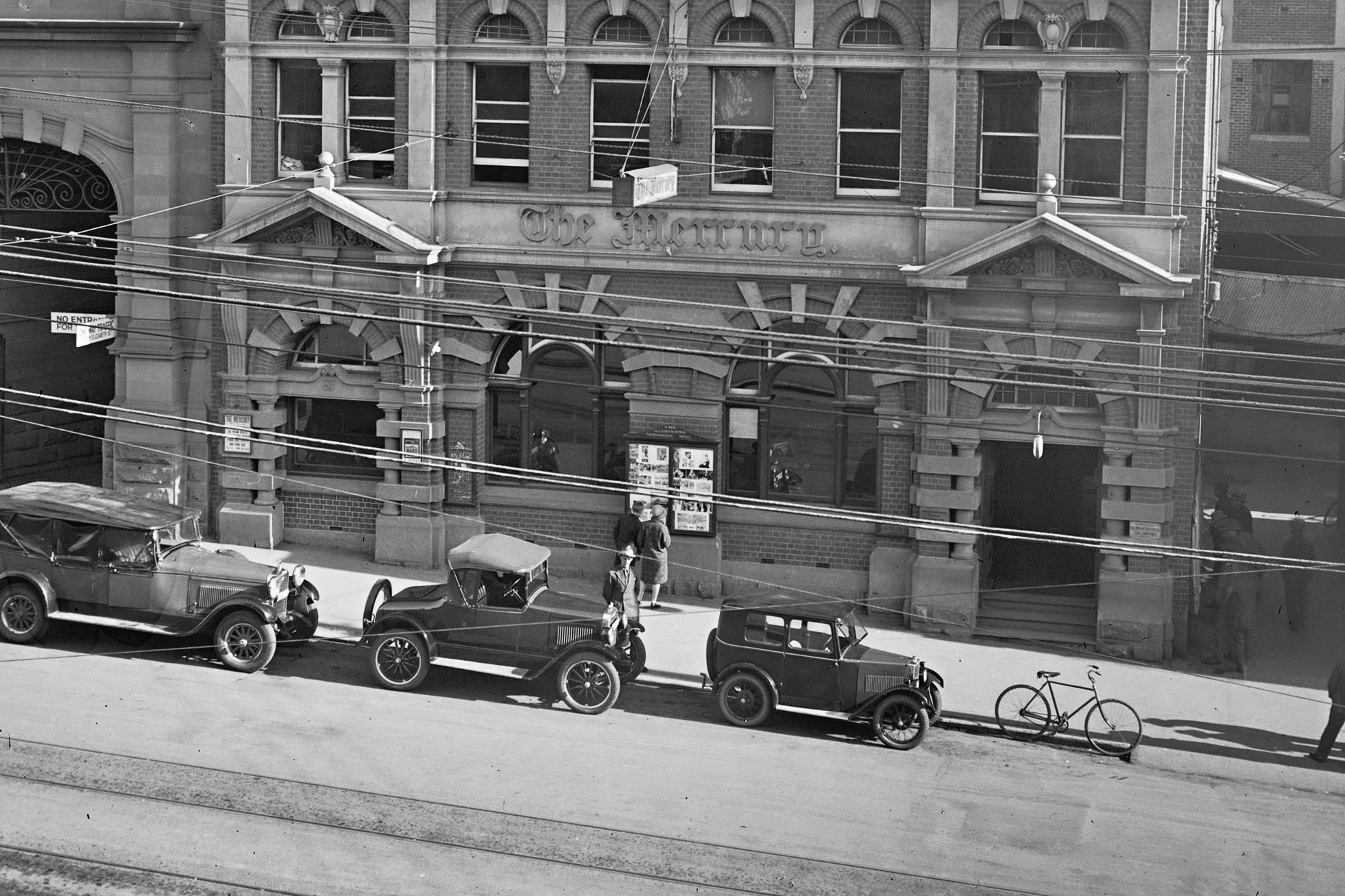
I realise now that my grandmother probably skipped all those earlier pages and went straight to the abdication news. She and my grandfather might have read it together before George left for work, and on his commute down to the city there could have been no other topic of conversation. The Mercury’s offices were on Macquarie Street next to the GPO, where he worked, and even as he stepped off the tram journalists and printers might still have been creeping home to bed after a long, memorable night.
The Mercury dedicated five full pages to the crisis, with no ads. A Friday issue was usually fourteen or eighteen pages; on this day it was twenty. The coverage recounted the life of Edward VIII and his ten-month reign; noted events leading up the abdication; added some discreet mentions of Mrs Simpson; and speculated on what the future held for the new monarch, “King Albert I” (as it was assumed George VI would style himself). There were photographs of the new King’s wife and daughters, including Princess Elizabeth, the future Queen.
This content would have come from overseas wire services, but the paper added its own thoughts in its editorial. Reflecting the prevailing view in Australia and other Dominions, the paper chastised Edward for having been “not strong enough to place duty before personal inclination.” Never again, it predicted (accurately, as we now know), could he live in his native land, instead dwelling “in some poor splendour” with the wife for whom he had thrown away the “splendid heritage of duty.”
After all that it was hard to find the strength to turn any more the pages. But life in Hobart had to go on. Cinemas still wanted to advertise their screenings, and there were yet more ads from Christmas retailers. The back page carried a lengthy report of England’s victory over Australia at the Ashes Test in Brisbane.
For this reading of a historical source, I made myself as small as an ant crawling through grass, and just as ready as an ant to be baffled when I bumped into things I didn’t understand. Then, climbing to the top of a blade of grass, I found myself gazing with wonder at events that have had a permanent impact on the history of the world.
This was not what I was expecting. And I never did find out anything about Henry Poynton’s old-time waltz challenge to J. Dillon. That story is not for me; it awaits the eye of a novelist. •