Among Papua New Guinea’s conundrums is that it must always live with Australia. History meets geography as both blessing and curse. Two of the most different nations in the world are together forever, and forever working out the balance in what they must do together.
The hues of this intimate but strange rapport evolve, even as much stays constant.
Defence fears prompted Australia’s first colonial grab for New Guinea in 1883. (Germany was coming.) The defence instinct was served anew last year when the two nations established a military alliance. (China is coming.) The treaty was finalised amid celebrations of the fiftieth anniversary of PNG’s independence from Australia.
The alliance is a natural expression of the vital interests Australia has in PNG. Yet it took fifty years, and it was PNG that suggested it was finally time for a formal alliance. This relationship is as complex as it is unusual.
“Complicated” is the headline word Sean Jacobs uses for his new collection of mediations on PNG, A Complicated Inheritance: Papua New Guinea at 50. The intricate inheritance is expressed in Jacobs’s own life: with an Australian father and PNG mother he describes himself as “a Papua New Guinean-born Australian writer.” His mother was from New Hanover, in New Ireland Province, a three-hour boat ride from the nearest airstrip in Kavieng. His father was a pilot flying for Air Niugini.
On such sliding-door meetings do lives turn, creating in Jacobs an expression of PNG and Australia together. He writes with a foot (and a heart) in both nations: “When working for the UN in Port Moresby,” he says, “I had spent most of my time living with extended family in Moresby’s rather grim settlement settings — nights and days of heat as the power cuts dragged on.”
Jacobs worked for Australia’s first two national security advisers, Duncan Lewis and Margo McCarthy. He recalls sitting one night in Parliament House “editing national security minutes and thinking that, only a few months before, I had been sitting in grass talking to PNG women market vendors on supply and security issues. A few years later, when finishing work for a senior Queensland government minister, I returned to PNG to tear around Manus province in a land cruiser as part of a company outreach program, liaising with police community groups, business and teachers. Moving between such extremes does provide one a ‘multi-disciplinary’ perspective on PNG.”
Jacobs says his writing on modern PNG offers two perspectives. The first fuses the “up close” PNG of markets and towns with the influence of “the tectonic shifts in geopolitics surrounding the country.”
His second perspective comes from a “conservative worldview — an enthusiasm for capitalism and consumption to lift PNG out of poverty, a desire for state-led deterrence with a strong police force, a scepticism of community justice, and a caution against excessive appeals for international climate change action at the expense of local domestic political leadership on sustainability and environmental issues. These aren’t entirely mainstream views.”
This slim volume takes a swift swing at many different topics; its thirty-six chapters consist of articles Jacobs has published since 2012. Each piece stands on its own, yet they are all part of the one jigsaw, expressing what Jacobs calls PNG’s “certain uniqueness.” He offers great “optimism for PNG’s future versus great pessimism,” giving the book its “complicated inheritance” flavour.
The optimism–pessimism tension isn’t surprising, Jacobs writes, “when one sees the creative and persistent spirit of Papua New Guineans constantly let down by poor government and even poorer conditions as the nation barrelled through its half a century.” PNG’s history since independence is “a steady catalogue of political crises,” with only three out of seventeen governments serving for a full term of parliament.
Jacobs offers many reasons for PNG’s performance, “ranging from poor leadership to lax party discipline, fragmented cultures, a hasty colonial retreat, and a Westminster system that is seen as a poor fit with the underlying society.”
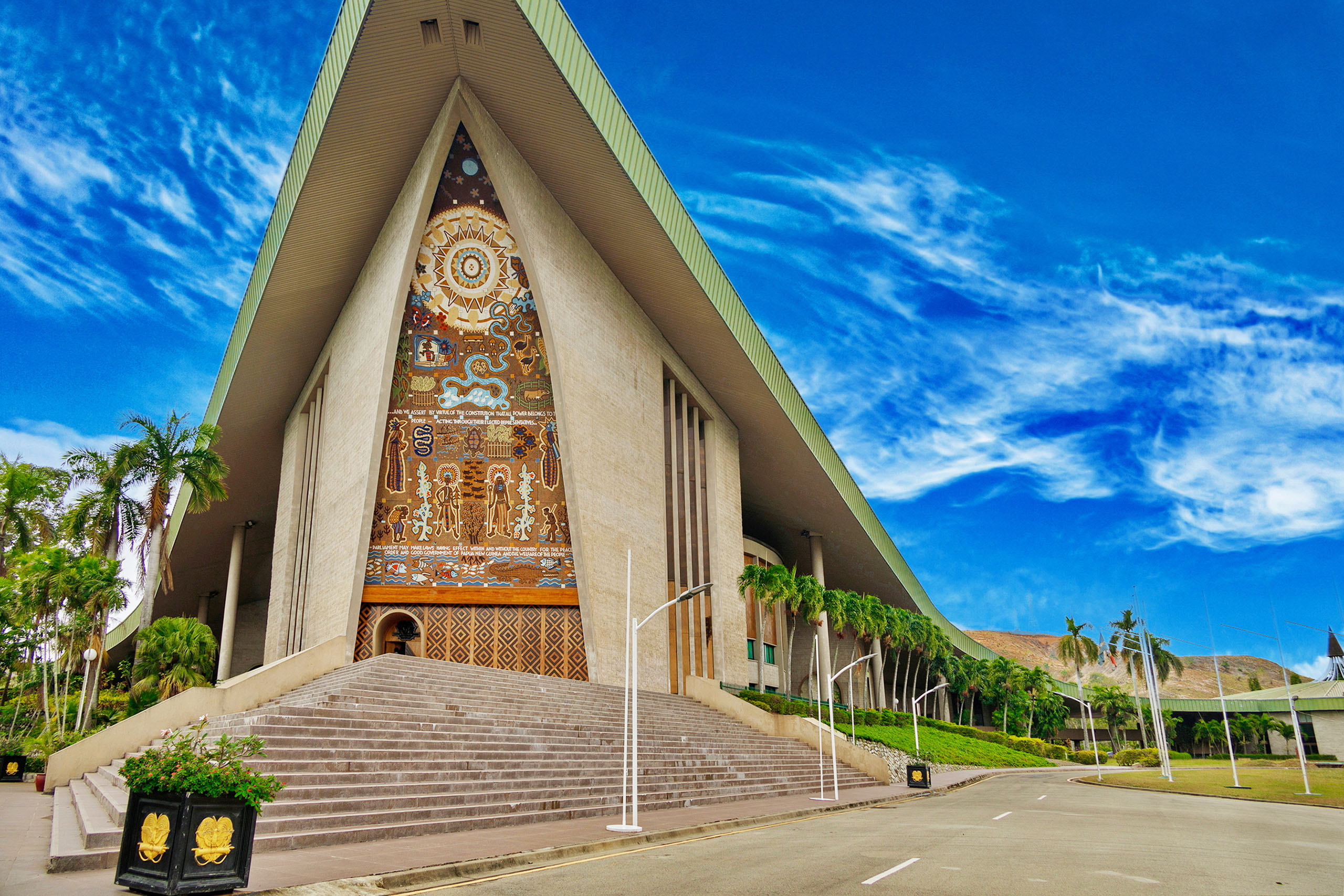
In a chapter titled “Seeking Optimism: Westminster in PNG,” he notes the great benefit of what hasn’t happened — a military coup or an authoritarian government. More than a thousand cultural groups prevent any one group from dominating politics. “Cultural fragmentation clearly frustrates political reform,” he writes, yet it delivers the benefit of a parliament that serves as a “shock absorber for the maze of cultural groups to coalesce and troubleshoot.”
PNG’s regular democratic elections place it “in a unique category among developing states.” Indeed, elections are “one of the few times that the state operates with a high degree of efficiency.” Add to that an independent judiciary, independent media, and the fiscal strength of an economy held up by resources and agriculture.
“Chaotic politics have been a feature of PNG since independence,” he notes, “yet the contortions have taken place within its institutions — a good outcome when considering the list of undesirable alternatives.”
In a chapter on Canberra’s promise to “step-up” in PNG and the South Pacific, Jacobs offers five areas where Australia could be more creative in using its influence:
- Send more diplomats to the South Pacific and give them more discretion
- Whatever you promise, deliver quickly
- More sport diplomacy offers “the language and actions of values”
- Build infrastructure, both hard and soft
- Get more Australian companies into PNG and the region.
In the permanent contest with China in the South Pacific, Australia can do things differently and better. Jacobs goes back to a speech delivered in Port Moresby in 1963 to define good Australian statecraft. Here are those 1963 words by Australia’s longest-serving prime minister, Robert Menzies: “We are not oppressors. On the contrary, our dominant aim is to raise the material, intellectual, social and political standards and self-reliance of the indigenous peoples to a point at which they may freely and competently choose their own future.”
Whatever the tensions of great-power politics and the many differences between Australia and PNG, Jacobs argues on his final page that these two strange neighbours share values:
PNG has been clear about its shared values versus its shared interests. Or, more specifically, its respective fundamental relationship with the United States and Australia, with whom PNG shares values, versus that of China, with whom PNG has strong and vital links. Amid all of PNG’s challenges it is a helpful and arguably optimistic reminder of the sum of its potential as a nation.”
In his final chapters, Jacobs ponders the state of PNG’s democracy after five decades, lamenting stark headlines about “sickening retributive tribal violence, broken schools and hospitals, stifling energy poverty, endemic corruption.”
While some might be surprised at the endurance of PNG’s Westminster scaffolding, the centralised power needed for a strong presidential system is hampered by “hyper-pluralism.” Citing 1990s Rwanda and Yugoslavia, he argues that “a lesser probability of one group dominating another is certainly a desirable democratic outcome. The challenge, however, emerges when finding consensus and concentrating power towards decent ends — delivering health services, for example, or basic law and order. Here, PNG is tremendously addled.” •
A Complicated Inheritance: Papua New Guinea at 50
By Sean Jacobs | Connor Court | $29.99 | 156 pages