Gripping as it was, the TV series Succession has had a long and rather unfortunate afterlife as a prism through which people view the travails of the Murdoch family empire.
Curious crossovers haven’t helped. Rupert’s divorce settlement with his fourth wife, Jerry Hall, barred her from giving story ideas to Succession’s scriptwriters. At one stage Lachlan told Rupert his brother James was leaking stories to those same script-writers. After daughter Elisabeth saw the TV patriarch Logan Roy die on-screen she began making plans with James and Prudence (Murdoch’s daughter from his first marriage) for how they would respond to their father’s death.
Essentially, though, none of the main characters in the TV series resembles any of the main players in the Murdoch dramas. Nor do any of their conflicts.
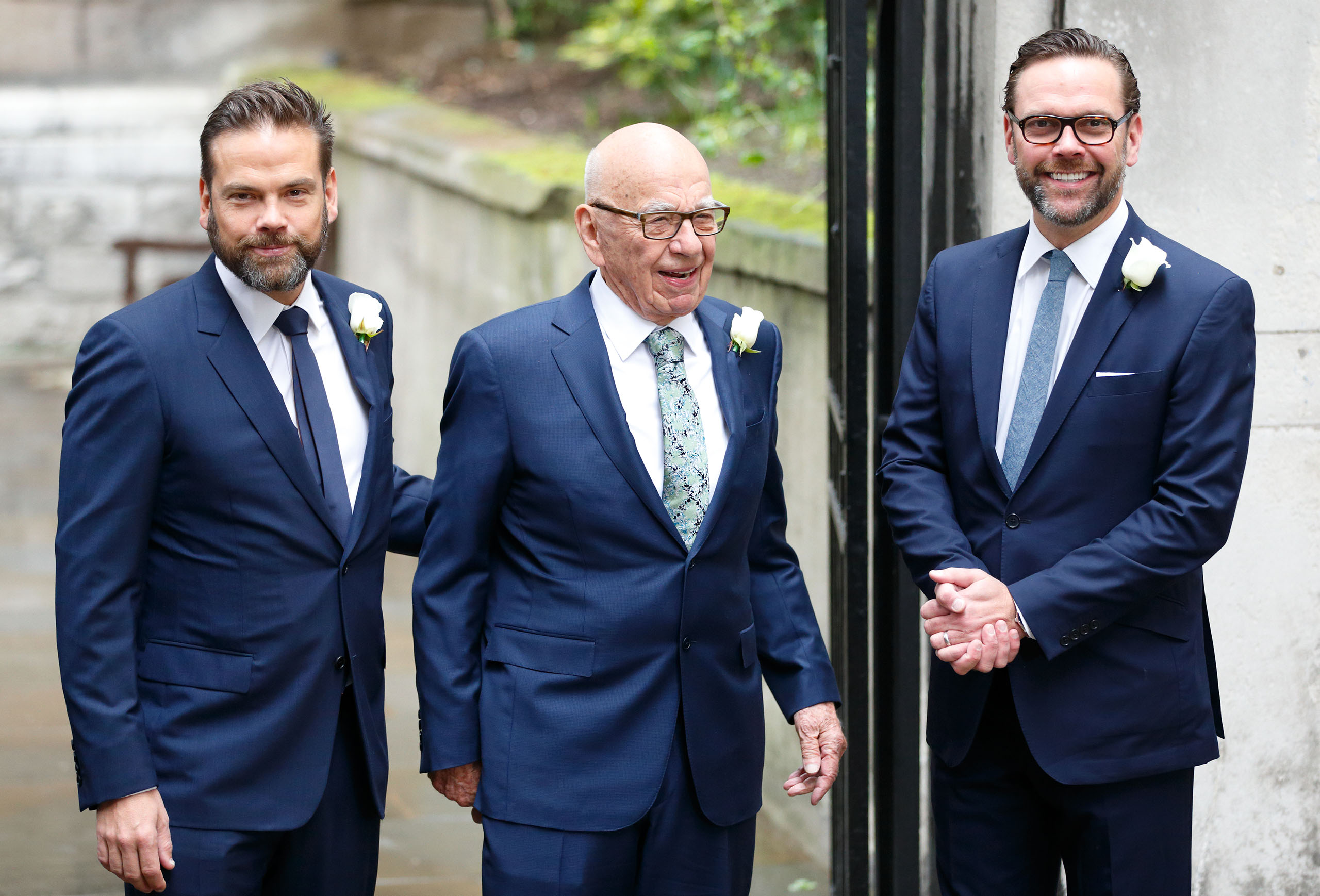
But the real life Murdoch story could make a good TV series of its own. The story would begin in 1998 with a departing wife (Anna) giving up a large fortune in return for an irrevocable trust to protect Rupert’s four children against future usurpers. Decades later, the father and oldest son Lachlan, fearful the favoured son could be outvoted three-to-one after Rupert’s death, sought to overturn the irrevocable trust — and actually called the move Operation Family Harmony. Unsurprisingly, the other three siblings refused. Father and son mounted a legal action in Nevada; equally unsurprisingly, it failed. Then, in a denouement only accountants could be excited by, the three siblings were paid a huge amount of money to go away (thereby ruling out a second season). The anointed heir’s future control is assured, but at a huge cost.
Gabriel Sherman’s new book, Bonfire of the Murdochs, is the first biography of Murdoch to be published since that sequence of events was revealed in the 3000 pages of discovery documents and legal testimony from the Operation Family Harmony court case leaked to the New York Times. More than any other Murdoch biographer, Sherman puts family relationships and dramas at its heart. His conclusion is brutal: “Over seventy years, Rupert said he was building a family business. But what he built was a business that destroyed his family.”
Sherman comes to his task with impeccable credentials. He wrote an excellent book about the boss of Fox News, Roger Ailes, has just written the reality-based TV drama The Apprentice — acclaimed by critics and attacked by Donald Trump — and has been a leading chronicler of Murdoch machinations over the past two decades.
First, the bad news. Sherman’s first chapter is, quite simply, terrible. It seems to be compulsory for American writers to be error-prone whenever they write about Australia. Among many lapses comes this: “Rupert also watered down [Rohan] Rivett’s coverage of a local murder trial because it undermined Rupert’s effort to curry favour with government officials who approved lucrative television licences.” Presumably this is a reference to the Adelaide News coverage of the trial of Max Stuart, which was appealed all the way to the Privy Council and prompted a royal commission into claims that police had written Stuart’s confession. Murdoch was just as active as his editor Rohan Rivett in a courageous campaign that climaxed with a threat of criminal defamation charges against the paper. And, of course, television licences are a federal not a state government responsibility.
As the action moves closer to the present day and New York, the standard fortunately improves greatly. Developments in Australia, Britain and China, though, are essentially a backdrop to changing family relationships.
That means Sherman’s account of the British phone-hacking scandal doesn’t mention the five years after 2006 when News Corp claimed the hacking was the work of just a single rogue reporter, or the frustrations and courage of Nick Davies and the Guardian in trying to penetrate their lies, or the efforts by some lawyers to hold the company to account, or the shameful passivity of the London police. Nor is the momentous Leveson inquiry and its report mentioned.
The family was still largely united when Rupert and James testified to a parliamentary committee in 2011. Lachlan and Prudence flew in to support them, and even Rupert’s ex-wife Anna came to support her son.
The only dissenter was Elisabeth, who thought James — the son in charge of the company’s UK branch — should resign. When she said this to Rupert, he agreed. “Rupert then made as cruel a request as a father could make,” writes Sherman: he told Elisabeth to fire James. “Dad and I think the only way to stop the noise is for you to step down,” she told James, who was “gutted” not only by his sister’s betrayal but also by their father’s cowardice. James told his sister that if Rupert wanted to fire him he should say it to his face. The siblings didn’t speak for years. Elisabeth later described her action as one of her greatest regrets.
This was not the only occasion when Rupert had one of James’s siblings deliver bad news. In 2015 Fox chief executive Chase Carey, who was in his early sixties, grew tired of being caught between the “warring brothers,” Lachlan and James, and told Rupert he wanted to leave after his contract ran out. Rupert was forced to make a decision on which son would take over. When James arrived for lunch with Carey and Lachlan at a club near the office he was told Lachlan would be chief executive and James would report to him. James recalled feeling hot anger surge through his body. Having Carey and Lachlan ambush him in public was, he felt, pathological, a corporate execution.
James felt — and Sherman argues — that while Rupert went to great lengths to foment competition between his children there was always only going to be one winner, Lachlan. Rupert’s treatment of Elisabeth seems particularly unfair. Despite her business successes, Rupert clearly thought her gender ruled her out from being his successor.
Lachlan was annoyed, meanwhile, that James “peacocked” around as if he were a better businessman than their father, and that James should show more respect. Others in the company thought James was happy to take the money earned by Fox News while also looking down on the network. In turn, James felt he had put in the hard yards for the company, in Hong Kong and with BSkyB, while Lachlan ran away to Australia and presided over a string of business failures.
Apart from anything else, James’s relations with his father were often confrontational, while Lachlan was much more emotionally supportive. Lachlan was most in tune with Rupert’s attitude to Fox News and its unwavering support for Trump, and was the only one who shared Rupert’s fondness for tabloid newspapers.
There is no doubt who the book’s chief villain is. While Rupert himself was vaccinated and took many precautions during the Covid-19 pandemic, he let Fox rail against lockdowns and often air anti-science stances. While Rupert had no doubt that Biden legitimately won the 2020 election and thought Trump should concede, a dip in ratings led him to encourage Fox News to stoke viewers’ prejudices; this proved a financial disaster when Dominion Voting Machines successfully sued for defamation.
Sherman chronicles the ups and downs of Rupert’s marriages, and particularly his resistance to looking back. Once he deems a relationship to be over, he is cold, unbending and unwilling to engage in any dialogue. This is true not only of his marriage break-ups, but at least sometimes with his children.
After the hearings in Nevada wound up, but before the verdict was handed down, James and his sisters sent Rupert a letter seeking to reconcile. “Thanksgiving and Christmas are upon us and the three of us wanted to reach out to you personally to say that we miss you and love you,” they wrote. “We are asking you with love to find a way to put an end to this destructive judicial path so that we can have a chance to heal as a collaborative and loving family.”
When Rupert replied a couple of days later, he said he’d read the children’s trial testimony twice and concluded that he, Rupert, was right: they were unfit to inherit the business. He said he only wanted to speak through lawyers henceforth, and signed off “Much love Dad.”
While the general thrust of Sherwin’s case against Rupert is sound, a couple of times he seems to overstep the mark. He writes, for example, that James denied knowing about the phone-hacking by his London-based tabloids, yet Rupert used the biggest scandal in the company’s history to demote him and promote. James’s wife Kathryn makes a similar point: she “later realised that Rupert had used James’s promotions as opportunities for James to fail so Lachlan could inherit the company.”
Rupert was not the author of James’s mismanagement of the phone-hacking crisis, James was. He signed off on payments of around a million pounds, he says, on the advice of the lawyers that misled him about the scale of the misdeeds. The lawyers deny this. At best, this shows an amazing lack of curiosity, indeed a lack of due diligence. True, he was much more interested in BSkyB, but newspapers were a big part of his job in Britain. (Rupert eventually defied the many calls that James should be forced to resign, and moved him sideways to a senior position in New York.)
Both James’s and the company’s behaviour stems from their sense of invulnerability. After the Independent ran an advertisement declaring “Rupert Murdoch Won’t Decide This Election. You Will,” James barged unannounced into the editor’s office and yelled “What the fuck are you playing at?”
Back in 2010, Rupert had taken an extraordinary step: he asked the children to join in family therapy. A therapist met with Rupert and the kids (no spouses allowed) on their farm in Australia. Ostensibly the family saw it as a chance to help James and Rupert get along. Each family member had to stand with their back to the others and let them vent their grievances. It was a car crash, James later said. By the end, they were more alienated from each other.
It was another move that would make great TV. •
Bonfire of the Murdochs
By Gabriel Sherman | Simon & Schuster | $36.99 | 256 pages