In the late 1960s I was teaching English in a government school in Chandigarh, a city being built from scratch as the capital for Punjab and Haryana, two newly formed states of the Indian Union.
On bitterly cold January mornings I’d sometimes cycle to school on a route that took me past a private school where two or three dozen men in white shirts and khaki shorts were doing “lathi drill” — practising combat with metre-long staves. They were members of the RSS, the Rashtriya Swayamsevak Sangh (national volunteer corps), which championed an aggressive Hindu nationalism.
One or two teachers at my school were, I think, members of the RSS, and a few others spoke of it sympathetically. But my teacher friends mostly regarded the “knicker-walas” as grown-up boy scouts.
About this time, a thousand kilometres away in the state of Gujarat, a boy in his early teens was lapping up RSS doctrine and discipline. Ten years later Narendra Modi was a full-time RSS worker and on the path that took him, the RSS and its affiliates to the dominance their doctrines enjoy in India today.
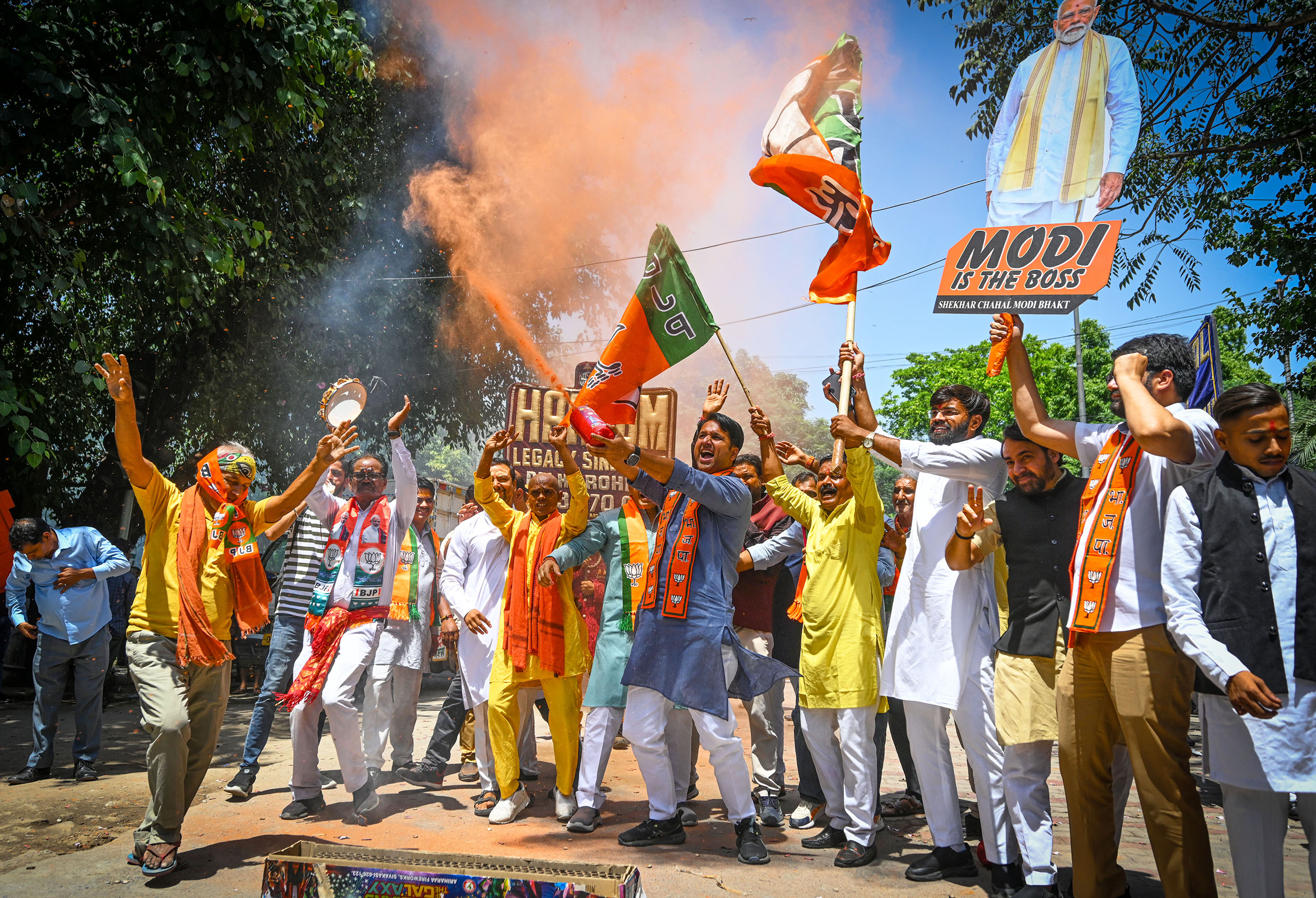
The results of elections in four Indian states, released this week, gave Modi, prime minister since 2014, a prize that he, the RSS and its offspring, the Bharatiya Janata Party, or BJP, have hungered for: the election of a BJP government in West Bengal and control of its capital Kolkata. Once upon a time, Calcutta (the name was changed in 2001) was the intellectual centre of India, home to anti-colonial organisation, cosmopolitan thought and many of the ideas, events and heroes celebrated by the RSS and BJP.
For nearly fifty years, however, West Bengal has been ruled either by the Communist Party of India (Marxist) or the Trinamool Congress of Mamata Banerjee, a three-time chief minister. A confident lawyer and battle-scarred stirrer, Banerjee, seventy-two, successfully presented herself to voters as both the defender of Bengal and as “Didi,” a caring, elder sister to the poor and weak.
The BJP threw a kitchen full of sinks at Banerjee and her party. Modi and his menacing home minister, Amit Shah, spent days campaigning in West Bengal. Preparations had begun a few years earlier when the central government began constricting funding to West Bengal from various national programs.
The Modi government also changed the process for appointing the chief commissioner of India’s once-admirable election commission to ensure the central government got the appointee of its choice. The new commissioner began a hastily contrived “special intensive review” of the voting register (long overdue) and quickly deleted nine million voters from the list, 2.7 million of whom claimed to have submitted citizenship documents establishing their right to vote. Because the process was hurried and poorly executed, it is not clear — and may never be — how many deleted names were Muslims, who constitute more than a quarter of West Bengal’s population and were considered to be Mamata Banerjee supporters.
Ten days before polling began, the Enforcement Directorate, a central government entity with wide powers to pursue financial crime, detained members of the consultancy firm advising Banerjee’s campaign. They were released after polling was completed.
The result was everything Modi could have hoped for. Banerjee’s fifteen-year-old government had long overstayed its welcome, and she lost her own seat by 15,000 votes to a former member of her party running as a BJP candidate. This BJP recruit, who had deserted her when she made a relative her deputy leader of her party, worked so hard for his new party that he now aspires to become its chief minister in the state.
The BJP won 70 per cent of West Bengal’s seats (206 in a house of 294) with 46 per cent of the vote. Banerjee’s party was not far off the voting pace with 41 per cent, but gained only eighty-one seats.
Banerjee’s CV has never claimed “gracious loser” as one of her attributes, and her reaction to the loss was captured in the page one Indian Express headline: MAMATA LOSES SEAT, SAYS “LOOT, LOOT, LOOT… AN IMMORAL VICTORY.”
The Modi mystique had taken a hit after the 2024 national elections. He began that election campaign proclaiming that the BJP aimed to increase its strength in parliament to 400 seats. Instead, the party lost sixty seats and its majority. In the current parliament, it needs support from two small regional parties.
The victory in West Bengal, and Modi’s part in it, repairs much of the damage and provides a powerful boost to the “Hindutva” project that aims to transform India into a Hindu-supremacist state. The ultimate goal is an all-powerful central government dedicated to infusing every level of Indian life with the RSS version of what it is to be Hindu. That means erasing much of India’s Muslim history of the past thousand years and treating 200 million Indian Muslims not so much as citizens as inhabitants.
What makes Modi and the Hindutva project so ominously impressive is its relentlessness. Partly, that’s because there is always another past grievance or present threat to rectify — another case of poor, uneducated people being converted by crafty Christians, another innocent Hindu girl converted to Islam by sly Muslim youths, another illegal structure put up by Muslims and needing to be bulldozed.
The Economist’s Asian columnist “Banyan” asked the cheeky Monty Python question: “What did the Mughals ever do for India?” The answer: “They gave political Hinduism its eternal, indispensable villain.”
In the other states where elections were held, one incumbent government was re-elected and, in the other two, governments were defeated in ways characteristic of each state’s political culture.
In Assam in the northeast, the BJP and its vituperative chief minister won a third term, cruising to an increased majority with a campaign riddled with anti-Muslim slurs. Assam is about one-third Muslim, the numbers padded, the BJP assures voters, by “illegal immigrants” from neighbouring Bangladesh.
Tamil Nadu in the southeast changed one movie-industry protégé for another. For nearly a hundred years, Tamils have demonstrated their love of Tamil movies, and the film industry, its fan clubs and welfare groups have been integral to Tamil life. Most of its chief ministers since the late 1960s have been associated with the industry as stars, writers or producers.
M.G. Ramachandran and J. Jayalalitha were legendary film stars before founding political parties and becoming long-time chief ministers. The outgoing chief minister, M.K. Stalin, born 1953, is the son of a chief minister who was a veteran scriptwriter.
The new chief minister is expected to be… you guessed it — another film star. His full name is Chandrasekhar Joseph Vijay, but his film name is simply Vijay. His mother is Hindu, his father Christian, and both were in films. Vijay has been acting in films since he was twelve. When he formed his own political party, he brought his fan clubs with him: the new party won 108 of the 234 seats; the outgoing government managed only fifty-nine. He is expected to form government with support from half dozen minor parties.
Vijay’s films have made him a fortune, but his record as an administrator remains to be proved. He arrived very late at rally of thousands of avid fans in September 2025, crowd management was appalling and forty people were killed in the crush.
In Tamil Nadu, the BJP won just a single seat.
In Kerala, in the southwest, the election result was so matter-of-fact that the New York Times failed to mention it at all in a wrap-up of these state elections. An irate Keralan wrote to the editor to complain, pointing out that Kerala, though a mere thirty-six million people, led India in health, and (most of the time) harmony among Hindus, Muslims, Christians and, long ago, Jews too. Just because the state was the most sane and sensible in India, he added, it should not be ignored. (The letter does not seem to have been published.)
Since the 1950s, Kerala has had a virtual two-party system. The Communist Party of India (Marxist) forms the core of one, and the Congress Party the other. Until 2021, they alternated at an election every five years. In 2021, the communists broke the mould and won two elections in a row, but it got its comeuppance in the latest poll. The Congress alliance won ninety-six of 140 seats and will form the next government.
The BJP won three seats in Kerala and about 10 per cent of the vote. But it will be back, just as it will be in Tamil Nadu. Its unattainable yet easily imaginable goal means it can keep on keeping on. And now it has a new how-to manual from West Bengal to work from. •