“Geopolitics” has made a comeback. The American historian Hal Brands defines it as “the study of how the physical features of the Earth interact with the struggle for influence and power.” It is, he says, a “discipline focused on the relationship between geographical realities and political power.”
Historically, the concept is associated first with German and then with British and American strategic thinkers of the nineteenth and early twentieth centuries. More recently University of Melbourne political scientist Michael Wesley recast it as “not an ideology or a theory but a cast of mind” that “challenges governments to think spatially about threats and opportunities: how their territories, topographies, waterways and seascapes make them either vulnerable or powerful.” As an analytical approach it informs choices about the use of (always scarce) resources to “limit the weaknesses and exploit the advantages conferred by geography.”
Geopolitical thinking inevitably deploys terms linking geography (North and South, East and West, Europe and Asia, the Americas, the Pacific) with political, social and cultural features. The emerging amalgams link geography, power and history in terms as familiar as they are ill-defined: “the West,” “Europe,” “the Global South,” “Eurasia.”
Here, I want to explore two of these concepts — “Eurasia” and “the West” — through two recent books: Brands’s The Eurasian Century, from which I’ve already quoted, and Georgios Varouxakis’s intellectual history of The West. I am particularly interested in whether these two books, written mainly for audiences in Europe and North America, make sense for Australia: a country located in the southern hemisphere and east of the Americas but usually seen as part of the “West” rather than the “Global South.” Do they offer useful insights for democratic middle-power strategy in the Asia-Pacific?
The history of “the West”
The West and The Eurasian Century are very different books. Varouxakis is an intellectual historian and his nearly 500-page book is a close reading of a dizzying array of sources and their interrelations. He rejects the notion that “the West” emerged as a concept after the second world war — when the United States sought a historical justification for its hegemony by constructing a line “from Plato to NATO” — but also takes issue with those scholars who argue the concept gestated as a corollary to high imperialism in the 1880s and 1890s.
Instead, Varouxakis shows that “the West” developed much earlier in the nineteenth century as an alternative to the term “Europe.” The distinction was a reaction to the Russian empire’s rise as a major European power: “It was as opposed to Russia, primarily, that ‘the West’ emerged and gained a meaning.”
The major theorist was the French philosopher Auguste Compte (1798–1857), who dreamt of a “Western Republic” as the avant garde of humanity. Having abolished all empires and replaced them with peaceful federation, it would be joined voluntarily by other parts of the world convinced of the superiority of “Western civilisation.” Its centre would be France and its capital, “naturellement,” would be Paris. Over the course of seven centuries, Compte believed, all of humanity would freely become part of the West and the West would thus wither away. The capital of the free republic would then move to Constantinople.
As the logical extension of this “supranational cultural identity… based on civilisational commonality and shared historical antecedents,” the West included the European colonial powers’ settler colonies. After 1871 the Russian empire’s “otherness” was allied with Prussia-dominated Germany, further entrenching the West’s Francocentrism.
While German and Russian thinkers were puzzling over whether they were part of this sociopolitical space (and whether that would be a good thing), Compte’s disciples had spread the concept to Britain. The United States was more resistant, as the young republic defined itself both against the moral and political corruption of “Europe” and its violent embrace of its own “West” — wild as it might be, but also central to the self-understanding of the American settlers. There, exceptionality was the dominant intellectual stream.
The first world war began to change this state of affairs. The journalist Walter Lippmann (1889–1974) was at the forefront of those who argued the United States needed to overcome isolationism and join “the West” because it was part of “the Atlantic community,” another product of Lippmann’s word-smithery (the “cold war” and “stereotype” are attributed to him too). Terms like these would help make American intervention in a European war thinkable.
As American troops were being shipped to Europe in 1917, American universities began to teach what would become that staple of US higher education: the “history of Western civilisation.” As one of the most influential textbook authors in that tradition, William McNeill (1917–2016), later put it, “Western Civ was designed to teach soldiers what it was they would be fighting for in Flanders Fields.” American exceptionalism thus transmogrified into a new manifest destiny: to lead the West (though initially against the Teutonic rather than the Russian barbarians, who had exited the war with the Russian revolution).
In the interwar years, then, Germans celebrated The Decline of the West (Oswald Spengler’s multi-volume work, 1918–23), British thinkers developed large-scale theories of the histories of civilisations, and many others tried to grapple with exactly what the new world order might be in the aftermath of the most destructive war since Napoleon’s campaigns of conquest and the American civil war. Bolshevik Russia transformed from a revolutionary republic into a severe, brutally modernist dictatorship, its grim totalitarianism enhancing “the established perception of Russia as alien and non-Western.”
This long-term attitude towards the Russians was interrupted by Hitler. At first, his alliance with Stalin in 1939 seemed to confirm a world divided between a liberal-democratic West and a totalitarian East. But his turn against Stalin in the summer of 1941 brought together the world’s greatest capitalist economy, the world’s largest empire, and the anti-capitalist, anti-imperial, revolutionary Soviet Union in a temporary Grand Alliance. For a moment, the Soviets joined the free world and expanded “the West” all the way to the Urals. Meanwhile, talk of “Western civilization” and the “Atlantic community” swirled around the heads of those daydreaming, in Britain and the United States, about how the aftermath of war would be ordered.
As the postwar order solidified into a confrontation between the United States and the enlarged, victorious Soviet Union, the terms were thus available to quickly conceptualise it as a conflict “between East and West.” Germans, once part of the “Eastern” opposite of Western civilisation, now quickly became “Westerners” — or at least those of them who had ended up under US, French or British occupation. Westorientierung, an “orientation towards the West,” became the watchword of the Federal Republic of Germany (“West Germany”) while the increasingly fortified borders with the German Democratic Republic (“East Germany”) now marked the frontier of Western civilisation.
Central Europeans, meanwhile, stuck on the other side of that line, complained that their countries had been “kidnapped” from a West they were a hereditary part of.
All this set the scene for the enthusiastic embrace of NATO and the European Union once the Soviet empire imploded in 1989–91. Today, there is much talk about whether the term “Eastern Europe” is a permissible categorisation for these Westerners. If you ask your trusted AI companion if Poland is part of the West, for example, you receive the paradoxical answer that “Poland is generally considered part of ‘the West’…, despite its geographic location in Central Europe.”
The problem with “the West”
As Varouxakis’s book demonstrates, then, nobody really knows where the West begins and where it ends. Is Japan part of it? Here, AI is more categorical: no, it is not, says that statistical aggregator of received wisdom. Why? Because “it is located in East Asia.” Evidently, geography matters more for categorising Japanese than Poles.
But Japanese intellectuals frequently disagree with such robo-wisdom. Like Russia or Germany, Japan has long struggled to find a place in a world where being part of the West comes with considerable prestige and claims to civilisational standing. If what the term refers to is the part of the globe that is democratically governed, economically prosperous and committed to the rule of both domestic and international law, then post-1945 Japan is self-evidently part of this “confederation of like-minded polities.”
But Japan’s inclusion in this civilisation is always tenuous, as Varouxakis points out: “Japan came to be considered a member of ‘the West’ during the cold war; but then it found itself… regarded as the main (economic) threat to ‘the West’ immediately after the collapse of the Communist bloc in the late 1980s.” And a little later, in political scientist Samuel Huntington’s 1996 map, it became the one country that formed a civilisation of its own: neither East nor West, but “Japanese.”
If the United States stops behaving like a member of the West — as it has been doing under Donald Trump — that would do more than just exclude it from this like-minded grouping of countries. It would threaten the edifice as a whole, with analysts declaring that “the ‘West’ cannot conceptually exist” when the United States “appears hostile to liberal democratic values under the rule of law.”
Confusing? The muddle stems from marrying a geographical concept (European countries to the West of either Germany or Russia, plus their settler-colonial outposts) with a set of political, economic and ideological commitments. Given that the latter were, and are, neither universal in Western Europe and its settler colonies nor absent from other places, the term is of little analytical value.
Indeed, its inherent Eurocentrism is a hindrance in a world where democratic middle powers need allies from a huge variety of cultural and geographic backgrounds. Thus, it is best discarded as a remnant of earlier geopolitical era — consigned to history, if you will. That is not Varouxakis’s conclusion, but it is one possible reading of the evidence in his book.
The borders of “Eurasia”
At first glance, “Eurasia” seems to refer to a more clearly defined geographical space: the Euro-Asian landmass. Upon closer inspection, of course, doubts creep in. Here is how Brands defines it in The Eurasian Century:
Eurasia consists of the combined expanse of those two Old World continents of the Northern Hemisphere, Europe and Asia. It includes the outlying islands of those continents, which are closely connected to them by Eurasia’s marginal seas, as well as north Africa, which is as thoroughly linked to Europe by the Mediterranean as it is blocked form the rest of Africa by the Sahara. Eurasia thus runs from littoral Asia in the east to the Iberian Peninsula and the British Isles in the west, from the Arctic Ocean in the north to the Indian Ocean in the south.
Comprising steppes, mountains, plains, deserts, jungles, and nearly every other topography, Eurasia accounts for more than one-third of the land on Earth. It possesses some 70 per cent of the world’s population as well as the bulk of its industrial might and military potential… In short, Eurasia represents a prize without equal; it is the strategic centre of the world.
This is a quite different “Eurasia” from the one scholars of the post-Soviet region imagine. The term became ubiquitous after 1991 as “a convenient way of referring to what had been Soviet territory.” When the implosion of the Soviet empire in 1989–91 showed the old equation of the Soviet Union with “Russia” had been fundamentally flawed, Russian studies departments rebranded as “Eurasian studies.”
The American Association for the Advancement of Slavic Studies became the Association for Slavic, East European, and Eurasian Studies, the Slavic Research Center at Hokkaido University became the Slavic-Eurasian Research Center, or SERC, and scholarly journals started to feature “Eurasia” more and more often in their titles. In most cases, the change didn’t penetrate much beyond the surface: what was taught and researched remained deeply Russo-centric. SERC was a remarkable exception. Located to the south east of Russia, the Japanese scholars could build on a long tradition of paying attention to the Asian part of the Russo-Soviet empire rather than to its European core alone.
In Russia, meanwhile, “Eurasianism” (евразийство) made a comeback. This 1920s émigré philosophy had portrayed Russia as a sui generis civilisation located not in Europe or Asia (as in the older debate between Westernisers and Slavophiles) but thoroughly rooted in the broader region of Eurasia. Russia was thus destined to be a territorial super-state and the saviour of the rest of the world. The most prominent post-Soviet apostle of this reinvigorated ideology was the fascist philosopher Aleksandr Dugin, author of The Foundations of Geopolitics (1997).
This appropriation of “Eurasia” by Russian neo-imperialists, including (occasionally) Russian president Vladimir Putin, prompted former subjects of the Soviet empire and victims of Russia’s contemporary aggression to condemn the term. In one memorable essay, a historian of Ukraine denounced “Eurasia” as the functional equivalent of “Lebensraum,” a central term in the German, including Nazi, school of geopolitics.
Geopolitical nightmares and realities
A historian of US foreign policy, Brands is blissfully ignorant of such polemics among post-Soviet scholars. He comes to “Eurasia” from the Anglo-American geopolitical tradition. Its founding fathers were Halford Mackinder (1861–1947), the inventor of “heartland theory,” and Nicholas Spykman (1893–1943) with his “rimland theory.” Its central concern is that a single power might come to control the “world island” of Eurasia, and with it the world. The twentieth century’s two contenders were Germany and the Soviet Union. Today, the threat allegedly emanates from China, possibly in an axis with Russia and Iran.
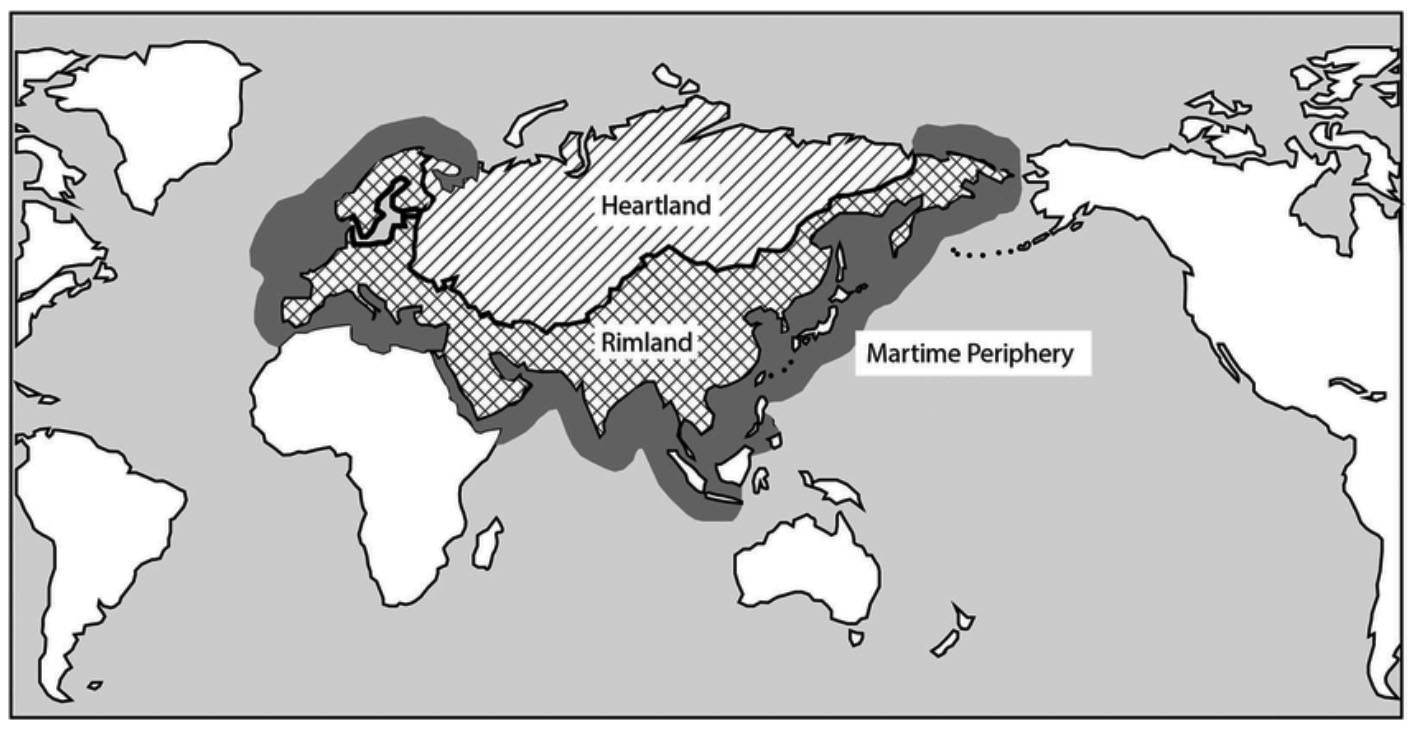
Spykman’s rendition of Mackinder’s “world island.”
The problem with this theory is twofold. For one, Brands’s expansive definition means the region encompasses nearly everything in the northern hemisphere except the Americas and sub-Saharan Africa. If that is so, the theory’s major thesis — who controls Eurasia controls the world — is circular: any one power dominating 70 per cent of the world’s population or well over a third of the world’s land area would, ipso facto, control a vast segment of the globe’s resources.
This leads to the second problem: at no point in history has any one power dominated this widely defined “Eurasia.” A contender would have to cover some fifty-five million square kilometres, or 37 per cent of the world’s land area. The three who have come closest — the Mongols, the Germans and the Soviets — were off by a large margin.
At its peak, the Mongol empire (the largest land empire in history) covered maybe twenty-four million square kilometres, or 16 per cent of the world. It did take in much, but not all, of Asia and subjugated the lands of the Rus and other parts of Eastern Europe, but it never took Vienna, let alone lands further to the west. The British Empire — a maritime, non-Eurasian affair — was considerably larger, covering nearly a quarter of the world.
Even at its largest expanse, the Third Reich was considerably smaller. It claimed only 3.3 million square kilometres, or 2 per cent of the world, taking in much of Western and central Europe as well as the Baltic states and Norway in the northeast and Ukraine and Belarus in the east. But it only ever held a small section of European Russia, and none of the vast expanse of Siberia, Central Asia and the South Caucasus.
The Soviet Union was based further to the east and covered larger sections of the Eurasia’s Asian part. The historical successor of the quite successful Russian empire, it managed to add an outer rim of satellites to the west after 1945, but at no point penetrated further into Europe or effectively controlled China or even North Korea. At its greatest extent, it covered some 22.4 million square kilometres, or about 15 per cent of the world’s land area. Adding the satellite states in Eastern Europe brings that number up a little to 23.4 million (nearly 16 per cent), similar to the Mongol empire but more to the north and west than its historically closest rival in the contest of Eurasian supremacy.
That proved a lot of territory, people, and resources for the Soviets to swallow, even with twentieth-century technology. Having indeed bitten off more than they could chew in 1945, they spat out areas they had occupied in the Asian “heartland” without trying to digest: they discarded Manchuria in 1945–46 and the northern part of Korea in 1948. In the “rimlands,” they abandoned northern Iran in 1946; in Europe, they let go their Austrian zone in 1955.
Might it be that both the dreams of German Nazis and Russian “Eurasianists” — not to mention the nightmares of Mackinder and Spykman — were always unrealistic? Is it possible to rule a region as enormous, diverse, and geographically as well as climatically challenging as “Eurasia”?
The thought that it might not be possible has crossed Brands’s mind. At the very end of his book he writes that the “history of the modern era might make one think Eurasian gambits are doomed to fail — that seeking hegemony is tantamount to committing strategic suicide. After all, from Mackinder onward, every Eurasian challenger was defeated, because every challenger provoked a pack of enemies that killed its prey.” But he dismisses such obvious conclusions as “pleasing” but “profoundly dangerous.” “Each fight for Eurasia could have gone differently,” he writes. And it was the United States that saved the day.
The second world war exemplar
Did it? Let’s take the second world war as an example. Here, Brands over-emphasises contingency in order to heighten the role of the United States. The Battle of Britain was won much less “narrowly” than he claims. German bombing caused significant damage but did not bring Britain to the brink of surrender. Germany had no amphibious invasion force able to overcome Britain’s moat, the English Channel, and then “fight on the beaches,” in Churchill’s memorable phrase.
As the leading historian of Britain’s war machine, David Edgerton, has pointed out, Britain sat at the centre of a global, seaborne economy that included the Empire and much besides. German submarine warfare never effectively interrupted the globalised network supporting Britain’s war effort. The island nation was “never alone.”
Nor was it helpless or unarmed. In the 1930s, it had been the world’s leading arms exporter. As Edgerton concluded, when Britain went to war in September 1939 it was “well-armed, united and confident of victory. It was under no immediate threat.” The bombing campaign of the Battle of Britain was “considerably less intensive, and less deadly,” than war planners had predicted.
As far as rescue by the United States is concerned, Edgerton was unequivocal: “The aggressive, defiant and powerful British Empire of 1940–41 had not been saved by the USA but rather had been spectacularly overtaken by it, not in 1940 but in 1942, in the wake of defeat in the East [that is, the fall of Singapore].”
Unable to defeat Britain, Hitler went to war against the Soviet Union, which he hoped to knock out quickly in order to appropriate its significant resources to continue the fight. This was indeed a “Eurasian” strategy: the goal was to make the Europe–Asia landmass the basis of a German bid for world power. According to Brands, it might well have succeeded: Hitler’s attack on the Soviet Union “almost worked.” That is a highly misleading interpretation, though, and his claim that “only winter and a thrown-together defence of Moscow saved Stalin’s regime” ignores the mainstream of professional historiography on this war.
War, of course, is always unpredictable. But waging war in “Eurasia” is extremely difficult, as Putin’s forces are learning the hard way. The road to Moscow was always long and winter comes every year in “Eurasia.” Moreover, the Soviet Union outmanned, out-gunned, and out-tanked the Germans from the start of the war; the Red Army fought an aggressive retreat, which cost the Germans much blood, treasure and time; the German army was largely horse-drawn; and throughout the war the Soviets outproduced their enemy in all classes of weaponry. The margin for German victory was extremely narrow.
Brands instead focuses on the role of American aid (“lend-lease”). Like many American historians he overestimates its significance, going as far as claiming “the United States delivered a quarter of the vehicles and much of the gas that helped Stalin’s forces defend Moscow in December 1941.”
As the standard operational history of this war points out, “Lend-Lease aid did not arrive in sufficient quantities to make the difference between defeat and victory in 1941–1942.” The vast majority of new tanks the Soviets received in late 1941 were British, not American, and while these foreign tanks did “play a role in both the defensive and offensive fighting near Moscow” (as a major archival study demonstrates) this assistance was “far from decisive.”
Hitler’s gamble of 1941 was not truly Eurasian either: it ignored the Far East of the Soviet Union as well as China. “Had Japan and Germany teamed up against the Soviet Union in 1941,” Brands writes, “the democracies might have faced a consolidated Eurasia.” But Germany and Japan did not team up, because they could not. Japan had fought, and lost, an undeclared border war with the Soviets in 1938–39, and that led the government to confront the United States instead (a fateful decision, as it turned out).
Even if a different decision had been made in Tokyo, Japan didn’t have troops available to attack the Soviets. Much of its land force had been bogged down in China since 1937. Well before the US Navy began to draw away Tokyo’s attention and resources, Stalin’s support for China’s desperate war of survival helped keep the country in the war and hence the Soviet Union’s back free from Japanese attack.
Eurasia — large and diverse as it was — could not easily be conquered, however well-armed, modernised and aggressive the attacker. Japan’s aggression, moreover, was not built on a Eurasian base but on a maritime empire surrounding the waters of the Sea of Japan, the Yellow Sea and the East China Sea. Once it was decided not to attack the Soviets, this regional empire expanded into southeast Asia as well.
Discarding the terms of an earlier era
Thus, the second world war was not a Eurasian war in any meaningful way. It was a global war, with nodes in Asia, Europe, Africa and the Pacific. In Europe, its centre of gravity was not a war between a Eurasian land power and a non-Eurasian maritime power, but a struggle between the German and Soviet land empires. Britain and the US did play a role, but it was secondary.
In the Pacific, meanwhile, it was a confrontation between two maritime powers, Japan the United States, the latter supported by Britain. None of this fits neatly into any “Eurasian” theory.
But historical accuracy is perhaps beside the point here. In its major thrust, Brands’s book is an attempt to jolt US foreign policymakers into re-embracing the idea of their country as a liberal world hegemon. To this end, Brands mobilises the old nightmare of a Eurasia dominated by a Sino-Russian axis of authoritarians. That might well be a worthy cause to fight from Baltimore or Washington, but for analysts and policymakers outside the United States this book’s “lessons of the past” are misleading: we can’t wait for the Americans to come to their senses on the assumption that history teaches us we are otherwise doomed. Instead, we need to urgently figure out how to live without them.
As we do so, we need to look at the present rather than the past. At stake today is not dominance over “Eurasia.” China is not trying to dominate that “world island” but is instead focused on East and Southeast Asia, with the South China Sea and the straight of Taiwan as centres of gravity. The alliance with Russia is of mutual benefit because it keeps both countries’ backs free: for Russia to wage war in Europe, for China to entrench itself in Asia.
The real threat is China’s growing naval power, not some combined Sino-Russian march on Warsaw, Berlin and Paris. If it takes over Taiwan, as many fear it will, its ability to project power across the Pacific will open up. That would be a problem for the United States, but it would be a fundamentally un-Eurasian challenge.
From Australia’s perspective, meanwhile, the issue is China’s attempt to build a sphere of influence in Southeast Asia, not its hypothetical potential as a “Eurasian” superpower. In both these quests China stands much more in the tradition of imperial Japan (“Asia for Asians!”) than of any of the land-powers who tried, unsuccessfully, to control Eurasia.
In building alliances to counter these threats, we need to overcome both dreams and nightmares from the cold war. The fear of a “Eurasian” superpower is one of these nightmares. And the desire for something called “the West” to serve as a counter-weight is one of these dreams.
Today, the geography of democracy is global rather than regional. Democracies still make up about half of the world’s countries and can be found in Asia, the Pacific, Africa, Europe, and the Americas. Nor are potential allies for democratic middle powers like Australia exclusively to be found in the democratic world. Many non-democratic nations share similar geopolitical interests, not least a preference for a stable international environment not dominated by a small set of uncontrollable great powers. But the geopolitical terms of the nineteenth and twentieth centuries are of little help in this quest, and are best discarded. •
The West: The History of an Idea
By Georgios Varouxakis | Princeton University Press | $69.99 | 512 pages
The Eurasian Century
By Hal Brands | W.W. Norton | $49.99 | 320 pages