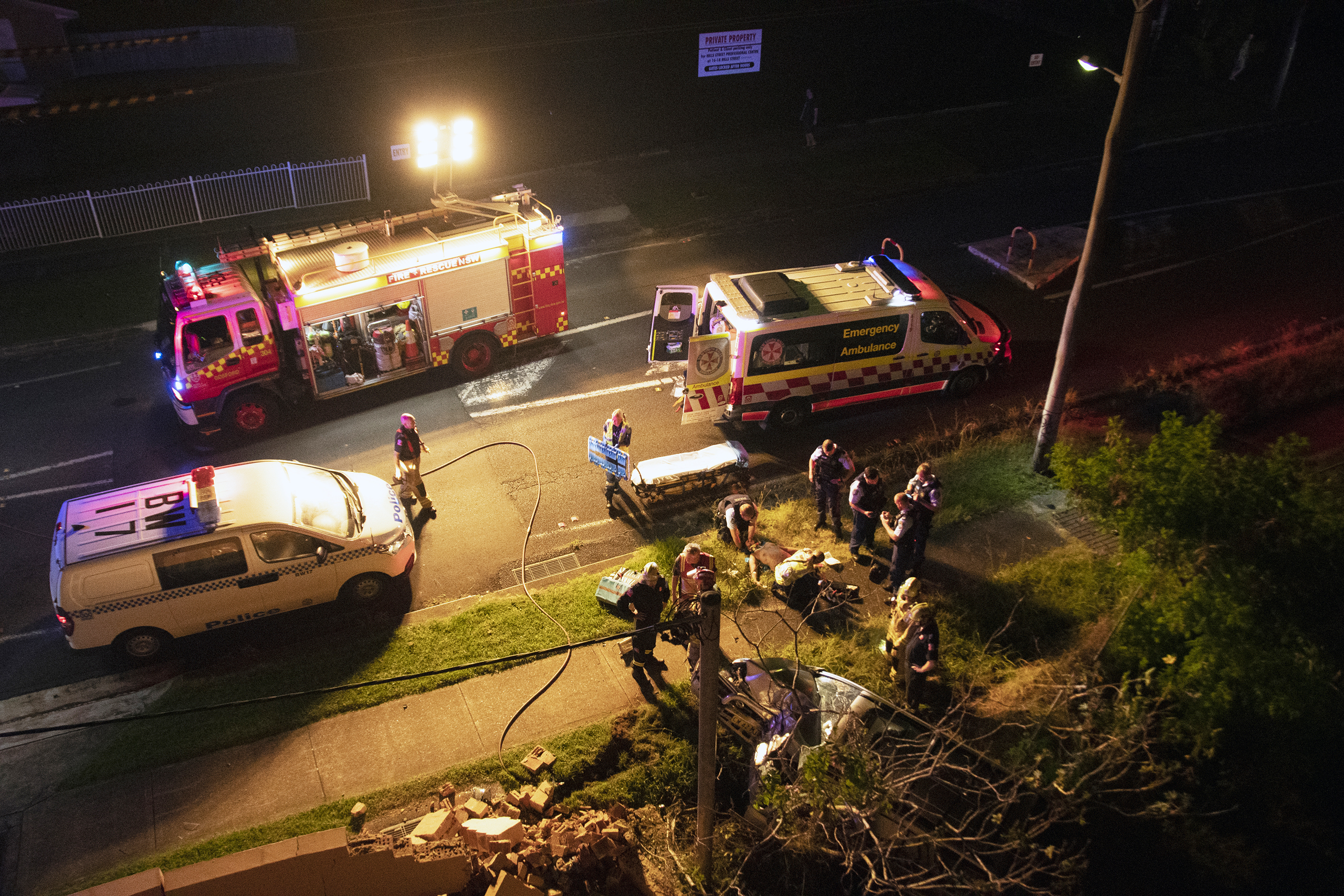
Occasionally, in the land of general practice, a patient in extremis walks through the door clutching their chest or bent double with abdominal pain. Very soon you’re dialling triple zero, and while you’re attaching the oxygen mask and inserting an intravenous line your ears are already straining for the sound of an ambulance siren drawing every nearer. As a GP, I was always relieved to see the paramedics in their no-nonsense blue uniforms and sturdy boots, shouldering the hefty bags that held remedies for every possible threat to life.
Without exception, these paramedics were steady and calmly spoken, intimidatingly so, and I was on my best behaviour, medically speaking. Sensing their intolerance of indecision, I stood aside as they scanned the ECG printout and replaced the cannula I’d already inserted with another, wider-gauged and better-sited.
Paramedics, as we generalists know, excel at emergencies. While our bread and butter are context and chronicity, the ambos know exactly what to do in a crisis. Shattered bones, massive blood loss, cardiac arrest: these devastations of the human body are their undisputed territory from the time of the triple zero call until the handover in the emergency department.
In Sirens, a delicately wrought work of creative non-fiction, writer Martin McKenzie-Murray goes beyond the steely professional front of first responders to examine the toll such a career can exact. His subjects are three admirable and articulate individuals: Peter, a paramedic; Brett, a copper; and Tara, a firie. While the reader learns of what can only be described as acts of heroism — delivering and resuscitating a preterm infant aboard a light plane; tackling an armed assailant on a staircase; working the dispatch phones during the Black Saturday bushfires — McKenzie-Murray also sensitively explores the antecedents and downstream effects of choosing a job that’s, on a bad day, akin to being in a war zone.
These days we’re generally cognisant of the concept of trauma and its aftermath, PTSD. These terms have become common parlance; too common, perhaps. I worry about our increasing tendency to label life’s daily trials and disappointments — a less-than-glowing performance review, an altercation with someone in customer service — as “traumatic.” Surely we run the risk of rendering the word meaningless through overuse.
That Peter, Brett and Tara were for many years unaware of the extent of their own, very real PTSD is one of the saddest ironies of emergency work: that is, to do the job of saving others from fire and gunshot, first responders must risk harm to themselves. Physical harm, yes, but that will be attended to while the psychic harm might be pushed aside in the struggle to get up the next day and save others all over again.
Peter James had a long and distinguished career as a paramedic in Tasmania, on duty for two of the most unforgettable and psychologically potent events in recent Tasmanian history: the Port Arthur massacre and the Beaconsfield mine disaster. The scene at Port Arthur’s Broad Arrow cafe that day is recreated for the reader through Peter’s altered senses: the magical stillness, the inability to hear others speak or to feel his own breath, the room seemingly sucked empty of air. “Just know that the man who goes in there will not be the same man who comes out,” a police officer said grimly just before Peter stepped inside. “Never was a truer word spoken,” Peter tells us.
When the Beaconsfield mine collapsed, he was assigned to a small team of paramedics who supported the two trapped miners, Todd Russell and Brant Webb. All the world remembers the footage of their triumphant release two weeks later, rising from their wheelchairs as they emerged to fist pump the night air. What’s seared into Peter’s memory is the fortnight deep underground, teaching the two men over the phone how to dress their wounds and self-inject anticoagulant supplied to them via a narrow borehole drilled through rock. He worked twelve-to-sixteen-hour shifts, talking to the trapped men about the outside world, playing their favourite music, all the while responsible for their physical and moral health, treading the tightrope between hope and honesty. Against all odds Russell and Webb survived, and Beaconsfield remains one of Peter’s better memories.
With the skill of a therapist and the fine prose of the award-winning writer that he is, McKenzie-Murray weaves the adverse childhood experiences of each of his subjects into the fabric of their working lives. It seems, he suggests, that those who know violence and loss at an early age might yearn for a sense of control and security in work that is helpful and worthy with clear protocols and lines of command. Peter’s first childhood blow was the divorce of his parents when he was ten was, “an early lesson in the impermanence of things.” Then, five years later, his grandfather was brutally murdered on his way home. The killer was never found, and the murder, just like Peter’s parents’ divorce, was never again discussed. Just two years later, he was a trainee paramedic.
Of this, McKenzie-Murray writes with quiet devastation: “One of Peter’s first jobs was driving to the midwifery home for single mothers on Monday mornings to collect the gauze-wrapped bodies of stillborn babies and place them in cardboard boxes once used to pack margarine.” Peter was seventeen, unaware that this was “his first moral injury… the first time that the virgin smoothness of his values — in this case, respect for the dead — met the coarseness of reality.”
Such psychic blows are cumulative. Peter describes them as photographs taken by the brain, images that can be recalled as clear as day. Over his lifetime his brain has recorded thousands. Once tall, lithe and Clint Eastwood-esque, he’s now shuffling and stooped, very nearly a recluse, “his confidence and physical charisma long dissolved in the acid bath of trauma.” Retired in 2019 with an official medical declaration of incapacity, he has undergone multiple courses of ECT and countless hours of psychotherapy, and still takes clonidine to dull his PTSD-induced nightmares.
Brett Kersten’s childhood reads like something from the bleakest of Dicken’s novels: family violence, vagrancy and neglect, an alcoholic father, a mother who up and left with Brett’s little sister, and ultimately, alongside his younger brother, years of deprivation and abuse in a Christian Brother’s orphanage. How does a child survive such an upbringing? What sense does he make of it?
Current neuropsychology teaches us that a childhood of this sort shapes the brain circuitry in lasting ways. Constant exposure to threat and the stark absence or inconsistency of attachment figures can lead to compromised executive functioning, high or low emotional responsiveness, difficulty with attention and memory, increased reactivity to sensory stimuli and disruptions to sleep and other circadian rhythms.
Brett was physically strong, a leader of the orphanage pack, his physical prowess only as current as the last fight he won. Understandably, he later found a home in the tough, hierarchical environment of the army. He loved the hazing he received from a bullying sergeant, seeing it as part of how the army made soldiers strong by breaking them down before building them up again. “But whereas the orphanage’s cruelty had felt senseless,” McKenzie-Murray notes, “in the army he could glimpse the brutality’s purpose. It was making him a soldier, and he was making a self…”
And in the police force, too, he found a sense of purpose and order, a binary assignment of good and bad. He hated the drug users who passed out on the St Kilda backstreets only to spit in his face when they came to. Perhaps some of them had lived childhoods like his, but Brett’s strict moral code prevented compassion. Brett “talks about ‘compassion’ and ‘professionalism’ as two different, incompatible things — compassion is a weakness that can have terrible consequences,” McKenzie-Murray writes. He adds, “For Brett, compassion is a curiously charged and dangerous bipolar impulse, simultaneously holding the potential for love and injury.”
Brett was retired on medical grounds — major depression and PTSD — in 2009, years after his symptoms first emerged. But he still craves purpose, and a role in public life that feeds his self-esteem and identity. He speaks at RSL clubs and talks ex-cops down from the ledge with a sympathetic ear and endless cups of tea. Twice-divorced and alone, he “continues to hold his hand to the flame.”
Tara Lal, a physiotherapist turned firie, lost her mother to cancer when she was thirteen. Her father, incapacitated by severe depression, became her charge instead of her carer. This role reversal and Tara’s father’s inability to support her in her grief “left her a lifetime of guilty oscillations between anger and sympathy.” Then, some years later, her bright, sensitive older brother committed suicide.
Tara says of this litany of loss, “I didn’t think the world was safe. [I thought] that people could die at any time… and so I wanted things to be black and white, right and wrong, which is quite a normal response to trauma.” While her time as a firefighter provided camaraderie and the occasional brittle sense of achievement, she was continually plagued with guilt, shame and self-doubt.
But her response to her situation was different from Peter’s or Brett’s. She sought psychological help before medical retirement was forced upon her. And she enrolled in a PhD for which she interviewed firefighters about their experiences of suicide. This scholarly inquiry into the emotional pain of her peers afforded her new insights and a measure of catharsis.
While, Tara, too, has now retired, she left on her own terms. Her story, the last of the three, while coloured with personal loss and disappointment — not least in the institutional culture of the fire service — is also more hopeful. Of her retirement, McKenzie-Murray writes, “She now saw the blankness of her future not as an abyss but a clear canvas… She could now, as she told me, sit with the irresolution of things.”
To interview such wounded people about the darkest moments of their life and to recreate these narratives with tenderness and empathy requires a certain type of listener and writer. McKenzie-Murray is the person for the job, in part because of his own experience of trauma. As he writes, “my own diagnosis of PTSD came years after I began work on this book. After years of hearing about the symptoms of others it became harder to deny my own.”
It’s not hard to imagine why he was drawn to write this book, and why in the past he’s written true crime and worked as an adviser to the chief commissioner of Victoria Police. Unacknowledged and untreated trauma can take many paths in its rise to the surface. A double meaning of the book’s title presents itself: perhaps proximity to the trauma of others is a siren song for those who’ve suffered something similar but haven’t yet understood how to process it.
And finally, a gentle warning here: the subject matter of Sirens is undeniably grizzly. But in the hands of a writer as good as McKenzie-Murray it transforms into something necessary and deeply human. He imbues his subject’s lives with dignity and understanding, leaving the reader with immense gratitude for their bravery and dedication, and a clearer understanding of the personal cost of their work. •
Sirens: Inside the Shadow World of First Responders
By Martin McKenzie-Murray | Black Inc. | $34.99 | 240 pages