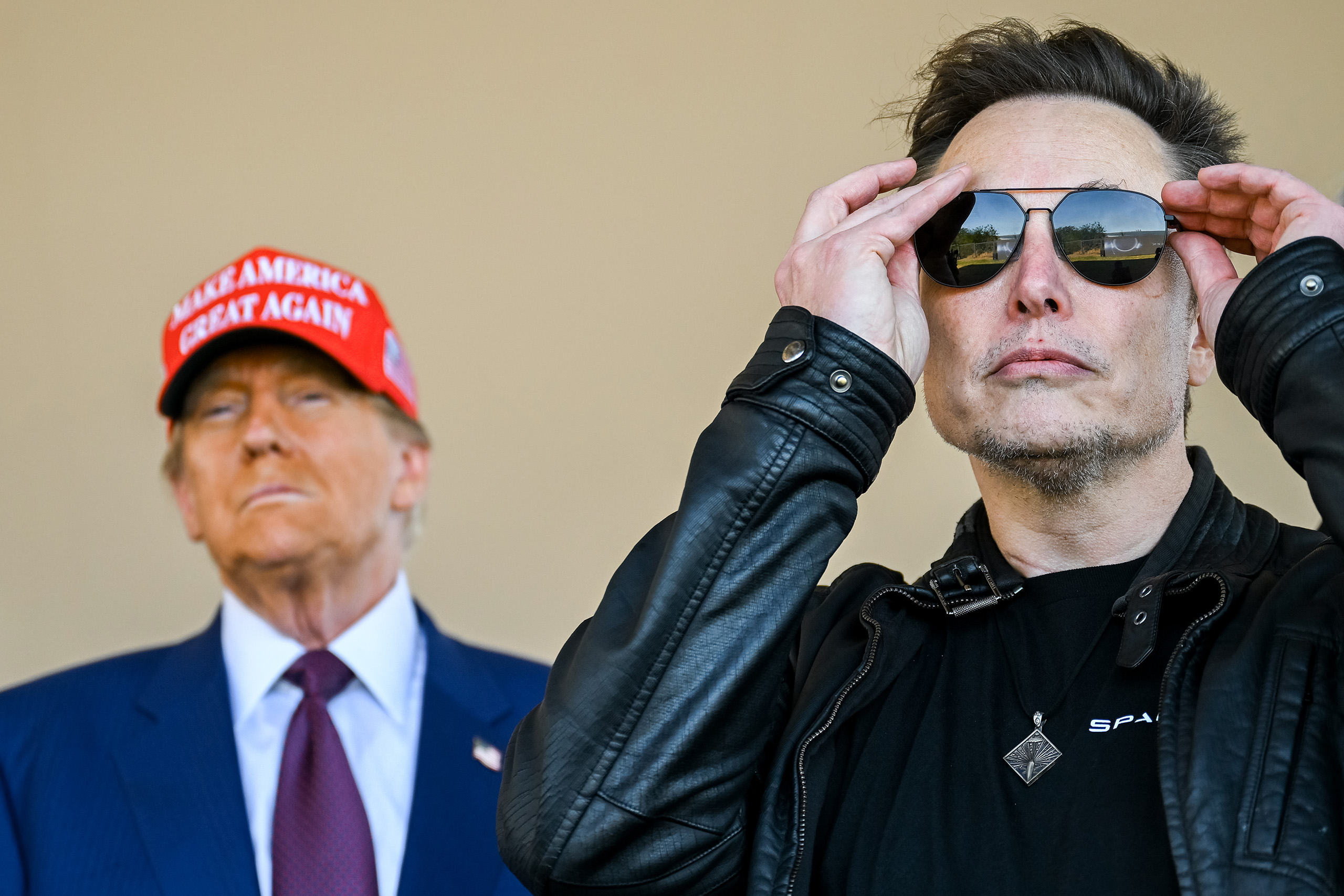
Elon Musk doesn’t just mark these times, he has helped to make them. The world’s richest person, the recent architect of the largest share float in history, he has worked against the grain of accepted commercial wisdom in many ways.
In Muskism, a remarkable new book about this man and this moment, Quinn Slobodian and Ben Tarnoff show how Musk chose to make stuff — rockets, cars, batteries — at a time when the future was supposed to be virtual. His companies make a lot of it themselves, vertically integrating, centralising, bringing activities in-house long ago, when the fashion in manufacturing was still for radically dispersed supply chains. He has made stuff in America, “re-shoring before it was cool.” Unlike most business leaders who “speak at the internet,” Musk “speaks with it” say Slobodian and Tarnoff, generating power from his “willingness to enter into a medium as a peer, to play the game alongside others.”
The times are suiting him. People have lost trust in institutions like governments and mainstream media, and that breakdown brings commercial opportunities. Borders are hardening: in a “fragmented, paranoid, militarised world,” some nation states speak as much of resilience and self-reliance as they do of cooperation and integration. Migration and humanitarianism are being attacked everywhere. A political and business elite preaching “techno-maximalism” finds “every occasion to digitise our lives more deeply.” The planet keeps getting warmer.
Slobodian and Tarnoff’s moniker, Muskism, tilts to the “Fordism” that emerged from one businessman, Henry Ford, and “became a shorthand for twentieth-century capitalism.” The two authors — one an international historian, the other a tech reporter — set out to explore “how [Musk’s] improvisations, magnified by financial cycles and geopolitical crises,” crystallised into “a possible operating system for the twenty-first century.” The first half of the book identifies Muskism’s four “pillars”; the second half examines its evolution over the last decade as Musk got deeply into social media, shifted decisively to the political right, and became “the highly visible indicator species for the consequences of fusing the economy ever more tightly with the digital world.”
Pillar One is apartheid South Africa, where Musk spent his childhood, a fortress of technology, surveillance, personal data and racial exclusion that repelled the world and ultimately failed in its country of origin but migrated with Musk, “like a spore in his luggage,” first to Canada and then to the United States. Settling in Silicon Valley in the mid 1990s, Muskism located Pillar Two. Some internet pioneers dreamt of escaping the state. Musk was interested in “grafting onto it,” specifically its free GPS data, its stable financial system, and the internet itself, developed within a state agency.
When, from late 2001, the War on Terror encouraged the US military to try to draw private industrial dynamism deeper into hardware design and production, Musk founded SpaceX. It would build rockets and launch them for all-comers at cheaper rates, operating like a Silicon Valley startup rather than a traditional aerospace titan, turning “a country thing” into “a company thing.” Later it sent up a constellation of thousands of small, low earth orbiting, or LEO, satellites that would enable faster, cheaper communications services to be delivered, in theory, to anyone, anywhere on earth. This would be “a global platform for national projects,” a purveyor of new forms of resilience for nation states, military forces, government agencies, commercial and other enterprises and individuals, what Slobodian and Tarnoff call “sovereignty as a service.” Here was Muskism’s third pillar.
Pillar Four is autonomy, Tesla’s mission, to liberate drivers from their carbon footprints and their driving, households from power grids, and the United States from its dependence on energy from overseas.
Musk talks of “symbiotes” and Muskism breeds two kinds. The first melds people and machines, the second Musk’s companies and the state. Initially troubled by the rogue potential of artificial intelligence, Musk came to see the solution in more, not less, technology, an even deeper fusion of humans, equipment and code. Fusing himself with the state briefly at the start of Donald Trump’s second term, Musk found the “cyborg logic of optimisation” did not “scale into a social contract,” although the tools he brought stayed in the “toolkit available to those who govern.”
Moving on quickly from that moment of personal overreach, Musk restructured the public private symbiote SpaceX, cemented his own control of it, vastly expanded its mission to encompass artificial intelligence and data-centres-in-space, and sold a sliver of shares for an unimaginable fortune that can be deployed more or less as Muskism dictates.
SpaceX already sells sovereignty to Australia through services supplied by its Starlink division. “Designed, owned and operated by SpaceX,” Starlink’s network of LEO satellites began delivering commercial internet services to government, commercial and residential customers in 2021. Australia is now one of more than 160 countries where services are available.
The Western Australian Police Force claimed to be the first law enforcement agency in the world to integrate LEO satellite technology into its communication network in 2023 when it committed to equipping 550 vehicles and more than a hundred regional police stations. Australian Navy ships are using Starlink access to create an “unclassified welfare network” that helps sailors at sea to stay in touch with their families. Starlink services are one of several back-ups in the Australian Electoral Commission’s contract with Telstra that helped to communicate encrypted results for the 2025 federal election quickly and securely. The NSW Rural Fire Service is installing Starlink units in 5000 rural fire vehicles as backup if local towers or other infrastructure are damaged during disasters.
FIFO workers at Rio Tinto’s Pilbara mine sites now access high-speed broadband on the buses that take them to and from work, supplied through a partnership with Vocus that integrates the Starlink service. Singapore Airlines announced in May that Starlink’s Aero Terminal would be installed on Airbus A350-900 and A380 aircraft to enhance in-flight wi-fi.
Retail broadband customers are also signing up either directly or through Starlink plans offered by local providers — “From space to your place: Telstra Satellite Internet, Powered by Starlink.” A recent Singapore Space Agency analysis estimated that Starlink had around 220,000 to 250,000 Australian residential subscribers in rural and peri-urban areas at the end of 2025 and perhaps 350,000 Australian customers in total: the rest were commercial mining, maritime, agriculture, construction and aviation enterprises, plus government and emergency service organisations. Globally, Starlink reported 10.3 million subscribers at the end of March 2026, more than double the figure a year earlier.
A dedicated Starlink satellite receiving kit, currently costing $549, is required for these retail services. In June 2025, Telstra launched “direct-to-device” messaging, which allows Telstra customers with recent Samsung Galaxy phones or iPhones and “up-front” mobile plans to send or receive text messages via Starlink’s satellites when they are outside the range of terrestrial mobile networks. No separate equipment is needed.
These capabilities are completely transforming connectivity and consumer choices in rural and remote areas, allowing the federal government to propose a significant expansion of the basic standard of telecommunications available to all, a Universal Outdoor Mobile Obligation, currently before parliament. “This is a world-first policy,” says the National Farmers Federation. “If we get it right, Australia becomes the gold standard for regional communications.”
Federal government trials of voice services in fifty regional and remote locations between November 2024 and July 2025 confirmed anecdotal evidence that Starlink was outclassing the government-supported NBN Co’s satellite service on most metrics. NBN Co was created by the Rudd government in 2009 to deliver fibre broadband to most Australian households and businesses and fixed wireless or satellite to the rest.
A decade before Starlink began commercial services, NBN Co commissioned its own two Sky Muster “GEO” satellites, operating in geo-stationary orbits much higher than LEOs. Due to reach the end of their lives in 2032, those satellites are bleeding users to Starlink (and some to its own improved fixed wireless services). NBN Co announced a new partnership in August last year to deliver high-speed broadband via a LEO constellation to the more than 300,000 premises that it currently aims to serve via Sky Muster. What surprised some observers was that NBN Co did not choose Starlink. Instead, it will work with the system being launched by another US-based tech giant, Amazon LEO (formerly Project Kuiper). It was due to commence services in mid-2026.
The Singapore Space Agency analysis explains that NBN Co had several options, none perfect. It could not commission new GEO satellites because of relative performance and it could not build its own LEO constellation because of the cost. It had to deal with a commercial LEO operator. Starlink already had thousands of satellites in orbit, several years of operating history, lots of Australian customers and proven technical performance. But three other factors are said to have tipped NBN Co’s decision towards Amazon.
First, “concentration risk,” a desire to reduce the future leverage available to a dominant operator like Starlink. Second, government-owned NBN Co is a wholesale provider of broadband capacity to retail service providers. This DNA meshes with Amazon LEO, which is structuring its business as a wholesale and institutional provider. Starlink sells retail services direct to consumers as well, an unacceptable conflict for NBN Co. Third, Amazon LEO brings smoother and more secure integration with the company’s cloud provider, Amazon Web Services, which is widely used by Australian governments and enterprises.
Sovereignty in the era of LEO satellites turns out to have multiple dimensions and Elon Musk is not the only one trying to sell it. Beyond Starlink and Amazon LEO, other LEO systems are in various stages of deployment, including China’s two.
It is also fiendishly difficult to deliver. Amazon LEO’s — and hence NBN Co’s — timeline now appears unrealistic after the explosion of a “Blue Origin” rocket in late May damaged a launch pad at Cape Canaveral. Blue Origin is the aerospace company created by Amazon founder Jeff Bezos, separate from Amazon and its web services and LEO divisions. Reuters reported Amazon LEO is already relying on other launchers, including SpaceX, but was counting on the damaged facility to deploy half of its more than 3200 broadband satellites by July 2026 to meet US regulatory deadlines. “An extended grounding [of Blue Origin] by the Federal Aviation Administration will severely threaten the timeline,” reported the news agency.
Muskism should be on every reading list for students of contemporary politics, economics, business and media. It is clear, incisive and short, and the links to implications for Australia are numerous. The authors are deeply engaged but coolly observant. They judge but they do not preach. Musk’s odious personal behaviour is everywhere, but it is not the story: readers get biographical detail, not a biography. Published before the extraordinary SpaceX initial public offering in June, the work has stood up well to this extreme stress-test.
“The magic trick of the founder was to stand on a stage built by the state and pull the future out of a hat,” they write. That seems a little too much, because all entrepreneurs in capitalist societies stand on stages built partly by their governments. Henry Ford’s cars drove on roads his company didn’t build. In communications, especially in Australia, colonial and later national governments were always big players and remain so.
But Slobodian and Tarnoff understand well that what is distinctive about this era is the particular configurations of private and public power that Elon Musk, this man at this moment, is exploiting and shaping. “Sovereignty as a service,” the retailing of resilience in rough times, is their potent summing-up of the relationship between Musk’s companies and nation states, between his corporate and political aspirations.
Muskism is also a major contribution to debates among scholars and policy-makers over notions of “digital sovereignty.” The Singapore Space Agency’s analysis cited above poses a pragmatic question for nation states in the era of LEO satellites: “How much sovereign space capability is enough?”
Sovereignty is always complicated and rarely absolute. Nation states, especially small ones, craft ingenious arrangements to try to get as much of it as they can. They need partners, alliances. Arrangements have to be adapted, sometimes totally overhauled, as emerging technologies bring distinctive capabilities, new constraints and surprising economics, and with them fresh possibilities and demands.
When messages travelled with human beings and in envelopes and packages, Australian governments had to cut deals with global shipping companies to get the mail through. Australians were first connected to a global electronic telecommunications network not just through an overland line between Adelaide and Darwin, celebrated as a milestone of nation-building, but via a submarine cable it met at Darwin that continued on to London and the world, a cable built, owned and operated by “Eastern Extension,” a subsidiary of one of the first and most powerful, ruthless multinational corporations of the nineteenth and early-twentieth centuries.
Sometimes, a little bit of sovereignty has to go a long way. •
Muskism: A Guide for the Perplexed
By Quinn Slobodian and Ben Tarnoff | Allen Lane | $59.99 | 242 pages