The relationship of people to Australia’s environment has been a key interest of scholars and a founding rationale for scientific and cultural institutions for much of the past two centuries. Investigated by a diverse range of disciplines, framed by changing imperial, national, and ecological outlooks, the topic was a central concern of colonial museum-making, and underpinned establishment of Commonwealth organisations including the CSIRO and the Australian Institute of Tropical Medicine. “People and the Environment” was one of the Museum of Australia’s three organising themes when it was established in 1980.
The topic has also evolved in the published scholarship. For example, the focus of historian Russel Ward’s 1977 A Nation for a Continent (the title snipped from a Federation campaign speech by Edmund Barton) was neatly flipped by environmental historian Libby Robin’s 2007 book How a Continent Created a Nation. Robin advanced the transdisciplinary dialogue between science and history that is central to Billy Griffiths, Larissa Behrendt and Sean Ulm’s new book, The First Inventors: How People Shaped a Continent. As the subtitle indicates, though, the central focus here is on culture rather than the environment.
The book’s immense temporal and spatial reach is organised by chapters focused on journeying, food gathering, landscape management and social organisation. In each, the authors synthesise archaeological evidence, computer modelling and the Indigenous knowledge and cultural memory encoded in song and story to document human flourishing in diverse and changing landscapes.
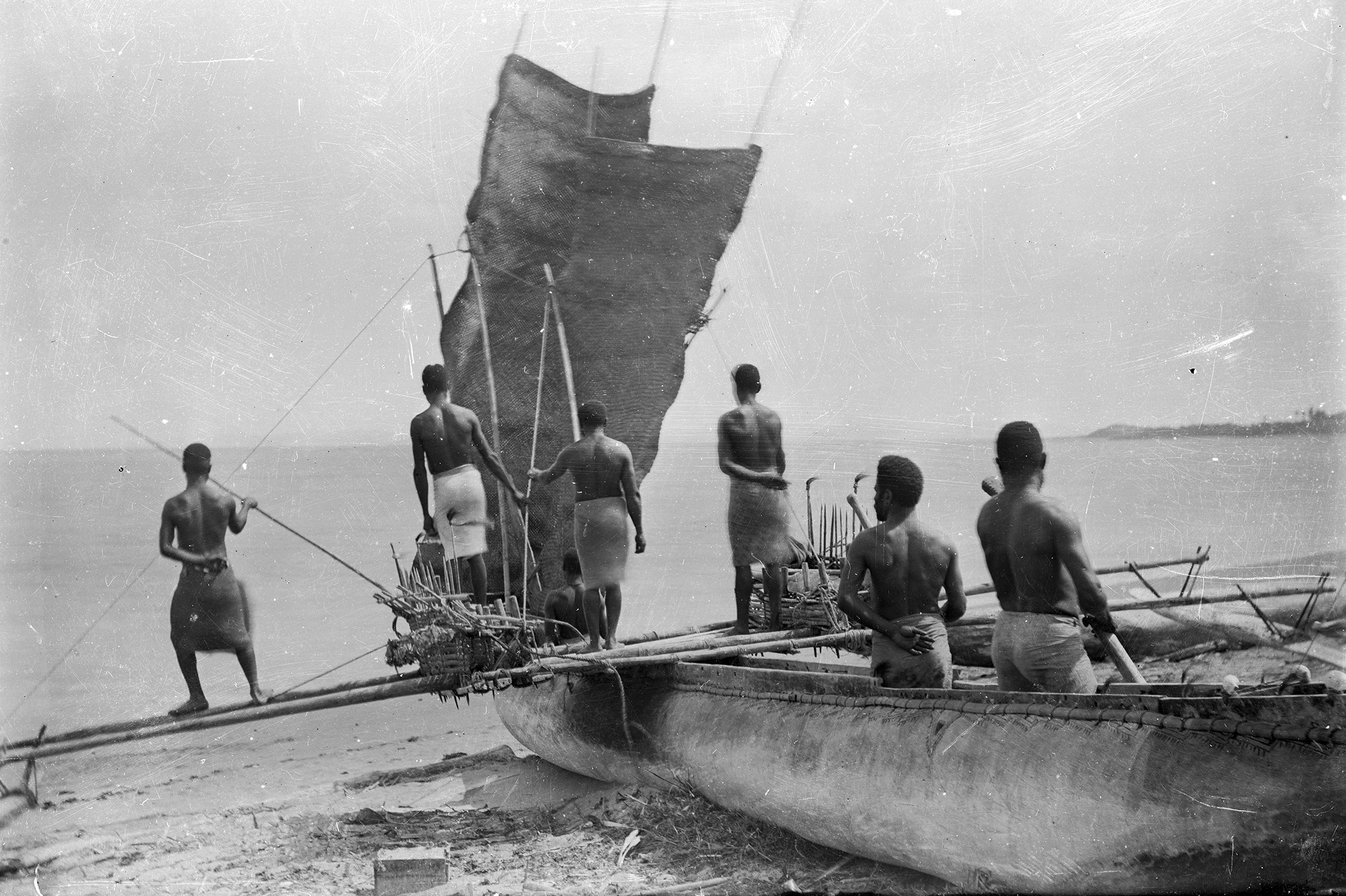
Like the television series of the same name, which screened in 2023, The First Inventors begins with the peopling of the Australian continent around 65,000 years ago. The Australian landmass, a third larger than today, was part of the Sahul region that included New Guinea and eventually Tasmania. Crossing between Timor and the Kimberley coast, one of the first settlement routes, required watercraft and navigation techniques suitable for over-the-horizon voyaging. This was, the authors contend, the longest sea journey yet undertaken by humans. Several centuries of two-way journeys suggest purposeful rather than accidental settlement, and left an archaeological record that the authors believe provides the first evidence of modern human behaviour.
Much of that evidence was submerged by a sea level rise, eventually reaching some 130 metres following the last glacial maximum around 21,000 years ago. The first humans settled along coastal fringes like those of Timor and Sulawesi, but movement inland — the speed and spread of which has long been underestimated, according to new modelling — required adaptation to hotter, drier environments, and to country that had evolved to burn.
Across the continent, developments in aquaculture, astronomy and pharmaceuticals came through observation, experimentation and evaluation, the hallmarks of science. Archaeological evidence shows the development of hafted axes suited to the dominant eucalypt hardwoods. Maps were encoded in song and story to guide navigation and help locate food and water sources. Fire was repurposed for landscape management, with cool season burns facilitating hunting while preserving local ecologies.
Present-day dating techniques, computer modelling and simulation have produced new evidence of occupation and adaptation that frequently overlays and supports traditional knowledge embedded in stories, songs and cultural memory. “We come to these ancient oral accounts with a healthy scepticism, as well as a deep regard for Indigenous knowledge of Country,” conclude the authors, “and we are persuaded of their veracity by the sheer volume and variety of narratives, both across the continent and within specific stories.”
Describing the earliest Indigenous occupants as inventors might seem implausible to some. The authors tackle this head on, subverting a romantic trope of the inventor as a solitary genius to argue for understanding “invention” at landscape scale, adapted and nurtured across countless generations.
The myth of European exploration and discovery, too, is debunked in the book’s discussion of the songlines and long-distance navigation trails, some stretching across the continent, that facilitated food gathering and cultural diplomacy. European explorers frequently relied on Indigenous guides or followed established tracks, as do many present-day roads. Blaxland, Wentworth and Lawson completed their celebrated crossing of the Blue Mountains in 1813 by trailing a short distance behind an advance Indigenous party.
Yet a colonial mindset lingers. The material evidence of early settlement and trade located by underwater archaeology is unrecognised and unprotected by maritime heritage legislation. Australia is not party to the 2001 UNESCO Convention on the Protection of Underwater Cultural Heritage. Australia’s Underwater Cultural Heritage Act of 2018, the authors assert, prioritises the protection of shipwrecks and submerged aircraft. Conversely, the nomination of the Budj Bim cultural landscape in southwest Victoria, with its network of kooyang (eel) traps, was Australia’s first community-nominated accession to UNESCO’s world heritage list. The chapter featuring Budj Bim shows the capacity of new remote sensing technologies to accurately map the extent and sophistication of Gunditjmara aquaculture in this region.
More encouragingly, settler-colonial perceptions of fire as an alien force and deadly threat is giving way to an appreciation of cultural burning as a strategy for wildfire management.
The First Inventors does feature one figure who might more conventionally be identified as an inventor: Ngarrandjeri man David Unaipon. A chapter recounts the well-known story of Unaipon’s modified design of a sheep-shearing comb, which revolutionised productivity in the wool industry but yielded no financial benefit for its developer. But readers may be less familiar with the oppressive regulation of Unaipon’s daily life. Most of the chapter’s attention, though, is given to his design of a helicopter that applied the aerofoil principle of a boomerang. The final part of the TV series featured a delightful proof-of-concept trial of the design.
Of the three authors, Larissa Behrendt’s name is likely to be most familiar to non-academic audiences, although many may be unaware of the breadth of her activity across academia, fiction, screen and media, and in advisory roles. Larissa wrote and directed The First Inventors series.
Billy Griffiths, a research fellow at Deakin University’s Centre for Cultural Heritage and Museum Studies, enlivened the history of archaeology in Australia in his award-winning Deep Time Dreaming. The accessible, character-driven style of that book is emulated in The First Inventors.
Sean Ulm is a professor of archaeology at James Cook University whose substantial body of work focuses on the relationship of cultural and environmental change in archaeological and paleo-environmental eras. Deep knowledge of the country and longstanding relationships with Indigenous people and disciplinary colleagues come to fruition in this project.
The book, which has appeared after the documentary’s screening, provides space to expand and defend claims and arguments, grounding the project in an impressively wide scholarship. It is also candid about the limits of the archaeological record. Much of the technical innovation described in the text involved the use of fibres, which have limited chances of surviving as material evidence. Beware, say the authors, of conflating the archaeological record with what was once considered important, and which might influence later judgements of cultural advancement. The durability of stone gave rise to the trope of a stone-age people, and to anthropologist A.P. Elkin’s marginally less crude assessment that Indigenous people were parasites, dependent on what nature produced.
But the tendency to essentialise — to fall back on descriptions of timelessness and cultural uniformity — persists. Kevin Rudd’s 2007 apology, note the authors, referred to an “ancient culture.” The demand to prove the existence of native title rests on a static concept of continuity. Perhaps the strongest message of this book is its debunking of a primitivist notion that Indigenous people lived in simple harmony with their natural environment. They were — we all are — living with complex, changing and constructed environments. Successfully navigating the future, argue the authors, will need Indigenous knowledge and Western science working together. •
The First Inventors: How People Shaped a Continent
By Billy Griffiths, Larissa Behrendt and Sean Ulm | Allen & Unwin | $36.99 | 320 pages