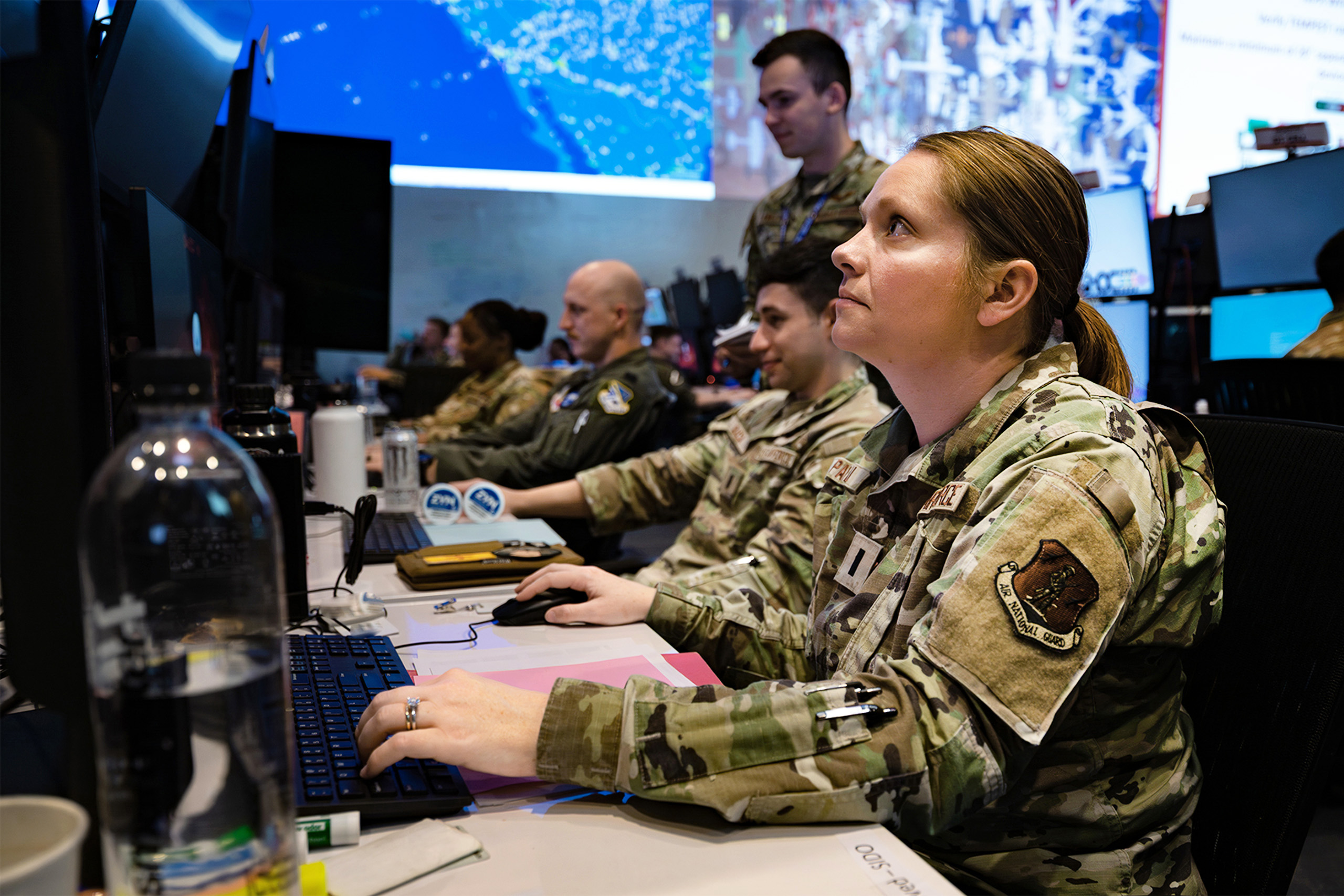
Artificial intelligence is everywhere now. And everywhere it appears, it raises questions. Artists and writers fear it will trawl their work, produce derivative products and make their creativity redundant. Courts are grappling with AI hallucinations in pleadings by unrepresented litigants and legal professionals. Even where the benefits of AI’s information-processing abilities are clear, as in medical scans, an unintended by-product is the deskilling of the humans who use its outputs. But nowhere are the questions for humanity more acute than in AI’s use in warfare, where regulation is needed both at national and international levels.
Bloomberg reporter Katrina Manson’s Project Maven tells the story of how, over the past decade, the US military has developed AI-targeting tools. Manson, an experienced technology and national security journalist, focuses primarily on the period 2016–21 and the titular project, which was led by US Marine Colonel Drew Cukor.
From the start, Cukor believed AI should be used in warfare only if two conditions were met: humans would still make the final decisions about targeting, and the laws of war would regulate AI in the same way as other methods of waging war. By the end of the book, when Manson brings the reader right up to 2026, that vision seems almost quaint.
Cukor is no longer in the US military, and nor is he associated with military research on AI. Military use of AI now includes autonomous weapons, the so-called “killer robots” deplored by human rights campaigners and condemned by UN secretary-general António Guterres. Governments seem uninterested in regulating or banning this new technology, with American defense secretary Pete Hegseth going as far as rejecting all international law–based rules of engagement in favour of a “warrior” culture.
At the heart of the debate is targeting, a key issue in international humanitarian law that regulates armed conflict. (Although many of the rules of war are set out in the Geneva Conventions and its protocols, the law is grounded in customary rules, some of which are based on centuries-long practice.) One of the first principles of contemporary customary international humanitarian law is the principle of distinction, which states that military attacks must only be directed at military targets and not at civilians. The principle may be widely accepted, but its application is often contested. Who is a civilian? How many civilian deaths (often referred to as “collateral damage”) are acceptable when armies attack a military target?
Careless or malign targeting isn’t new, of course. Manson notes American targeting failures in the pre-AI 1990s and 2000s. Proponents of AI, particularly the Mavenites, have argued that AI will reduce errors in targeting. But not all civilian casualties result from errors: even in the AI age, civilian targets are attacked, sometimes deliberately, and some countries locate civilian infrastructure near military installations in an attempt to immunise them from attack.
In the Middle East, for example, Israel has argued that Hamas uses hospitals — which international law says cannot be targeted — to conceal its operations. The Israeli military has thus targeted hospitals in Gaza, resulting in what Médecins Sans Frontières has described as a dismantling of the health system, leaving many without access to healthcare. In February 2026, the United States bombed a school in Iran, killing nearly 200 adults and children. In that case AI targeting may well have worked as intended, with the United States willing to accept a high risk of civilian casualties to hit an important military target, although recent reports suggest the databases of intelligence on Iran may have been out of date.
Manson argues that pointing to policy choices about acceptable targets and civilian casualties shifts responsibility away from the designers and users of AI. I disagree with her characterisation of the problem, largely because I don’t think these are separate exercises. Settings on AI-supported weapons and autonomous weapons result from the choices of human designers and human users.
But the story Manson tells in Project Maven begins at a different technological moment. Cukor, stationed in Afghanistan in the 2000s, despaired of the inadequacy of the technology available to him. Poor intelligence was leading to flawed identification of targets. American service personnel and civilians alike were unnecessarily killed. Cukor wanted better intelligence. Later, as he sought support to research AI use in the military, he focused on its use for intelligence rather than targeting. Nonetheless, the logical endpoint of improved intelligence was improved targeting. The Mavenites’ main goal in improving targeting was preventing loss of life among soldiers; they don’t seem to have devoted much attention to reducing civilian casualties.
Cukor and his team are the protagonists of Project Maven. But one important strand of the book is the role of the Big Tech companies. As Manson shows, Google (and particularly its employees) was initially reluctant to participate in military research. Over time, that reluctance disappeared internally rather than being overcome by Project Maven. Google and other large technology companies became part of Maven’s network of operations as they developed and tested AI tools.
More significant than this vanishing opposition is the consistent enthusiastic participation in developing AI for military use by the increasingly powerful data company Palantir. Manson’s final mention of Palantir, in the last pages of the final chapter, highlights the company’s involvement with the Israel Defence Force, or IDF, as well as the US military. While Microsoft disabled some cloud services to the IDF late last year, Manson notes, Palantir’s Alex Karp seems much more comfortable with the level of civilian deaths in IDF operations, despite Cukor’s evident discomfort with Karp’s statements.
Project Maven is structured around the three-part targeting process — “find; fix; finish” — plus a fourth section called “feedback.” There, Manson discusses ethics and accountability, including regulation of AI in weapons in international law. She occasionally refers to the Geneva Conventions or the law of armed conflict in the first three sections of the book, and some of her interviewees note that they could break military law and possibly wind up in jail if they target civilians. In the fourth section, she dives deeper into the question of regulation.
AI creates problems of accountability. If an algorithm determines what should be targeted, who is responsible? At the level of state responsibility, there is probably no difference between attributing the conduct of a soldier to the state that issues the orders and attributing the output of technology to the state that used it. When we move to the level of individual accountability, the problem is more acute.
Australia is currently discovering how difficult it is to ensure responsibility for alleged war crimes where direct person-to-person conduct is involved. But determining responsibility for targeting decisions would be even more complex. At least since the end of the second world war, “just following orders” is not a defence, so in principle doing what the AI instructed would not deflect responsibility. But it might be difficult to locate the specific human or humans ultimately responsible. If the soldier firing the weapon doesn’t have the information or the agency to challenge an AI-selected target, does responsibility shift upwards in the chain of command, and if so, where does it land?
Some of the people Manson quotes, as well as many governments, are confident that the existing law of armed conflict is adequate to regulate the use of AI for targeting. Indeed, some of them believe AI targeting already conforms with international law. That view is not universally accepted, however, even among governments, and some argue for new agreements to define acceptable use of AI. In the absence of comprehensive approach to regulation, two strands have emerged: a push to ban autonomous weapons and attempts to ensure that human soldiers retain control of AI-supported weapons. Neither seems likely to succeed in the near future.
Campaigners including Human Rights Watch’s Mary Wareham believe autonomous weapons should be banned by treaty. While Secretary-General Guterres supports an international ban on autonomous weapons, not enough governments want action. Wareham analogises efforts to ban autonomous weapons to the 1990s campaign for a treaty banning the use of landmines, which succeeded in 1997 and now numbers about three-quarters of countries as parties. But recent developments suggests that treaty is not a useful precedent for advocates of banning autonomous weapons. Ukraine and five other European states have withdrawn or declared an intention to withdraw, citing the fact that Russia is not a party and has used landmines in Ukraine.
The other strand for potential regulation of AI weaponry is a requirement for “meaningful human control.” The concept was initially proposed in 2016 by civil society group Article 36, named for Article 36 of Protocol I of the Geneva Conventions that requires governments to ensure that new weapons are consistent with international law. Article 36 presented meaningful human control as a framework requiring transparency, accurate information, opportunities for human intervention, and accountability.
Although Manson doesn’t discuss meaningful human control extensively in Project Maven, some experts, including the International Committee of the Red Cross, believe it would be a useful supplement to existing rules. The threshold requirement for the legal use of AI in targeting would be that the human soldier retains control over the decision to use the weapon. It is impossible to define meaningful human control exhaustively, but based on Article 36’s framework it means more than human decision-making as a backup for automated targeting.
Possibly the best we can expect is for governments to agree on some red lines for AI use overing cases where human decision-making is obviously absent, for example, or is too insignificant to the process. Nonetheless, like a ban on autonomous weapons, any agreement to subject military AI to meaningful human control seems unlikely at present. Unsurprisingly, in submissions to a UN report on military use of AI published in 2025, none of the three key members of the UN Security Council — the United States, China and Russia — advocated new regulation based on meaningful human control of AI use.
Without rules specifically banning autonomous weapons or regulating AI targeting, governments can only fall back on the existing law of armed conflict, including the principle of distinction, with all the uncertainty within those rules.
As the reader progresses through Project Maven, Manson’s concern about regulation and accountability becomes more evident. She seems to regard Cukor and at least most of the Mavenites as good-faith advocates of AI that supports rather than replaces human judgements about targeting. But developments after Cukor’s departure, particularly in the second Trump administration, raise doubts both for Manson and for Cukor himself. The question now is whether regulation under international law can catch up, even as some commentators declare the death of international law.
One final reflection: the back cover of Project Maven includes eight enthusiastic endorsements. Most reveal as much about the authors of the endorsers as they do about the book itself. Some liken the book to a gripping thriller; others see it as a warning about the dangers of AI. I would instead characterise it as a book of reportage, based on extensive research and interviewing, as well as years of experience reporting on the role of technology in security.
Unlike a thriller or a polemic, this book requires close attention from the reader but repays that attention with a detailed and insightful account of how we got here and where the technology might take us. Ironically, one of the by-products of the ubiquity of AI, the increased use of AI-generated news stories to replace human journalists, means that we may have less reporting of this quality in the future. Appreciate this book while you can. •
Project Maven: A Marine Colonel, His Team and the Dawn of AI Warfare
By Katrina Manson | W.W. Norton & Company | $52.95 | 406 pages