On 24 November this year Laos reaches a milestone more than two decades in the making. The UN General Assembly will formally graduate the country from the ranks of the world’s Least Developed Countries, or LDCs. Only eight countries have ever made the transition out of LDC, and Laos has the added distinction of graduating ahead of fellow ASEAN countries Cambodia, Myanmar and Timor-Leste.
LDC status is determined according to three measures: per capita income, a Human Assets Index of health and education, and an Economic and Vulnerability Index. LDCs receive special support to overcome severe structural impediments to development. Of the world’s forty-four LDCs, eight are in Asia.
Laos will lose that special assistance when it graduates, but by its own reckoning — and that of the UN Committee for Development Policy — that won’t matter greatly. The country has made only limited use of LDC-specific trade preferences and international support measures, so the practical consequences of their loss will be modest. There are warning signs for the country, however, in the policies its government has pursued in its quest to shake off the LDC label.
Large-scale infrastructure projects, resource extraction and agribusiness have been at the core of the country’s development model. The government has marketed its hydropower dams under the “Battery of Southeast Asia” strategy; built transnational highways and railways to “landlink” the landlocked country; touted special economic zones as a way of transforming transport routes into “economic corridors”; and encouraged cash-crop plantations and speculative real estate investments that “turn land into capital.”
A relentless quest for foreign investment has been accompanied by reduced poverty and improved human development. The good news is that economic growth averaged 6.8 per cent between 1990 and 2019, though it crashed to 0.5 per cent in 2020 following the Covid-19 pandemic before rising to 4.5 per cent in 2025. The national poverty rate fell from 46 per cent in 1993 to 18.3 per cent in 2019.
But while Laos’s score on the UN’s Human Development Index also improved, it still ranks 139th of 193 countries — well below the East Asian and Pacific regional average. Factor in a sharp increase in inequality and the picture worsens. And even before the Covid-influenced crash the country’s annual economic growth figure had been on a consistent downward trajectory since 2013.
In the polite language used by diplomats and international development banks — Laos’s efforts to graduate from LDC status has come with many “trade-offs.” At the micro-scale, these have been felt in a multitude of ways, often falling most heavily on the poorest and most vulnerable: farming families displaced by dams and other infrastructure projects, trafficking victims held in forced labour within special economic zones, households squeezed between currency collapse, inflation and stagnant wages.
Perhaps the clearest evidence of the costs of growth, however, is government debt. Laos’s public and publicly guaranteed debt-to-GDP ratio peaked at around 116 per cent at the end of 2022 — among the highest in the Global South — before falling to roughly 82 per cent by the end of 2025. The IMF’s February 2026 assessment still classifies Laos as being in debt distress, with both solvency and liquidity indicators sitting well above the thresholds considered sustainable.
As a result, Laos has been paying an average of roughly US$1.2 billion a year in debt service since 2022, a figure that exceeds its combined spending on health and education. Roughly half of the country’s external debt — which has been used mainly to finance hydropower dams offering limited employment or livelihood opportunities — is owed to China. The value of the country’s currency, the kip, collapsed from around 9000 to the US dollar in mid-2020 to more than 21,500 by October last year, driving inflation to more than 31 per cent in 2023, a figure that only fell to single digits after aggressive monetary tightening through 2025. Cost of living pressures grew accordingly, and social discontent intensified.
One casualty of the debt burden has been a loss of control over key national assets. Électricité du Laos, the state utility responsible for much of the country’s dam-building borrowings, accumulated liabilities of roughly US$8 billion by 2020. Facing a possible default, the government ceded a twenty-five-year concession over its high-voltage transmission grid to China Southern Power Grid, which holds a reported 90 per cent stake in the resulting joint venture. That might have eased the financial strain in the short-term, but it also handed significant ownership of a strategic national asset to a Chinese state-owned enterprise that now has effective control of Laos’s electricity exports, the centrepiece of its “Battery of Southeast Asia” ambitions.
So too with the country’s national airline. After a debt-laden Lao Airlines sought foreign capital, China’s state aircraft manufacturer COMAC took a 49 per cent stake. Likewise, the Laos–China Railway Company, which built the country’s showcase high-speed rail, is now 70 per cent owned by a consortium of Chinese state enterprises — and Laos’s 30 per cent stake is part-financed with a loan from China’s Export-Import Bank.
The railway illustrates the human costs of debt-financed infrastructure well. By mid-2023 the project had displaced an estimated 6855 families across five provinces and, as of late 2024, at least 371 of them remained uncompensated, with many resettled to remote sites lacking quality farmland, schools or markets.
Debt constraints have also meant chronic underinvestment in human capital. Laos spends around 2.7 per cent of GDP on health — the second-lowest share in ASEAN after Brunei, against a regional high of more than 5.9 per cent in the Philippines. While education spending fares somewhat better, it still trails Vietnam, the Philippines, Malaysia and Brunei as percentage of GDP.
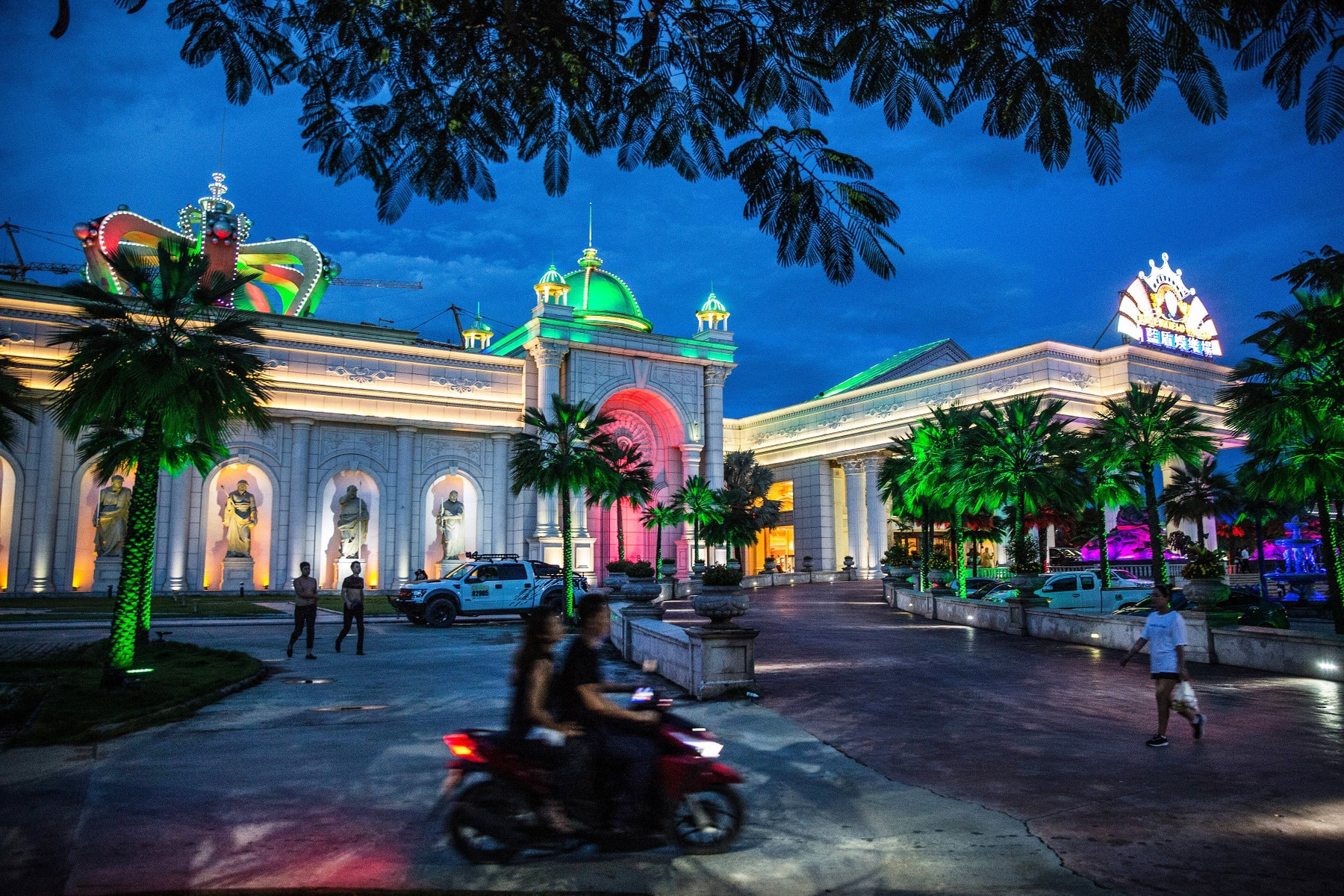
Fiscal desperation, corruption, criminality and cronyism have also opened space for governance failures with international consequences. The Golden Triangle Special Economic Zone — leased for ninety-nine years in 2007 to an ethnically Chinese business operator later sanctioned by the US Treasury for drug and human trafficking — is a notorious hub for cyber-scam operations, human trafficking and forced labour, yet the Lao government maintains a 20 per cent stake.
The US State Department’s 2025 Trafficking in Persons report found that Lao authorities had conducted no independent prosecutions of trafficking within the country’s special economic zones in the preceding year. Researchers estimate scam operations across Laos, Cambodia and Myanmar generated some US$43.8 billion in 2023 alone, a figure equivalent to roughly 40 per cent of the three countries’ combined GDP.
Unfortunately this record of governance failures and growth trade-offs sits alongside a deteriorating human rights record. Civic space in Laos is rated “closed” by the CIVICUS Monitor, and the country has an unresolved pattern of enforced disappearances of activists and dissidents. They include community development worker Sombath Somphone, abducted in Vientiane in 2012, and political activists and regime dissidents including Od Sayavong, who disappeared in Bangkok in 2019, Bounsuan Kitiyano, whose body was found near the Thai–Lao border in 2023, and Anousa Luangsuphom, who survived a 2023 assassination attempt. These attacks reflect a pattern of attacks on critics of the government that includes growing transnational repression.
The closed and repressive roots of Laos’s political system were on full display in this year’s National Assembly elections. Despite debt and the cost of living being among the most prominent campaign issues, the vote produced no meaningful institutional change: the ruling Lao People’s Revolutionary Party won 169 of the expanded 175-seat legislature, with the remaining seats going to vetted independents. No opposition parties were permitted, no independent election monitoring allowed, and in the days around the election, exiled online critic Bao Mo Khaen was killed after reportedly being detained by soldiers in Vientiane.
Laos’s own assessments, and those of the UN Committee for Development Policy, suggest that the economic consequences of casting off LDC status will be modest. Most Lao exports already move duty-free within ASEAN or under bilateral agreements unrelated to LDC status. Development cooperation from the World Bank, most UN agencies and other leading donors is expected to continue with little attributable change.
Meanwhile, China remains by far the largest source of both foreign direct investment and development financing. China, Vietnam and Thailand together bought more than 70 per cent of Lao exports in 2023, and Laos’s total exports — around US$9.9 billion in 2024 — remain modest by regional standards, meaning that the loss of EU trade preferences will register only at the margins of the wider economy.
More fundamentally, the change in status will do nothing to tackle the political corruption and chronically underdeveloped human capital that foreign investors consistently cite as primary deterrents to doing business in Laos. The country ranked 109th of 182 countries on Transparency International’s 2025 Corruption Perceptions Index, scoring just 34 out of 100.
In other words, graduation won’t itself attract new foreign investment or improve ordinary living standards, as the experience of the eight LDC graduates that came before Laos shows. Botswana (1994) is the case most often cited as a success, but its per capita income had surged years earlier. Equatorial Guinea’s graduation off the back of oil exports has not led to a shift towards a more complex or diversified economy. Vanuatu (2020) and Samoa (2014) both face the same climate and natural-disaster exposure that characterised their LDC years, with little evidence that graduation has altered their trajectory.
Bhutan is the most recent (2023) and structurally closest graduate to Laos. There, however, rising unemployment and significant youth emigration have remained challenges for its small hydropower- and tourism-dependent economy.
The pattern is fairly consistent across the eight countries: narrow economic bases, weak human capital and climate exposure persist largely unchanged because the UN’s graduation criteria focus on income and select social indicators without necessarily capturing structural transformation. Indeed, US tariff measures and recent cuts to bilateral aid have already had a far more significant effect on Laos’s economic position than LDC graduation is likely to produce.
What better options does the country have? A more sustainable and equitable approach would involve three major changes: transparent debt management (the government’s forthcoming external debt strategy is a step in this direction); genuine economic diversification beyond hydropower and resource extraction; and a serious reckoning with corruption and authoritarianism.
The government seems to partially recognise that change is needed. Its Smooth Transition Strategy acknowledges that urgent investment is needed in social sectors and green growth, along with measures to create sufficient decent jobs for a large, increasingly mobile youth population.
There are signs of movement on corruption too: on 1 July the Vientiane Capital People’s Court handed down verdicts in four major corruption cases involving seventeen defendants, at least ten of whom received life sentences. The largest case centred on Électricité du Laos, and was the third distinct wave of EDL-linked prosecutions in eighteen months, following the March 2025 detention of a former deputy director and four contractors over an alleged US$90 million misappropriation, and further detentions in September 2025 over transmission-line graft.
As well as showing a commitment to reducing corruption these prosecutions carry a plausible fiscal logic. Électricité du Laos remains the country’s most financially distressed state enterprise and a major cause of its debt burden. Likewise, the challenges identified in the Smooth Transition Strategy are well considered, and urgent.
But prosecuting individuals within an unaccountable system is not the same as making the system accountable. Laos’s judiciary remains subject to the ruling party; the country has no free press or independent civil society able to surface corruption before a prosecution is politically sanctioned; and a near-identical anti-corruption drive under the 2016–2021 premiership of Thongloun Sisoulith left the country’s corruption ranking largely unchanged for years afterward.
For the international community, graduation should not be seen as a signal that Laos needs less scrutiny but as an opportunity for intensified advocacy of political freedoms and human rights, debt transparency and a more equitable distribution of the benefits of growth.
This shouldn’t mean withdrawing support. Laos will continue to need significant development assistance, but it needs to be accompanied by a heightened recognition that the structural challenges Laos faces have been allowed to persist for decades, largely supported by the international community. Future prosperity depends on greater transparency, accountability and the freedom for the people of Laos to better determine their own development pathways. •