Michael Young deserves to be remembered for many things but is in fact remembered for just one: he was author of that extraordinary book, The Rise of the Meritocracy. Published nearly seventy years ago, Rise is enjoying a second life, thanks mainly to its remarkable prescience: it foresaw a populist revolt against meritocratic elites — of which Brexit, Trump, right-wing parties across Europe and now One Nation here in Australia are cases in point — and, what’s more, it explained in close detail why things would turn out as they have.
If Young’s prescience is now recognised, much of his argument is not. The eminent US political philosopher Michel Sandel, for example, is awed by Young’s foresight, and Sandel’s The Tyranny of Merit owes much to Rise. But Sandel still manages to get the book fundamentally wrong: it reflects a time (he says) “when the British class system was breaking down, giving way to a system of educational and political advancement based on merit.” Well, perhaps it did and perhaps it was, but that’s the exact opposite of what Young himself thought.
The even more eminent Nobel Prize–winning economist Kenneth Arrow and colleagues were still further from the mark. They saw Rise as predicting a “hereditary cognitive elite whose position is secured by the possession of advanced mental skills and passed on from generation to generation through the genetic inheritance of those skills.” It predicted nothing of the sort.
Google in its AI incarnation has Rise as a “dystopian satire warning that a society rewarding ‘IQ + effort’ would become a rigid, stifling hierarchy,” a near-complete misconstruction. An Australian educationist, following Sandel, recently picked up on Young’s prescience and his catalogue of meritocracy’s consequences but misses the class dynamics underlying Young’s account of “the rise of the meritocracy.” Meritocracy, a term popularised by Young, is often turned into an ideal; to Young himself it was an abomination.
For these and many other misunderstandings Young himself is at least partly to blame. Rise was a polemic, but it doesn’t look like one. It looks like a history of 200 years of class relations in England, the first century actual, the second imagined. (The book’s full title: The Rise of the Meritocracy 1870–2033.) It was a kind of novel, written in the voice of a Tory meritocrat of Young’s invention. It is thick with allusions to events and debates that would have been familiar to only some of Young’s 1958 readers and to hardly anyone now. No wonder Young himself expected the book to be misunderstood and no wonder it was. It was rejected by eleven publishers before eventually being taken on by a friend at Thames & Hudson — publishers of high-end art books — more or less as a favour.
It turned out that it was Young who was doing the favour: Rise was translated into nine languages and sold in the hundreds of thousands — to more confusion. It was widely recognised as having something really important to say, but what, exactly? Even the book’s many reviewers, expert readers after all, couldn’t agree on that.
For readers of our day an unusual literary form is just the first hurdle. The more fundamental difficulty is that Young’s way of understanding the world was so very different from that which dominates ours. Young’s outlook descended from revolutionary Europe of the nineteenth century; most contemporary readers have been formed by the postwar American dominance of almost everything, including social analysis and commentary, much of which anathematised ways of seeing such as Young’s.
Most contemporary readers assume that when Young talked about “class” or “equality” he meant what they mean by those terms. He did not. “Class” now refers to a hierarchy defined by possessions or attributes, typically income and/or status; for Young, “class” referred to groups constituted in the ceaseless battle for power and its rewards. “Equality” is now seen as fair distribution of the opportunity to rise (the ideal of “social mobility’); Young, by contrast, wanted to return “equality” to its original owners, to make it once again a weapon in the hands of those below in their struggle for recognition of our common humanity.
These are radically different ways of seeing and explaining. The one takes photographs of this or that aspect of social life; the other is more like a movie, a saga. One cast of mind suggests that essentially functional social arrangements need only adjustment or improvement, particularly in making the distribution of positional, cultural and financial goods more just, an ideal celebrated by John Rawls’s hugely influential A Theory of Justice (1971); the other looks to a much more extensive reordering of social arrangements. Both arrive at education as central to the cause of “equality,” but where one is satisfied with “opportunity” to acquire and demonstrate “merit,” the other wants full, respectful, transforming schooling for everyone.
Young wasn’t right about everything, of course; he missed or misunderstood some fundamentals. But, as the second coming of The Rise of the Meritocracy testifies, he has given us a long-forgotten starting point for any effort to face up to some unpalatable and inconvenient truths about our social order and its educational arrangements.
Young’s unusual narrative device had the great advantage of allowing him to explain how class relations worked. His imagined Tory narrator says out loud what was said only behind closed doors or in code or taken as given and never said at all. He was thus able to unmask a ruling class that didn’t “rule” in the usual sense of that term but played a complex game from a position of advantage with a view to maintaining it — and also to reveal those “ruled” as necessarily playing the same game, mostly to advance or defend hard-won rights, very occasionally with a view to changing the rules of the game itself.
The game was set in motion in England by the creation from the 1770s of the world’s first industrial working class. Growing in number, organisation and confidence (a story famously told by E.P. Thompson in his 1963 classic The Rise of the English Working Class, 1770-1832) this new class put the wind up a long-established landed ruling class. By the middle of the nineteenth-century English working-class movements had settled on the goal of “socialism”; by century’s end they had constructed the principal means of its achievement, the Labour Party.
On what the English called “the continent,” many emerging working-class movements had meanwhile set out on the “revolutionary road’; in England, by contrast, the romantic visions of John Ruskin and William Morris were gradually whittled down and toughened up to meet the realities of the “parliamentary road” and its electoral politics.
In reaction to this threatening new class an expanding section of the ruling class was, like Giuseppi di Lampedusa’s padrone, made to realise that if things were to stay the same everything would have to change. An essentially feudal form of class relations and its “hereditary principle” would have to give way to a quite different form, apparently accommodating of working-class demands.
“The 1870s have been called the beginning of the modern era,” says Young’s imagined narrator in the first sentences of the first chapter of The Rise of the Meritocracy, “not so much because of the [Paris] Commune as because… education was then made compulsory in Britain, patronage at last abolished in the civil service and competitive entry made the rule.” Until then, “the greater part of society was governed by nepotism” in “a hundred subtle forms,” but from the 1870s forward individual “merit” would increasingly be the arbiter, where Merit is Intelligence plus Effort, I + E = M in Young’s algebra.
This fundamental shift in the basic logic of class relations, Young asserts via his narrator, was made possible by an unacknowledged class collaboration. “The British socialists of the first three-quarters of the last century,” says the sarcastic Tory from the vantage point of 2034, “were most commendable for the single-mindedness with which they attacked the evils of inheritance in property, job and education”; it was they, the socialists, who produced “a new mental climate within the span of less than a century.”
Progress in this massive task “would have been forfeit had it not been for the relentless efforts of the now-famous ‘midwives of progress’”; pressure for greater equality of opportunity was “unceasing,” continuing well into the twentieth century,” with the result that “elementary schools were improved, secondary education made free and the numbers of University scholarships multiplied.” The culminating Education Act of 1944 was introduced to parliament by a Conservative minister in a wartime “national” government but “the purpose” was that of the Labour Party.
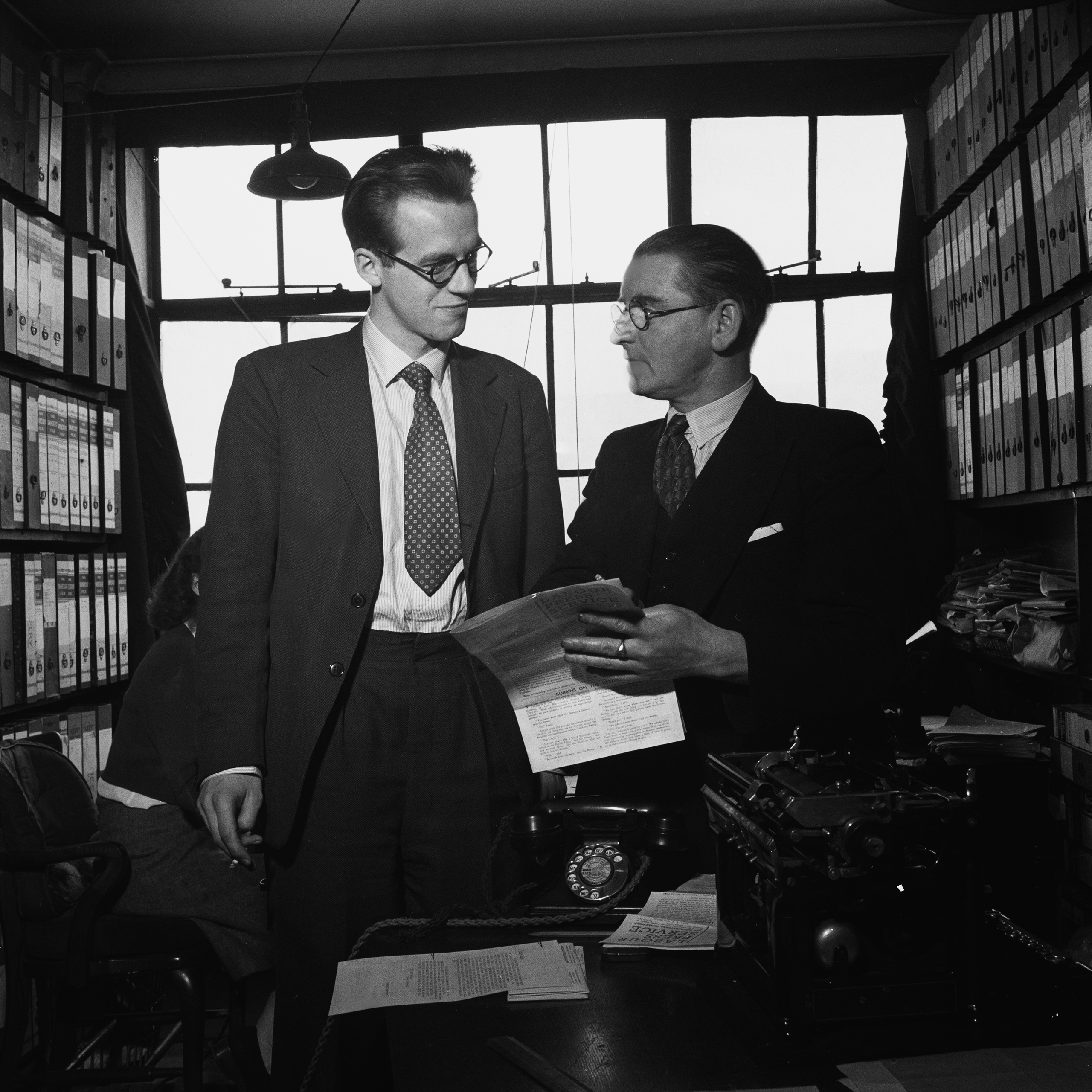
It is at this point that Michael Young joins the story he tells. At just thirty years of age he was head of the Labour Party’s research department and hence principal author of Labour’s manifesto for the 1945 general election. That election, coming just two months after the end of the second world war in Europe (and hence the end of the wartime national government), pitted the towering figure of Winston Churchill and his Conservatives against Labour’s relatively colourless Clement Attlee, the butt of one of Churchill’s deadly jibes. (Mr Attlee is a modest man, but he has much to be modest about.) The Labour manifesto, titled in the unrecognisably courteous political idiom of the day Let Us Face the Future: A Declaration of Labour Policy for the Consideration of the Nation, was a blueprint for the achievement of socialism by parliamentary means.
Working-class voters came to the election with a lively memory of outright defeat in the General Strike of 1926 (in which Churchill was a leading strike-buster), of being let down by Labour in the Great Depression of the 1930s, and of a truce maintained for the duration of the war on the promise of a brave new postwar world. At the 1945 election, they presented their IOU. Labour promised jobs for all, a welfare state to include a national health service, pensions for the aged and infirm and the unemployed, and full and free secondary education.
Young and many others were convinced that this time Labour really meant it. “There was a champagne fizz in the air,” he recalled, and so there was: the modest Mr Attlee led Labour to a landslide victory over the Tories.
The struggle now shifted from conflict and collaboration between the classes and their political parties to dispute within the new Labour government. For Young the big fight was not over welfare or a national health service but over education, and that in turn centred on how to understand “equality.”
The trouble started, Young has his Tory narrator say, when Labour’s left — ie. Young and his faction — wanted an interpretation of equality that ignored differences in human ability and urged that “everyone, those with talent as well as those without, should attend the same schools and received the same basic education.” These idealists (the narrator continues) claimed that “to segregate the clever from the stupid was to deepen class divisions.” What they demanded was as unrealistic as it was absurd: they wanted “all children, irrespective of sex, race, creed, class (that was all right but they went on) or ability, [to] be lumped together.” Fortunately, however, “ambitious parents always brought to grief the best-laid schemes of egalitarian reformers,” and the schools played their part too, “dividing the goats from the sheep” and thereby continuing segregation by ability, “the saving grace of the whole educational system.”
Confronted by ambitious parents and a deeply class-structured school system, the idealistic socialists “collapsed as an organised force,” leaving Labour under the control of the “practical men.” “Express[ing] the grievances of those with nothing to inherit or bequeath,” the practical men “drew up the masses in good order” behind the false banner of equality of opportunity.
To Young, the practical men had been sucked in, out-envisioned and outplayed by a class that had seen way back in the middle of the nineteenth century that class relations based on the “hereditary principle” had to give way to a quite new form based on “merit.” The champagne fizz had gone; in 1950 Young quit the Labour Party and wrote the fierce defence of the defeated cause and bitter rebuke to his erstwhile comrades, The Rise of the Meritocracy.
Rise predicted that enlisting education in the construction of a meritocracy would end in tears, and its author lived long enough to see his worst fears realised. “I expected that the poor and the disadvantaged would be done down,” he wrote in 2001, “and in fact they have been.” Working-class children were being streamed and humiliated at school then branded for life by “education’s seal of disapproval.” Those judged to have “merit,” by contrast, were granted one of education’s “amazing battery of certificates and degrees” and entry to a privileged life. “Insufferably smug,” these meritocrats invented new ways to feather their own nests as inequality soared to unprecedented levels. Adding insult to injury, the leader of the nominally working-class party (Labour prime minister Tony Blair) promised a more meritocratic meritocracy: his government would make “opportunity” more equal.
Members of the working class, deprived by the meritocratic absorption of those who would once have been their natural leaders, had become so disengaged and disaffected they scarcely even bothered to vote, while those who had done well for themselves had hardened into a new social class. A “social revolution” had been wrought by “harnessing schools and universities to the task of sieving people according to education’s narrow band of values.”
Rise’s prescience has distracted attention from its core: it was, as the subtitle has it, An Essay on Education and Equality. Young believed that equality would be the defining characteristic of a different kind of society and that education could exemplify and help create it.
Here in 2026 the education system might be mistaken for what Young wanted: more and yet more education for just about everyone, “equality” the light on the hill. But it is not the kind of enlarging experience that Young believed in, and it does not deliver his kind of equality.
In Rise’s long, wide view — so much more revealing than the current focus on the pond life of teaching — schooling is a powerful institution at the heart of the social order, doing the dirty work of social allocation and turning “equality” into a cover story for its sorting of “non-academic” chaff from university-bound wheat. Young was not opposed to advancement according to merit; to the contrary, he thought it essential to modernising an increasingly technological economy. What he did oppose was the judging of “merit” by educational institutions and their certificates, degrading both education and “equality” and mystifying society’s actual workings. “Why has society been so stable in spite of a widening gulf between the bottom and the top?” asks Young’s narrator of 2034. “The cardinal reason is that stratification has been in accord with the principle of merit.”
Young realised that whatever might be said for distributional interpretations of “equality” among adults doesn’t apply to schooling. The defining characteristic of schools is that they are for children and young people who, by definition, cannot be said to “deserve” whatever they get. The application of distributional thinking to schooling has sent schools on a fool’s errand, done a good deal of damage to those in greatest need, and concealed from view what “school” should be in the lives of kids.
Young reminds us that “equality” is properly understood as a big, even grand ideal, a demand from below for respect. Applied to schooling, respect must be found not just in day-to-day interactions between teacher and taught but in the relationship between the kids and their lives and the work they’re offered and in the organisation of their working lives and careers at school. There are no grounds on which to justify some of them getting twelve safe, happy and worthwhile years while others do not.
What Young didn’t foresee was the extent to which his view of “equality” would survive, albeit in muffled form, in widespread resentment of the ATAR (Australian Tertiary Admission Rank) and its dominance, in untold thousands of hours spent by teachers giving the strugglers a hand, in the work of researchers and schools, including “alternative” schools, to figure out how schooling can engage heart and hand as well as head, and how “the curriculum” can be organised around each student rather than vice versa. It is one of the unhappy ironies of schooling that we now possess a much fuller understanding of how to make schooling work for all comers than was available to Young, more than matched by entrenched opposition to doing so from schooling’s established order. •
Inside Story is reader funded
Join the many readers who’ve donated so far this year