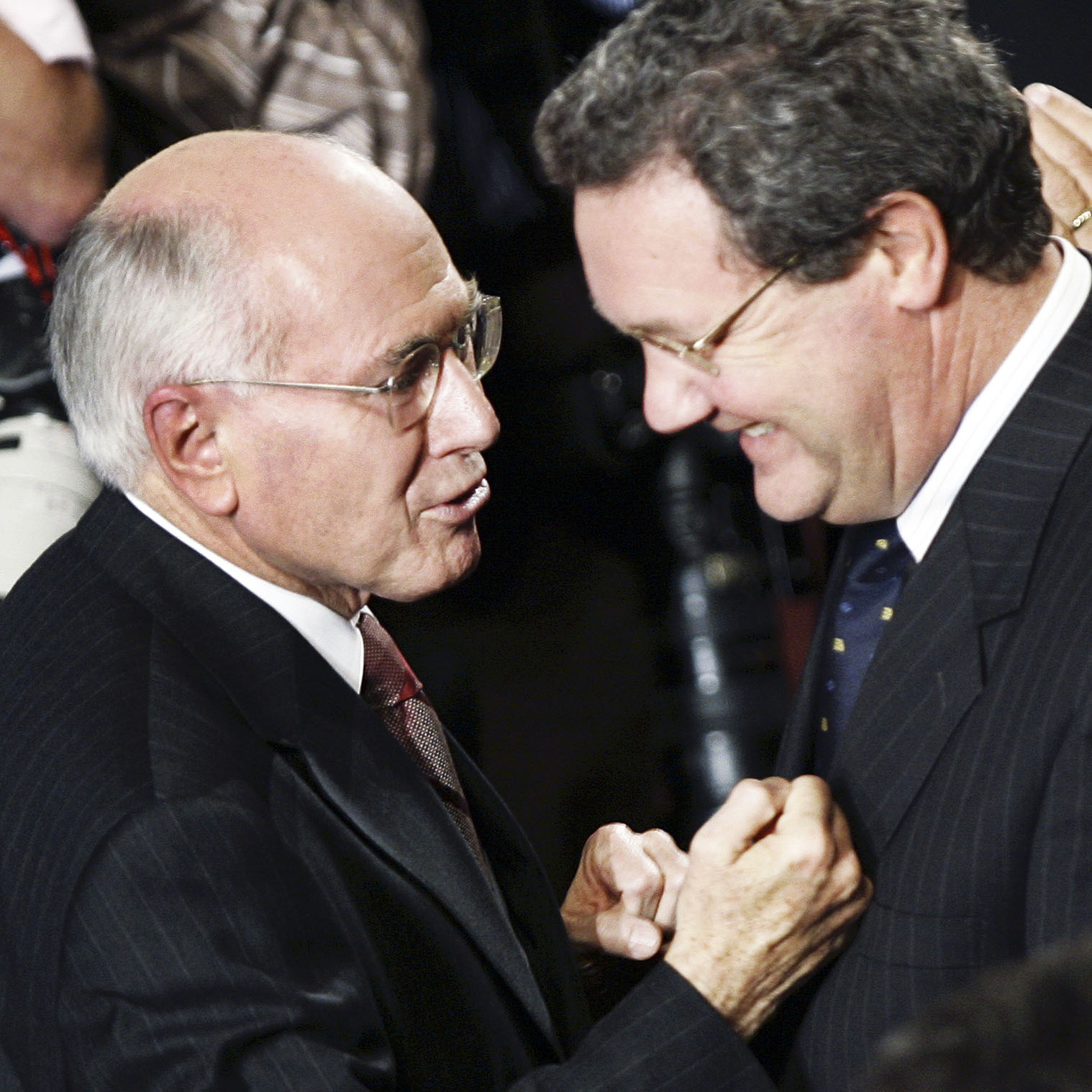
In the beginning, there was a moment when Alexander Downer’s term as foreign minister could have been a mere blip, as short as his leadership of the Liberal Party. Instead of nearly a dozen years as foreign minister, he could have been gone in his first year. Downer survived, then thrived, to become Australia’s longest-serving foreign minister (eleven years and 267 days from 1996 to 2007).
Politics is about disasters dodged as well as goals scored. In his first year in office, Downer stumbled into an Asian-policy disaster that threatened his career. He asserted in parliament that no Asian minister had protested at the new government’s scrapping of a tied aid scheme, the Development Import Finance Facility, or DIFF. The rush from the region to contradict that statement produced a near-death political crisis. China, Indonesia, Vietnam and the Philippines all averred that they had most definitely lodged official protests at the scheme’s cancellation.
Had Downer misled parliament? Would the new prime minister treat this as a “hanging offence”? Pistol cocked, John Howard sent Downer into parliament to make a statement to resolve the controversy. The line had been drawn: if any further difficulty emerged after Downer’s parliamentary purging, the pistol could be fired.
Howard’s commitment to “high standards” meant that several careers were terminated for such misdemeanours in the early years of his government. Downer was lucky to survive, commented the journalist Peter Hartcher: “Ordinarily a prime minister would have removed a minister with a first year as bad as Alexander Downer’s as foreign minister.”
The DIFF near-miss gets a passing mention in Tony Parkinson’s new book A Step to the Right: The Life and Times of Alexander Downer. He notes that Howard “watched the pressure build on his foreign minister.” Howard is quoted as acknowledging: “It was a very difficult start. That was a very testing year. But we got through it.”
Howard’s “we” is more than politeness. Writing about Downer’s legacy means describing the Howard–Downer approach to foreign policy.
A key Downer achievement was how close he got to Howard. The ability to coordinate policy with the leader and push decisions through cabinet is a foundational gauge of any minister. Downer’s determination to ensure no policy gaps with Howard formed what became a close personal bond.
Downer eventually served as Howard’s trusted go-between in the failed cabinet machinations to get the prime minister to step down near the end of his reign. Ultimately, cabinet would not plunge the sword. As Downer explained later, it would have been “more like executing your father than sacking your boss.”
The father figure reference points to a factor which defines Downer’s life: he is a natural politician, born to the Liberal Party, comfortable in his inheritance as a third-generation politician. Downer’s love of the tough life of politics meant he was a happy warrior. A beaming grin could deal with the most dire day.
His natural optimism made him a fine foil for Howard’s dour determination — the foreign policy they ran was a balance of characters as well as a meeting of minds. The presidential habits grafted onto Australian politics mean the prime minister leads on international policy; the foreign minister must serve the big picture while running the detail. The close partnership with Howard made Downer both servant and creator of foreign policy.
I was in the press gallery covering the Howard–Downer years as foreign affairs correspondent for ABC radio and Radio Australia. When we were chatting one day, Downer told me how a submission had been approved by cabinet: “The prime minister and I voted for it, the rest of cabinet were against. That means it was approved with a clear majority.” This typical Downer jest reflects Howard’s dominance, ranking behind only Menzies as the most powerful Liberal leader.
The prime minister’s nod became the cabinet consensus. The way Howard drove his ministers informed another joke from Downer. I’d just finished an interview with him about the South Pacific, and after I’d turned off the tape recorder he was lamenting that he spent 25 per cent of his time on the region — and it was the worst 25 per cent. I gave Downer a one-liner fed to me years before by a veteran wire-service man in Aggie Grey’s hotel in Apia: “There’s less to the South Pacific than meets the eye!” Downer gave this a big laugh, then topped it: “I must immediately wipe that thought from my mind. It could expose me to the most terrifying sentence known to Canberra.”
According to Downer’s gag, the scariest sentence any minister can hear in Parliament House is: “It’s the prime minister on line one.”
A commitment to conservative politics and the Liberal Party formed the Howard–Downer world view, giving these two deeply different personalities a common professional purpose. Downer became one of the closest servants of Howard’s dominance. His pragmatism defined two dimensions of the relationship — his decision to cede the party leadership to Howard in 1995, and his refusal to allow that shattering of his leadership ambition to infect his personality or darken his approach to Howard.
The Liberal leadership was a central dynamic of Howard’s vastly different relationship with the two senior ministers who held the same portfolios throughout his government, Downer and treasurer Peter Costello. Because the leadership issue had been settled between Downer and Howard, they had a personal openness the prime minister could never have with Costello, the Liberal deputy who always loomed as his potential challenger
The bonhomie rather than bitterness Downer displayed in achieving harmony with Howard should not be underestimated. Downer shares with Labor’s Bill Hayden the gruelling experience of having to surrender his ambitions for love of party. Hayden and Downer each stepped down without forcing their colleagues to vote them out; becoming foreign minister was consolation and salve.
Downer’s political opinions aligned with Howard’s, which certainly helped. But what cemented their ties was that Downer buried his leadership regrets. No bitterness. No sniping. Such maturity is not always evident at the peak of politics, where thwarted desires are the acid of treachery.
Parkinson’s analysis of Downer’s character starts with his passion for fast cars. The love of motorsport — he once clocked 250kmh on a practice circuit — displayed Downer’s “tendency to go full speed ahead… hurtling and weaving through thrills or spills.”
Howard is quoted on Downer’s “slightly outrageous sense of humour,” linked to the ability to speak his mind in language that could go from crisp to blunt and abrasive. This was a foreign minister who could label poor developing states as “busted arse countries.” Howard said Downer “could always tell you what he thought of people and why, and that’s a very good quality in a foreign minister. The job tends to be rather robotically associated with tact and diplomacy. Downer knew when to be tactful and diplomatic — but when the circumstances required, he was anything but.”
In running Foreign Affairs, Downer returned to a department he had joined in 1976 as a diplomatic cadet. The first assessment of that young recruit, written by the veteran diplomat Bill Farmer, stated: “Downer has the capacity to be the best diplomat of his generation — but he will need to control a tendency to bumptiousness.”
In Downer’s early years in politics, Parkinson writes, “he was denounced as too flippant and frivolous. In later years, some critics complained he was too imperious and unyielding — Lord Downer they called him.” The biographer’s conclusion is that Downer “can bounce easily from conservative and cerebral to effusive and exuberant. A flinty glare can transform into a smirk — sometimes a chuckle.”
Downer’s dozen years as foreign minister followed a dozen years in the purgatory of opposition. He entered federal parliament in 1984, aged thirty-three, an economist and former diplomat who’d worked as a staffer for two Liberal leaders, Malcolm Fraser in government and Andrew Peacock in opposition. He held the Adelaide seat of Mayo through nine elections.
The tough terrain of opposition withholds power but offers a young politician the chance to rise rapidly through the ranks. After serving as shadow defence minister and shadow treasurer, Downer seized the Liberal leadership in 1994, promising generational change, with another young frontbencher, Peter Costello as his deputy in a “Dream Team.”
At forty-two, Downer was the youngest-ever federal Liberal leader, proclaiming: “I am born of the Liberal Party, and I am a creature of the Liberal Party.” He loved the party but was not ready to lead it. The night before winning the partyroom ballot, Downer told his wife: “I don’t think I’m ready for this job.”
Downer is impressively candid in telling his biographer of his failures as leader: “I never thought I was mentally prepared for it. I hadn’t thought through what I would do if I became leader of the Liberal Party. Where I would like to take it. How would I set things up? It sort of just happened. Suddenly.” Seldom is a politician so honest about their own abilities.
The Dream Team transformed into a nightmare, Parkinson writes. Downer was unable to control the splintering Liberal–National coalition, finding himself “trudging through a quagmire of disunity and dissent.” Much of the damage suffered was self-inflicted, and Downer was “looking and sounding shell-shocked.”
By the end of 1994, a despairing Downer decided: “I think I’ve blown this.” His leadership lasted 252 days, and Downer tells Parkinson: “I hated the job. I just hated it.” He announced his resignation as Liberal leader at the end of January. Howard was elected to the position unopposed.
Downer says his calculation was that he couldn’t defeat the Keating government at the election due in 1996: “I would have fought those people. But I didn’t think I could win. And I figured that the only person that could win — although I wasn’t sure he would — was John Howard. The main game wasn’t me. The main game was beating Keating. I thought the Keating government was an abomination. Terrible.”
In discussions with Howard before standing down, Downer said he wanted to be foreign minister. Howard replied: “You will have it.” When Howard led the Liberals back into government in 1996, Parkinson writes, Downer was given every opportunity to redefine himself as one of the “big beasts of Australian political life.”
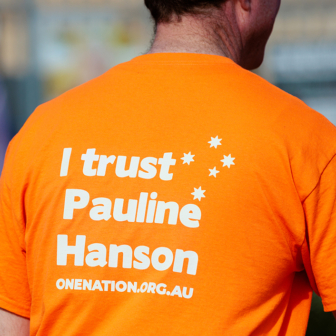
As the Howard government took office, Australia was introduced to Pauline Hanson. She troubled the Liberals then as she does today. During the 1996 election, the Liberal Party disendorsed her as their candidate for the Queensland seat of Oxley after she attacked special government assistance for Aboriginal Australians. Winning Oxley because of the collapse of the Labor vote in Queensland, Hanson entered parliament as an independent, making headlines with a maiden speech claiming Australia was being “swamped by Asians.”
The “race-based posturing of Hansonism,” Parkinson writes, produced a headline frenzy. But Howard believed a full-frontal attack on Hanson would elevate her while alienating some conservative voters.
The foreign minister, though, saw Hanson as a threat to Australia’s standing in Asia. Downer went into the region with a loud affirmation of Australia’s non-discriminatory immigration policy, describing Hanson’s race comments as repugnant: “Australia has a proud record for welcoming migrants from all around the world. We will not let that achievement be threatened in any way.”
Downer had skewered Hanson while his prime minister refused to speak. The contrast between the foreign minister and prime minister sparked their biggest row. Howard vented his “fury,” Downer recalls: “We sometimes disagreed. But we didn’t often disagree vehemently.” Downer said the argument over Hanson was the only time he was chastised by Howard in their dozen years in office.
Thirty years later, the Liberal Party’s response to Hanson follows Howard’s hesitant path rather than Downer’s principled clarity.
On the old Liberal Wet–Dry belief spectrum, Downer describes himself as a “libertarian dry,” not a conservative. Parkinson calls him “an avid and energetic internationalist.” These days the Liberal Party has mislaid its liberal compass and its economic thinking has gone crumbly rather than damp. Parkinson’s biography is a reminder of a time when the Liberal Party had a broader understanding of itself — and Australia.
As foreign minister, Downer carried his “battered bright yellow suitcase” to every continent bar Antarctica. Almost half of his flights were to Asia. He went to Indonesia more than any other country, visiting twenty-seven times.
Parkinson’s second chapter covers the Howard government’s most dramatic international achievement — the vote that gave East Timor’s independence from Indonesia — which was a result of Howard and Downer’s desire to strengthen the relationship with Indonesia by offering new thoughts on East Timor. The effort turned into what Parkinson calls a “quantum shift” and a “radical policy realignment.”
Howard’s letter to Indonesian president B.J. Habibie, calling for a change in Indonesia’s approach to East Timor — while maintaining Jakarta’s rule —illustrates how Howard and Downer could take their colleagues for granted, even on major issues of foreign policy. The letter was sent without formal reference to cabinet. Foreign Affairs made the running, the PM’s office wavered, Defence wasn’t consulted. Howard urged Habibie to “negotiate directly with the East Timorese and consider the option of an act of self-determination after a substantial period of autonomy.”
Howard and Downer understood the significance of the letter (even if they miscalculated the response from Habibie). What began as a diplomatic initiative by Australia turned into a military intervention at the head of a United Nations force. Australia arrived at a happy destination it hadn’t aimed for, while sailing close to a war with Indonesia. Howard credits his foreign affairs minister as one of the architects of success: “I regard the intervention in East Timor as not only the right and noble thing to have done. It was also extremely well executed. And Downer played a major role in that.”
The “right and noble” claim is justified — especially in the eventual result, if not the original aim — but “extremely well executed” underplays the contingent and unexpected nature of diplomacy. The policy scramble of Timor Leste’s birth was marked by fire and ash, its goal reached by desperate ad hoc responses, sudden turns, determination and simple luck.
Many of the same elements were involved in the two great achievements Downer helped deliver in the South Pacific: the Bougainville peace agreement and the regional assistance mission that stabilised and saved Solomon Islands.
When Howard entered office in March 1996, his central international focus was what it’d always been: the US alliance. Within four months, Australia and US issued a security declaration, the “Sydney statement,” proclaiming “A Strategic Partnership for the 21st Century.” Howard’s vision of that partnership meant he found it “inconceivable” that Australia would fail to enlist in a US war, which would mean committing to our longest wars in Afghanistan and Iraq.
Downer lined up right beside Howard on the alliance. But Downer slowly broadened Howard’s understanding to give Asia and the South Pacific close to equal standing with the US.
He did the trick by aligning regional interests with the alliance, arguing that closeness to America gave Australia a louder voice. “In my nearly twelve years as foreign minister,” he told Parkinson, “I was very conscious regional neighbours knew that Australia, more than any other Indo-Pacific country, had the ear of Washington. There were many occasions in that period when we exercised that influence to guide successfully American policy on issues as wide-ranging as China, Indonesia and the Asian financial crisis.”
An outstanding example of Downer reconciling region and alliance was how he gently pushed Howard beyond his focus on the US to win Australia a seat at the East Asia Summit. Here was Australia’s foreign minister doing a complicated diplomatic dance to turn around his own prime minister.
To get into the EAS, hosted by the Association of Southeast Asian Nations, Australia had to sign ASEAN’s non-aggression pact, the Treaty of Amity and Cooperation. Howard balked, seeing the non-aligned language of the treaty as cutting across Australia’s alliance commitments. Singapore’s prime minister Lee Hsien Loong also told Howard that Australia wouldn’t get the support it needed, while China was actively resisting Australian membership.
To sign the treaty in Kuala Lumpur in 2005, Downer had to swerve by two sceptical leaders. One of the PMs, Malaysia’s Mahathir Mohamad, had retired in 2003, so he could no longer use his veto. Howard’s objections were met by adroit diplomatic juggling, enabling Australia to emphasise two different commitments. As he signed the treaty, Downer lodged an accompanying letter stating Australia’s view that it would have no influence on the US alliance. With help from Indonesia and Japan, Downer and his diplomats achieved a win against the odds that mattered for Australia’s place in the region.
Downer’s last overseas trip as foreign minister was to leave Australia in the final week of the election campaign that swept the Howard government from office in 2007. He flew to Singapore to represent Howard at the East Asia Summit. “It was a gratifying symbolic moment for Downer,” Parkinson writes, because of his determined campaign “to ensure Australia was included as a member of this auspicious regional forum.”
Senior Australian diplomats naturally appear throughout the biography, but it gives little attention to how Downer ran the foreign affairs department. One judgement Parkinson offers is that the minister wanted argument from his officials, not just agreement.
“Downer could be deliberately provocative, inviting passionate arguments,” he writes. “He would put up unorthodox ideas he knew would prompt strong pushback. This was not just to be a contrarian. It was strategic. There was a purpose. It was his way of testing opinions, teasing out nuance, exploring new ideas and different angles.”
Downer trusted his diplomats but his prime minister started with a jaundiced view of the foreign service he had inherited. Howard saw “Foreign” as tainted by its association with the into-Asia-crusade of his predecessor, Labor’s Paul Keating. Others in the early Howard cabinets were even more sceptical about the diplomatic “aliens.” The head of the department from 1996 to 1999, Philip Flood, said some ministers doubted they even needed the foreign service. A privatised version of diplomacy using services from the Yellow Pages didn’t get dialled up, although the government did sell off DFAT’s headquarters, the Casey Building.
A quiet discipline imposed on Australia’s embassies during the Howard era was a warning against sending negative or embarrassing cables critical of government policy. As former ambassador Lachlan Strahan recalled: “Such cables would be seen as inconvenient, even disloyal, undermining the government’s policies. Some officers in our missions self-censored, knowing that conveying certain feedback would be unwelcome… Missions that did send discordant communications sometimes received admonishing calls from Canberra.”
Howard came to value some of the individual diplomats who served him as foreign policy advisers. They were later dispatched to run myriad departments: Defence, Immigration, ASIO, ASIS, ONA.
Australian diplomacy, however, suffered a financial squeeze throughout the Howard–Downer years. Between 1996 and 2008 the Australian Public Service grew by between 25 and 30 per cent. The Department of Foreign Affairs and Trade shrank by 11 per cent. By 2008 100 fewer people were working overseas for DFAT than had been fifteen years before. Such stringency has consequences for aims, ambition and achievement.
Downer took direct control of international development and he kept the dollars flowing to aid. Overseas development assistance was worth $1.5 billion when the coalition took office in 1996; by 2007 it was $3.1 billion. While tight on DFAT jobs, Downer doubled the money spent on foreign aid. The increase meant aid kept pace with the growth of the Australian economy — at the start and end of the Howard government, aid represented 0.3 per cent of GDP.
Tony Parkinson’s biography of his old boss is a fine addition to a notable segment of Australian political publishing — the account of a journalist who served on the staff of a politician. The journalist has left the press gallery and gone to work for the politician as a speech writer/press secretary/adviser, becoming in the modern term a “minder.” The journalist gets into the inner sanctum, serving the court, with the final service being a book-length record of its tempers, trials and triumphs.
The journo-minder account tends to praise, not blame, because the minder is on the inside. They write in close-up because they know the politician well, often having stood together for many of the battles.
The journo-minder gold standard was set by Graham Freudenberg’s biography of Gough Whitlam, A Certain Grandeur. Russell Schneider produced an acerbic account of the first five years of Malcolm Fraser’s government, War Without Blood, recording the “frustrating and sometimes infuriating” experience of being inside the government machine.
From a speech-writing chair, Stephen Mills had a close-up view of Bob Hawke’s “love affair with the Australian people” and wrote The Hawke Years: The Story from the Inside.
Paul Keating was well served by his eminent hacks, with John Edwards producing Keating: The Inside Story and Don Watson his wonderful Recollections of a Bleeding Heart: A Portrait of Paul Keating PM. (Watson entered as an historian, but by his scribbling wins honoured hack status.)
The married journalist couple, Pru Goward and David Barnett, wrote the biography, John Howard: Prime Minister. They had known Howard for years, and Barnett had been press secretary to Malcolm Fraser. Goward wrote the early chapters of the book but stepped back from the project when Howard appointed her head of the Office of the Status of Women and later made her Sex Discrimination Commissioner.
The masterful Niki Savva produced So Greek: Confessions of a Conservative Leftie on working for Peter Costello and John Howard. Her following three books on the governments of Tony Abbott, Malcolm Turnbull and Scott Morrison are the outsider accounts of a journo with a lot of inside insight.
Capturing the madness and mayhem, James Button produced Speechless on his year writing speeches for Kevin Rudd.
From state politics, Joel Deane records the Victorian Labor governments of Steve Bracks and John Brumby in Catch and Kill: The Politics of Power. Deane captures the profanity of the pols — “the private language of the political tribe” — and “the unholy trinity of political power: winning it, wielding it, losing it.”
The category can stretch to include Sean Kelly’s The Game: A Portrait of Scott Morrison. Kelly was a minder to Labor’s Kevin Rudd and Julia Gillard, so he is writing about a political foe, not his ex-boss. His is a sharper and more critical book than is usual in the genre, but Kelly’s minder skills give him the experience to expose how “the game” is played, with chapter headings such as “Appearances,” “Authentic,” “Pragmatic,” “Suburban,” “Proud,” “Secure,” “Division,” and “Violence.”
Parkinson’s biography means Australia’s two leading foreign ministers of the post–cold war era, Gareth Evans and Alexander Downer, have each received a journo-minder biography. Keith Scott served as Evans’s media adviser for three years; his Gareth Evans depicts the Labor foreign minister as “an unusual politician, an intellectual who has been described as garrulous, impatient, generous, energetic and at times abrasive.” Scott’s book — based on 132 interviews with 117 people — illustrates a basic working difference between academics and hacks: professors search documents while journos do interviews.
Parkinson, too, uses interviews to trace Downer’s “odyssey at the helm of Australia’s foreign policy” during a time of “great dynamism and gathering dangers.” He judges Downer’s impact to be “serious, substantial and often controversial.” The book is built around many hours of interviews with Downer and the quotes from the former foreign minister offer both accounting and judgement of the alliance response to the 11 September attacks on the US, the arrival of a more assertive China, and Australia’s seeking a role and a say in the many futures of the Asia-Pacific.
Towards the end of the biography, Parkinson quotes the former head of DFAT, Philip Flood, on Downer’s diplomatic approach. Downer’s instruction was to show proper respect but to “be assertively, robustly and distinctively Australian.” The journo-minder follows Downer’s creed, offering a distinct and robust account of the life of Australia’s longest-serving foreign minister.
Anyone seeking to understand how Australia viewed the world and did its diplomacy in the last decade of the twentieth century and the first decade of this century will find much in this biography. In some areas it is not definitive. But in typical Downer fashion, the case is strongly argued. •
A Step to the Right: The Life and Times of Alexander Downer
By Tony Parkinson | Connor Court | 394 pages | $39.95