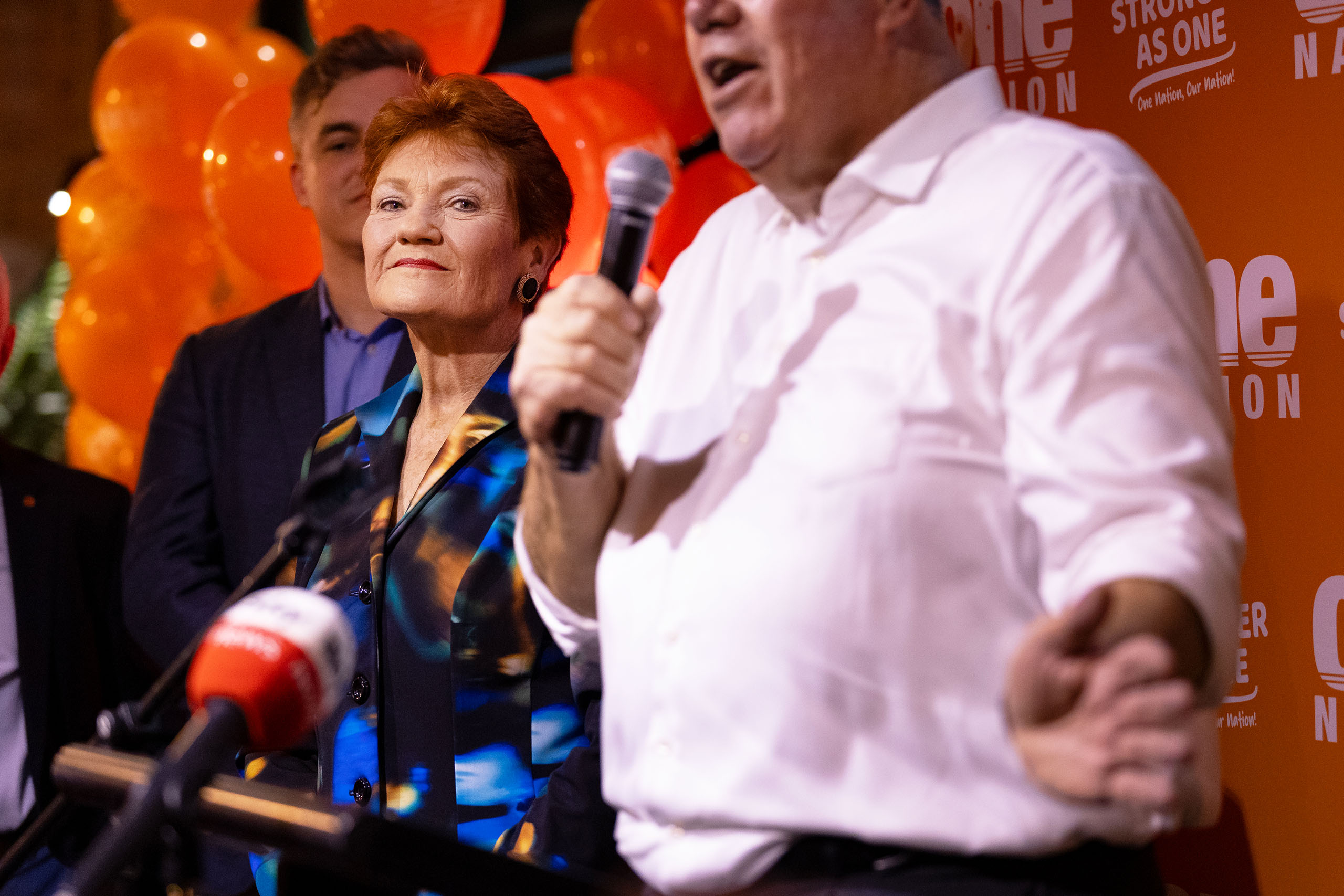
Saturday’s result in the Farrer by-election — One Nation’s first win for the House of Representatives — is one for the history books. Some commentariat carry-on is therefore justified. But by-elections are not like general elections and tell us nothing about the electoral future. That’s mostly because the crucial question, who should run the country for the next three years, is not on the menu.
For this reason, candidates tend to matter more in by-elections, although in this case an objectively poor one romped home anyway. The party name, synonymous with its leader Pauline Hanson, was more than enough. David Farley’s roughly 39 per cent primary vote (on latest counting) doesn’t reflect much of anything outside Farrer in May 2026 — certainly not the party’s likely national support at the next election, or even “if an election were held today.” The national opinion polls, which have One Nation averaging around 25 per cent, are the tools for that. But a general election that saw One Nation get 25 per cent overall would certainly include electorates where the minor party received 39 per cent or more. And they’d mostly be rural, as Riverina is.
Labor didn’t contest Farrer. The big parties tend not to run these days in by-elections they have no chance of winning (although the Albanese government made an exception in Fadden in its first term). Would it have made a difference if they had? Actually, it might have. We’ll come back to that.
This will not be the first time One Nation has sat in the House of Reps. After winning the Queensland seat of Oxley as a Liberal in 1996 (despite having been deselected just weeks earlier), Pauline Hanson formed the first iteration of the far-right party in 1997–98 and unsuccessfully contested the 1998 federal election in Queensland’s Blair. Although she topped the primary vote with 36 per cent, she lost after buckets of preferences flowed to the Liberal candidate, thanks mainly to Labor how-to-vote cards.
In Farrer, a whole lot of preferences sat ready and willing ready to flow to the Liberal candidate Raissa Butkowski against Farley, but they didn’t matter because Butkowski didn’t get to the two-candidate-preferred count. Instead it was Farley who was deluged by preferences in the final count. His roughly eleven-point primary lead over independent Michelle Milthorpe increased after preferences to fourteen or fifteen points. That was the work of Liberal and National how-to-vote cards, which favoured One Nation over the independent, and of course the natural resistance of many Coalition supporters to any independent candidate with a highly publicised Climate 200 connection.
It’ll be several weeks before the Australian Electoral Commission publishes individual candidate’s preference flows, but the back of my napkin suggests that Liberal and Nationals voters’ preferences, combined, went very approximately 65 per cent to Farley and 35 to Milthorpe. Could the Coalition, via its how-to-vote cards, have delivered victory to Milthorpe? It’s unlikely. She would have needed to receive more than 70 per cent of total Liberal and Nationals flows (perhaps more than 75 per cent), and it stretches credulity to believe the two parties exercise such influence over their supporters.
Anyway, it’s now a given: the Coalition preferences One Nation over virtually everyone else — certainly Labor, the Greens, and Climate 300–funded independents — and that’s not going to change before the next federal election, if for no other reason than the Coalition parties’ memberships would go ballistic, sending even more of them to the far-right alternative. (On the other side, imagine the outrage from Labor’s true believers if the party preferenced the Coalition over the Greens.)
Given Saturday’s results, the only way Farley could have conceivably lost would have been if, like Hanson in 1998, he had faced-off with the Liberals’ Butkowski in the two-candidate-preferred count. The current tally of first-preference votes suggests the Liberal didn’t come close to reaching the top two. (The AEC had correctly picked the identity of the final two candidates who all other preferences needed to distributed to, and is currently concerning itself mostly with that count.)
But what if Labor had contested Farrer? It would have done embarrassingly poorly, struggling to hit double digits. But most of its votes would have come at Milthorpe’s expense, pulling her down closer to Butkowski. To meaningfully assist the Liberal (and admittedly the thought of party strategists doing this is a stretch) Labor could have preferenced her ahead of Milthorpe (while still putting One Nation last of course).
On the current counting, that probably still wouldn’t have been enough to elevate the Liberal to the final count. It’s not certain, though, and we’ll know more when final figures are available. But if Labor wants to minimise One Nation’s House of Representatives wins in 2028, this is the sort of preference action it would take, selectively, in seats where One Nation has a good chance. It might also mean installing the odd Coalition MP at the expense of a teal one, disadvantaging Labor in parliament. Look, they probably won’t do it. But they could.
In the meantime, the Liberals and Nationals can take some consolation from the fact that Farrer was unusual in having such a strong Climate 200–backed candidate, strong enough to have come second at last year’s general election. She came second this time too, which tolled the end for the Liberal candidate.
In a two-candidate-preferred count Butkowski would have easily defeated Milthorpe, while Butkowski versus Farley could’ve gone either way. But the Liberal and National parties’ combined primary support was just too low to reach that contest — thanks partly to Climate 200.•