If voting patterns at the Farrer by-election and the SA state election are replicated, the 2028 federal election might be a run-off between two political parties founded in Queensland, one by men in the bush in 1891, the other a century later by a woman living a short drive along the Ipswich Motorway from the capital city.
Queensland’s voice in the Australian polity has been growing steadily louder since it joined five other colonies in a federation ten years after those labour men got together in Barcaldine. The change is mainly a matter of arithmetic, for there are now so many more Queenslanders.
The House of Representatives embodies the consequences. When Australians elected their first national parliament in 1901, they voted in seventy-five electorates. Nine were in Queensland, 12 per cent of the total. This was more than in South Australia (seven seats), Tasmania and Western Australia (five each), but a lot fewer than in New South Wales (twenty-six) and Victoria (twenty-three).
Today, the House has twice as many members but the number from Queensland has more than trebled. Of the 150 electorates at the 2025 election, thirty (or 20 per cent) were in Queensland. South Australia, Victoria and New South Wales have gained seats since Federation too, but have reduced their share of the enlarged total — South Australia (ten seats) down from 9 to 7 per cent, Victoria (thirty-eight seats) from 31 to 25 per cent, New South Wales (forty-six seats) from 35 to 31 per cent. Tasmania still has the five seats it had at Federation, so its share of the total has halved. Only Western Australia, like Queensland, has increased both its number of seats (to sixteen) and share of the total, from 7 per cent in 1901 to 11 per cent in 2025.
Though louder, the political voice from the north carries confounding accents. Baby Boomers remember the Moonlight State of premier Joh Bjelke-Petersen, dominating much of the three decades of conservative rule between the Labor split and 1989. Yet Labor had been out of office for just one term between 1915 and 1957 and has now governed in Queensland for thirty of the nearly thirty-seven years since Wayne Goss’s victory in 1989.
Within the state, the big political voices have moved south. Labor once chose its premiers from the north and west, elevating the members for Barcoo, Chillagoe, Cairns and Mackay before the second world war; since then, they have come from Brisbane. No less than three have been the member for the southwest Brisbane seat of Inala (Ned Hanlon, premier 1946–52; Goss, 1989–96; Annastacia Palaszczuk, 2015–23) and two South Brisbane (Vince Gair, 1952–57, and Anna Bligh, 2007–12). Sydney-born Peter Beattie (1998–2007) was raised on the Atherton Tableland but moved to the capital and had represented Brisbane Central.
The last Labor premier, and now opposition leader, Stephen Miles, is a Brisbane boy, initially the member for Mt Coot-tha and now for the outer-northern suburban seat of Murrumba. Even in the era of conservative ascendancy, Country Party premiers Frank Nicklin (1957–68) and Bjelke-Petersen were from electorates in the southeast.
Victorians go to Queensland, I was once told, for two reasons: to holiday and to die. It was not true even then. For decades, they have been going there to live. Their numbers help make this the only state to have recorded positive net interstate migration every financial year since the early 1980s.
In Ray Lawler’s famous Doll trilogy, the Victorians don’t go there at all. The travellers come south. By December 1953, when the Summer of the Seventeenth Doll opens, sugar-cane-cutters Roo and Barney have spent sixteen summers in Melbourne’s inner-city suburb of Carlton.
The south is more than a holiday. After seven months working in the far north, “the lay-off” is “not just playin’ around and spendin’ a lot of money, but a time for livin’.” The pattern is established in the two prequels, written in the mid-1970s long after the Doll. In Kid Stakes, set in 1937 — “nothing to win and nothing to lose” — Roo and Barney meet young milliners Olive and Nancy and talk their way into staying in the boarding house Olive’s mother Emma runs. Other Times begins as the war is ending in 1945 and the women are waiting for their men to return, having hosted shorter summers of leave away from the fighting.
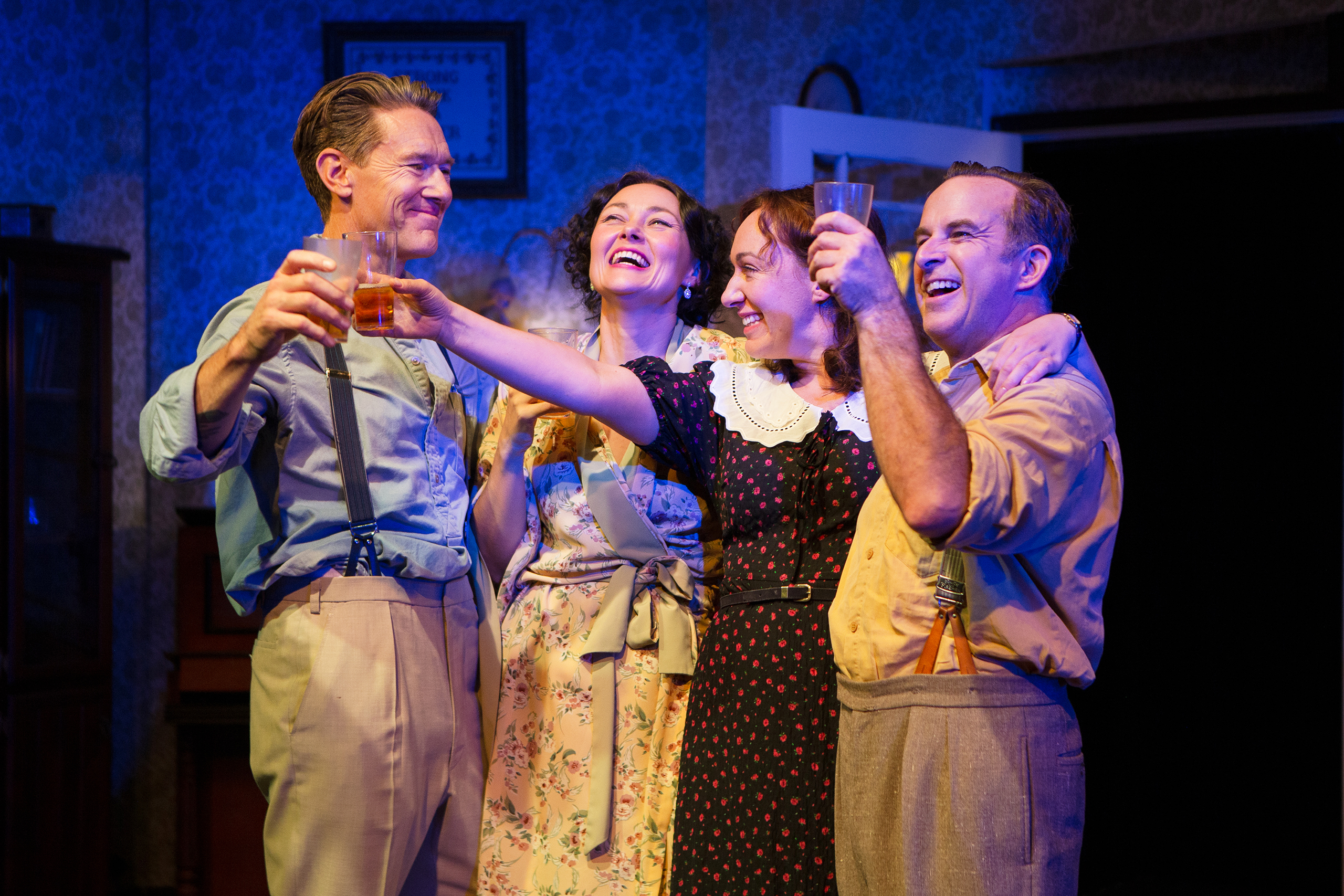
The Doll trilogy is a landmark in Australian theatre and culture. Red Stitch Actors’ Theatre in St Kilda ran a season of the three plays from February to April this year and is now touring it to cities including Hobart in late May and Ballarat in June, selling out “Trilogy Packages” with the three plays run end-to-end, performed over a single day by the same small ensemble cast, as Lawler preferred.
On its premiere in Melbourne in 1955, Summer of the Seventeenth Doll was celebrated for its urban setting, its assailing of myths about masculinity, its radical alternative to conventional marriage. Taken to stages in London two years later and then Broadway, the play “carr[ied] on its back those first timid assertions of national pride in ourselves since Federation,” Katherine Brisbane wrote in the Bulletin two decades later.
All three plays take place in the same sitting room in the same Carlton boarding house, a site dramatically different from the elemental landscapes that dominated the imaginations of Australia’s turn-of-the-century nationalist poets and storytellers. Those landscapes would feature again in the film renaissance a decade or two after the Doll. Red Stitch says Lawler’s characters “personify the friction that arises in a society transitioning from rural life to urban metropolises.” One metropolis stands for them all. Of the playwright himself, one of eight children who grew up in Footscray, Brisbane later wrote “Lawler belongs to Melbourne.”
The audience never sees Queensland but the distant place resonates through all three plays. Lawler, whose early career included a stint in Brisbane as a stage manager, a lyric rewrite man and a “filler-in” for a fortnightly variety show, gives it a dual identity. It is a dreamscape as well as a workplace.
Extensive stage notes require the sitting room for the Doll to be decorated not just with the sixteen kewpie dolls from previous summers but also with “colourful mementos” from North Queensland — “brilliantly plumaged, stuffed North Queensland birds, coral pieces and shells from the Great Barrier reef, and picture frames backed with black velvet to which cling crowds of shimmering-winged tropical butterflies.” These are Olive’s choices, acquired from her annual visitors, evidence of the unseen north but also signs that, over the three plays, “household power” has passed from tough, practical Emma to her endlessly romantic daughter.
The Queensland that Roo and Barney occupy, though, is a place of work, hard manual work, of masculinity and competitiveness. Only when the work is done does the north acquire colour and shimmer, wages for men to spend with women, trinkets to adorn a Carlton sitting room, wealth to last a southern, urban summer.
Filmmaker John Ruane tried “to imitate Summer of the Seventeenth Doll in reverse” in his mid-1970s Queensland. The movie was “a sort of Northcote version of Midnight Cowboy,” he said in a 1995 interview, “not the story, but the fact that they were headed for a dream. Their dream was Miami. Our film was obviously about heading to Queensland.” Ruane’s working class dreamers never make it, the film ending with one of them pushing a broken-down Holden up a hill, unable to get beyond inner-suburban Westgarth.
The Doll too ends tragically and in Melbourne. Roo has had a shocker of a season up north, humiliated in the canefields by a younger, stronger rival. He decides it is time to settle down, to marry Olive, get a job in Melbourne and start a new life. Olive is appalled. She doesn’t want years, she wants summers. A cane-cutter, not a worker in a paint factory. “You think I’ll let it all end up in marriage?” Roo thinks she’s “gone mad, or somethin’?!… You dunno what you want!” She does. “I want what I had before!,” she cries as she beats Roo’s chest with her fists. “You give it back to me — give me back what you’ve taken!”
The play and the trilogy end with Barney leading Roo away, suggesting they “go off on our own… Make a fresh start.” It could be the West, or Rum Jungle — “I bet fellers like us could really clean up there” — or maybe “that bloke up in Warwick, he always said he’d take us on.”
The North that Henry Reynolds looks from was no dreamscape for nineteenth century colonists. In his exploration of “Australian History from the Top Down,” the line that matters is the Tropic of Capricorn, a geographic feature with profound political consequences.
Above it, right across the continent, lay a zone of possibility and anxiety for southern colonists. Anxiety because they feared their claim to the land would be ceded to other colonial powers if they didn’t exploit it, and because they soon learned the land was already occupied by people who would fight for it. Possibility because those who ventured there sent back reports of economic potential, lush grasslands in the interior, a fertile coastal strip with reliable rainfall, pearls and bêche-de-mer (“sea cucumbers”) in the shallow seas, gold in the Palmer River. “Peopling the north became a generations-enduring obsession for policymakers in the south,” writes Reynolds.
Colonists from Port Jackson, Port Phillip, Port Adelaide, the Swan River and Moreton Bay wanted to develop the north but struggled to match their aspiration with people like them to do the work. Those who tried often found the best workers were already there or came from further north or east — Indigenous stockmen and women and crews for the pearling fleet, Pacific Islanders brought in to work on sugar plantations, Chinese miners, merchants, shopkeepers and market gardeners, Japanese and Filipino divers and crew. They provided the cheap labour British convicts had supplied for the economic development of the south. White workers didn’t much like the blistering, monsoonal, cyclonic north with its debilitating tropical diseases, and tended not to stay long. Many were “sojourners rather than settlers,” Reynolds says.
When the colonies federated, the more numerous politicians of the south, with “almost universal” support from electors throughout the new nation, insisted that a defining feature of Australia should be its whiteness. The federation would be British. Having never travelled north of Capricorn and seen the multicultural workforces and communities, they wanted Pacific Islanders sent home, Chinatowns demolished, non-white immigration ended. Over the first half of the twentieth century, they had their way.
Queensland no longer has as much difficulty getting people from the south. They don’t come just to holiday or retire in the sun but to work and live. When Adept Economics reported on Queensland’s decades-long record of net interstate immigration in January this year, it put the figure down to “lifestyle preferences, climate, employment opportunities, and relative affordability, particularly compared with Sydney and Melbourne.” Deputy Queensland premier Jarrod Bleijie recently said it was “an influx of people leaving the People’s Republic of Victoria,” individuals from the rest of Australia saying “we want to invest and we want to not only invest, we want to move our families up here and get a job and build a home in Queensland.”
The migration is not just from other states. New Zealanders who move to Australia are especially choosing Southeast Queensland. A third of Kiwis living in Australia are in Brisbane or on the Gold Coast, says Adept. But Australia’s broader population growth story is about more than Queensland: in 2024–25, Western Australia’s population grew faster than Queensland’s, and Victoria’s increased at the same rate. And population growth has costs. House and unit prices have grown faster in Brisbane, Adelaide and Perth in recent years than they have in Sydney and much faster than in Melbourne, jeopardising one of the factors that made the smaller capitals more attractive in the first place.
Australia has a geographic north and south but the boundaries of economy, society, culture and politics are harder to draw. The nation is dynamic, a network of exchanges, of movements across and within its borders.
Federal elections freeze Australia’s voting population every three years, locking electors into their residential addresses for the political stocktake. Once the numbers are counted and the government is determined, movements resume. Trends and counter-trends, the country and the city, North and South, fly-in fly-out, the season and the lay-off. The country is continually remade.
People like the poet and activist Judith Wright move south, from Tamborine Mountain to Braidwood and Canberra, “tired now, summers, of cutting you back to size.” Others head north, like the leftover Fitzroy Lions who merged with a team of Bears already on the Gold Coast: they all arrive in Melbourne as the Brisbane Lions these days, celebrating AFL premierships first at the Brunswick Street Oval before flying back to fans at their newish home ground in Springfield, near Ipswich.
Occasionally, someone or something returns home, like the literary journal Meanjin, established in Brisbane in 1940 and named for the finger of land where Brisbane’s central business district stands. A few years after its founding, it moved to the University of Melbourne, near Carlton. Last year, after eighty years, it went back, this time to the Queensland University of Technology on “Gardens Point.”
Even the university’s predecessor, the Queensland Institute of Technology, didn’t exist when Meanjin was founded. Vice-chancellor Margaret Sheil said the return “nods… to founding editor Clem Christensen’s naming of the journal to relate “culture… to place.”
Brisbane has got back what it had before, an old cultural institution in an unrecognisably changed place, an innovation from an era when the North was about to become Australia’s frontline. There’s a new publisher and a new “establishing editor.” There will be a new editorial advisory board and finally a new ongoing editor, someone who might move north, south, east or west, across the river, or who might not need to move at all. •