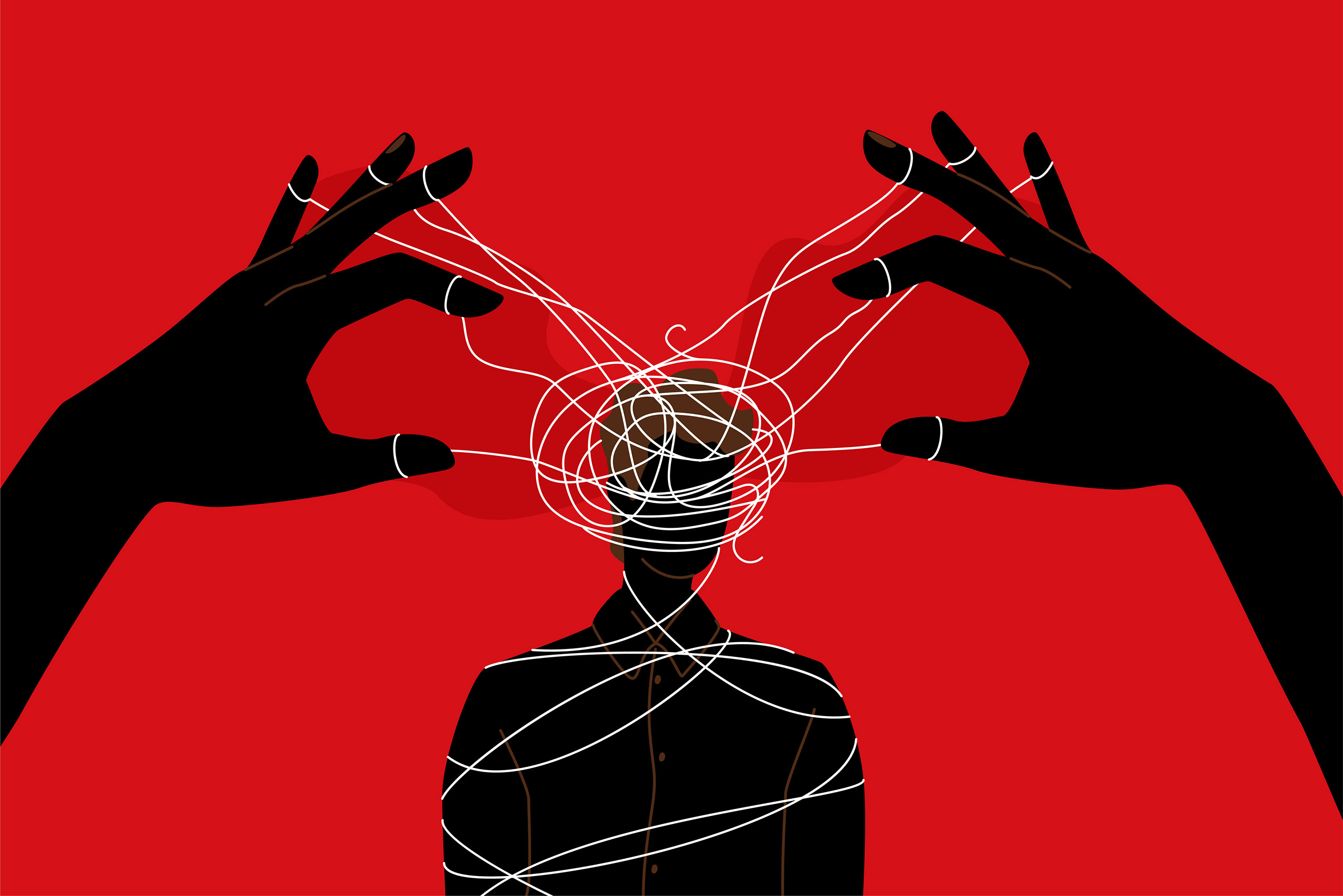
“Why do the many submit to the few?” This question, posed by Avishai Margalit and Assaf Sharon in their new book Captive Minds: A Study of Manipulation, surely invites immediate application to the contemporary political world, so much of which is held hostage to the will of a handful of imperious old men.
Yet Vladimir Putin and Benjamin Netanyahu are absent from the index, and Donald Trump gets only passing mentions. Instead, the authors are concerned with tracing the question to its best-known source in the philosophy of David Hume, and even further back to the work of Etienne de la Boétie, who wrote in the sixteenth century, a generation after Machiavelli. Force alone was not enough to account for the submission of thousands to a single tyrant, La Boétie reasoned.
Margalit and Sharon bring exceptional knowledge and experience to their subject. As cultural historians, they draw their lines of analysis through Montaigne, Hobbes, William Godwin and Tolstoy to the twentieth century’s Gore Vidal and Noam Chomsky. But what of the twenty-first? When it comes to compliance — a central factor in the success of manipulative politics — the second Trump administration has seen truly stupefying manifestations in the judiciary, the academy, the commercial world and the media. And yet the book doesn’t go there.
The authors make the case that examining political manipulation in ancient democracies and early modern republics helps to make us aware of recurring or enduring elements. Certainly many of the assertions drawn from historical sources have a keen relevance, all the more arresting for the terms in which they are expressed. La Boétie points to “practices and enticements” that serve to keep the people “stupefied.”
“Stupefied” is a good word for a study of manipulation. It communicates so much more than “stupid” and is not so readily weaponised. If claims that the people are stupid are replaced by the question of how they became stupefied, attention turns to causes and remedies. And so the authors set out to offer “a workable account of manipulation.”
The finger is most obviously pointed at propaganda campaigns, with social media as the arena of worst offences. But the authors also quote philosopher Susan Stebbing’s 1939 observation about the need to examine our individual failures of thinking, and the book’s argument is balanced between those polarities: personal responsibility for the formation of opinions versus external influences seeking to confuse or confound ethical judgement.
On the first, Margalit and Sharon take examples from literary and philosophical sources ranging from ancient Greek mythology to classics of the eighteenth and nineteenth century, with Shakespeare’s Othello as a recurrent illustration of how “perverting the way a person reaches decisions” is a deeply psychological process. It is also a form of domination. The authors emphasise that their main interest is in political manipulation, but Othello is a complex case of the personal being weaponised to political ends.
Margalit and Sharon introduce Plato and Aristotle as commentators on the centrality of flattery in tyrannical government. This is not just something that goes on among courtiers, as in Machiavelli’s account. Plato stresses the appetite for flattery within crowds seduced by grandiose figures purporting to embody their interests and aspirations. Aristotle identifies the strategy at all levels as “pandering to extract benefit.” Is this dynamic an insidious by-product of the arts of rhetoric?
That’s a disturbing ethical question. Rhetoric is the art of convincing, which is about more than presenting valid truths and arguments. It works by “engaging cognitive abilities” with opening gambits that implicitly flatter the audience’s intelligence: “This is a deep point…”; “We who can see through the lies…”; or (a Trump favourite) “Not many people know this…” But the book refers only in passing to the culture of sycophancy in the Trump White House.
Historical parallels can certainly be illuminating. Gustav Le Bon wrote in 1895 that new psychological characteristics emerge among people “from the mere fact of their being assembled.” This quotation appears in a section on mass manipulation, “mass-man” and the mob. Le Bon’s words could be applied, though, in a way he had not anticipated: what of the assemblies at Mar-a-Lago, or Epstein Island?
In our time, the concentration of wealth and celebrity in circles of political influence is a more bizarre and consequential manifestation of “new psychological characteristics” than anything we are seeing on the streets. The normalisation of plastic surgery, huge investments in immortality research, and exhibitions of infantile behaviour recall the excesses of eighteenth-century Versailles. The role of extreme wealth in contemporary manipulation is also something a book on this subject might be expected to deal with.
Concentrated analysis of psychological manipulation through the examples of Machiavelli, and Iago in Othello, may yield insights that apply to strategies used by influencers like Charlie Kirk, Tucker Carlson, Candace Owens and Ben Shapiro — or, for that matter, the left’s Rachel Maddow and Kara Swisher, who explicitly aim to call out manipulative tactics. Perhaps we should be able to draw the parallels for ourselves, but it’s complex work to untangle what is new and specific to the political dynamics of our times.
There’s certainly a case to be made for critical distance in an overheated political milieu in which public opinion is assiduously stirred by influencers seeking to push it into the red zone. Discussion of how manipulation contributes to the rise of the MAGA movement, the British Reform party or One Nation risks becoming caught up in the incendiary dynamics. The ideological vehemence of the Likud government under Benjamin Netanyahu, for example, has made commentary on antisemitism a high-risk activity, but it is one in which many forms of dangerous manipulation are at work.
What makes Netanyahu an especially striking omission from Captive Minds is the credentials of its two authors. Avishai Margalit is a professor emeritus at the Hebrew University of Jerusalem, and Assaf Sharon is professor of philosophy at Tel Aviv University and co-founder and senior fellow of Molad: the Center for Renewal of Israeli Democracy. Both have impressive records of active intellectual engagement with Israeli politics.
Margalit’s landmark books on the ethics of memory, occidentalism and compromise are informed by a lifelong engagement with the realities of a crisis-ridden nation. As a contributor to the New York Review of Books he has written articles on Yitzhak Rabin, Ariel Sharon, Yitzhak Shamir and Shimon Peres. In April 2023 he spoke with the New Yorker about the fusion of religion and nationalism strategically promoted in Netanyahu’s rhetoric.
Sharon’s Molad centre conducts research on forms of current populism associated with conspiracy theories, disinformation campaigns and anti-liberal incitement. He discusses the difficulty of speaking plainly in an environment where denunciations of the massacre by Hamas immediately bring accusations of being an apologist for Zionism. He, too, sees religious nationalism as an emergent force that deprives “actual living citizens” of the freedom to define their identity in the face of hereditary determinations.
They do return to the present in the final chapter, with a review of how manipulation is evolving in the present communications environment. They identify two primary aspects. One is the growing dominance of images in public discourse, which they describe as “a shift of momentous proportions.” Perhaps we need the perspective of a deeper history to see it that way, having taken it for granted for more than three generations.
The second factor is the rise of social media and independent blogging, and here the authors fall into the trap of judgementalism. They cite Gresham’s law: bad money drives out good. (Thomas Gresham, an advisor to Elizabeth I, urged her to raise confidence in the coin of the realm by reversing the practice of blending the metals with alloys.) Something similar, they say, is true of public discourse, when professional journalism is driven out by amateur punditry and the viral propagation of shrill opinion.
It’s a common complaint, but one that skates over the more complex realities. Social media is not all bad. To cast it as debased currency is to ignore the amount of genuinely informed and ethical concern circulating among regular contributors. In many situations it serves as counter to the heavily weighted messaging of billionaire-owned newspapers and television networks. Professional journalism is itself a debased currency in an era when media owners determine what is reported, and how.
The authors describe their own conclusion as “unsatisfying,” a word that may echo Margalit’s long engagement with the principle of compromise. Like generals, they acknowledge, philosophers tend to prepare for the previous war, but they rest their case for the value of hindsight on some fundamental principles, the most important of which is freedom. A free society can only be built on the freedom of individuals as thinkers and adjudicators of the most important issues confronting them. It is this freedom at the level of cognition that is the book’s fundamental concern. •
Captive Minds: A Study of Manipulation
By Avishai Margalit and Assaf Sharon | Harvard University Press | $64 | 288 pages