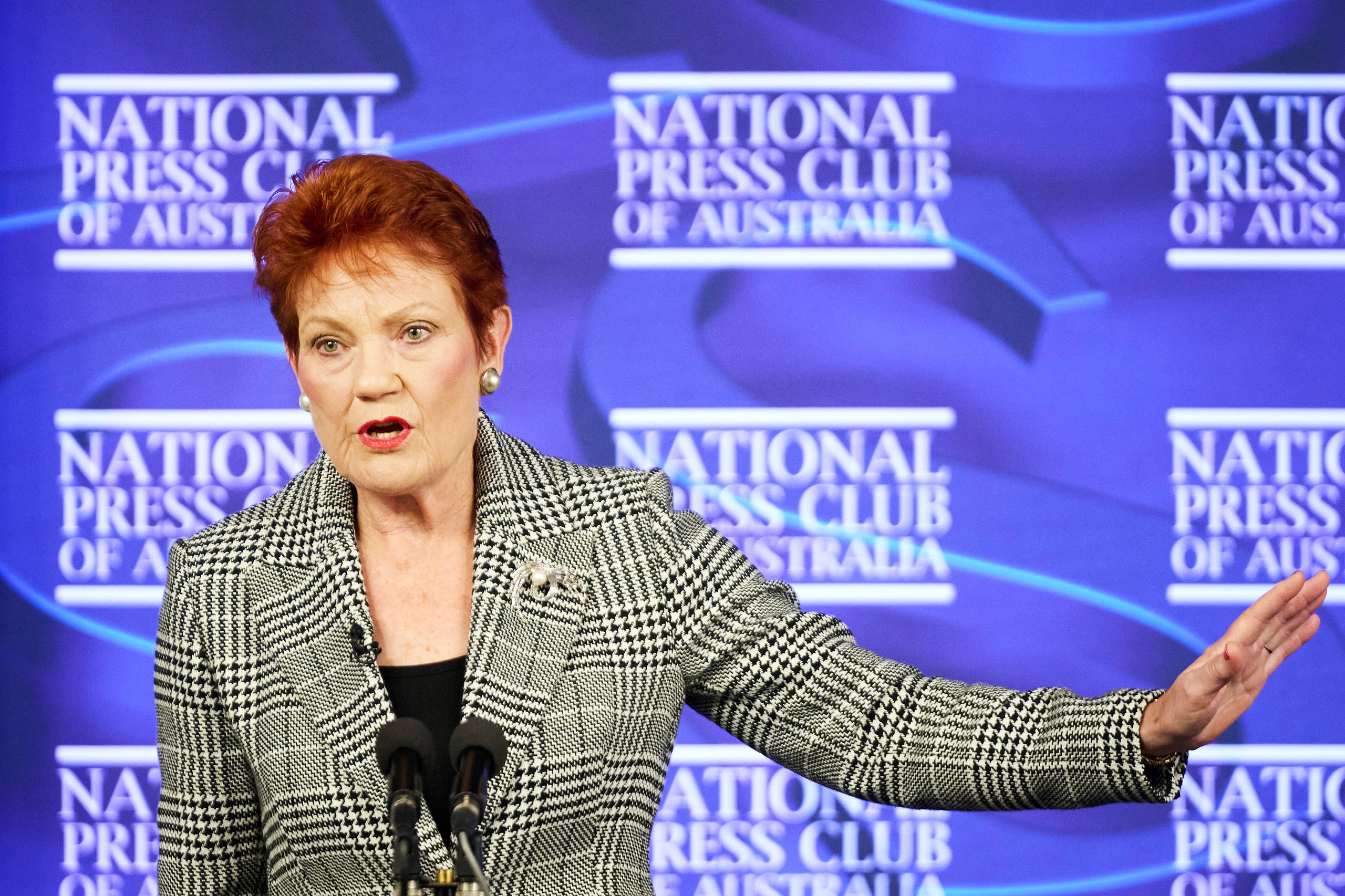
Pauline Hanson’s address to the National Press Club was the talk of the town — well, of the town in which I live, Canberra, anyway — for a few days last week. But GetUp!’s banner stunt and Hanson’s intemperate abuse of Guardian journalist Sarah Martin have distracted analysts from the best evidence we have so far of what One Nation, in the guise of a putative mainstream party of the right, now stands for. If it is no longer a minor party of protest rooted in rural and regional grievance and reaction, what exactly is it?
For full disclosure, I should say that I am among those who doubt One Nation will be able to sustain its momentum. It is therefore possible I found what I was expecting or even hoping to find in her address. Still, it is striking that once she no longer had a script written by someone else in front of her — once question time began at the Press Club — her discipline slipped and we got to see the old One Nation, and the old Pauline Hanson. In substance she sounded much like the right-wing Liberal she was before she lost preselection in February 1996 — even while her message was delivered in the familiar populist style that, through word, tone, facial expression and body language, constantly announces Hanson has “had a gutful.”
In her seemingly interminable speech — at one stage, the chair Tom Connell asked her to begin winding up — she was making a pitch to keep a hold on that 30 per cent of voters who are already saying they will vote One Nation and to add perhaps 5 per cent more. After refusing to give a “divisive Welcome to Country” (she presumably meant “Acknowledgement,” but never mind), Hanson spent most of the next three-quarters of an hour continuing to tell us who and what she hates.
Hanson remains, in that sense, what she has always been: a bundle of resentments and a harvester of grievance. But her present efforts meet with the most favourable of seasons for such a politician and movement: an energy crisis, a cost-of-living crisis, a housing crisis, high immigration coming out of Covid, and the Bondi terrorist attack. On the political front, the Coalition is a mess, its leadership ineffectual. Labor stumbles on — paradoxically, given its enormous majority would normally be considered unassailable in a single election.
Predictably, Hanson treated immigration as the cause of the housing crisis. She then went on to link the problem to “the utterly flawed policy of multiculturalism.” Australia is “multiracial,” she said, but should be “monocultural.” Liberal leader Billy Snedden said much the same thing in 1969: “I am quite determined we should have a monoculture, with everyone living in the same way, understanding each other, and sharing the same aspirations. We don’t want pluralism.” But back then, to call for “monoculture” still meant something: Australia had barely passed out of the era of Britishness, and the White Australia Policy, while on the way out, was still in place. Even the politicians contributing to the dismantling of that old order still assumed the place would remain a white nation even when they politely refrained from saying so. But what could “monocultural” mean today, unless it is a nostalgic appeal to an Australia outside the living memory even of ageing Gen Xers like me?
As a populist, Hanson naturally claims the privilege of defining what that culture is: she represents real Australians, not the kinds of people who read Inside Story. More than half the population was either born overseas or had a parent born overseas: “Is that what Australia wants?,” she complains. It is a startling pitch, vaguely reminiscent of the old-time bragging that Australia was 98 per cent British and that it needed to stay that way notwithstanding the covetous Asian hordes to our north.
Populist politics is obsessed with drawing boundaries between those who truly belong and those who do not. But it is surely risky in an immigrant nation that has had an official policy of multiculturalism for about half a century to draw the line where she and her advisers seem to have decided to draw it. Who does Hanson think is living in all those suburbs she wants to win back from the Labor Party if not migrants and their children?
All the same, Hanson more or less held it together during her haltingly read text. Australia is “predominantly a Judeo-Christian society” and “Western civilisation and its values are under siege.” “Radical Islam” and the “transgender insurgency” menace the country. Net zero is a “hoax.” Anthony Albanese is a “liar.”
And a few specific policies. Nuclear energy for Australia. More control of artificial intelligence. Abolish SBS. Turn the ABC into a subscription service for city people. End government financial subsidies to renewable energy: after all, “the bloke in the corner store” doesn’t get this kind of help. (To which the obvious retort is that “the bloke in the corner store” no longer exists. There’s that nostalgia again.)
I don’t doubt the popular resonance of this kind of appeal in our present moment, even while I am sceptical whether most Australians support having broadcasts of the World Cup football taken from them because Hanson objects to the existence of a multicultural broadcaster. That said, it is in keeping with the basic joylessness of her politics. Hanson began her political career, in local government, with a campaign to prevent the building of a library in Ipswich because she thought it was a waste of ratepayers’ money. It is hard to discern much change in her outlook thirty years later. She is one of life’s straighteners.
Alongside her selective nostalgia, Hanson combines a vision of homeliness, an articulation of resentment, and a performance of authenticity, however contrived. Even while One Nation takes Rinehart’s money and Hanson drops in on Donald Trump at Florida’s Versailles, Mar-a-Lago, she continues to play the outsider challenging the political establishment, the real taking on the fake. All of this is well calculated to appeal to people who believe the world is hurtling outside their control, nothing is what it seems, and that politicians — insiders all — won’t listen to them.
And to be fair, it is hard to have much sympathy with the mainstream politicians who looked on complacently for decades while house prices went through the roof and now find themselves berated for it by a gifted, tested political opportunist. Hanson spent a lot of time in her address talking about poverty, hunger and homelessness, too — perhaps part of an effort to give her cause some moral ballast and confound the accusation she is the puppet of filthy rich “Mrs Rinehart,” as she likes to call Australia’s wealthiest woman and One Nation’s most generous financial sponsor. Still, Hanson had no policy to offer the poor and the battler apart from suggesting less government spending and more coal would reduce their cost of living.
In this connection, One Nation has a problem — and that materialised once the question and answer session started. It was then that we got our reminder that Hanson, for all her longevity, is not a particularly creative politician. Successful populisms elsewhere have mixed and matched, assembling bits and pieces from the left and right to create a broad constituency and thereby take the wind out of more centrist opponents’ sails.
If she were one of these types, Hanson would have said that she intends doubling the parental leave allowance and spending even more on childcare by taking funding away from Indigenous people or universities or the ABC – or from other of the many “rorts” she believes are being perpetrated under our collective noses. Instead, she said businesses should not be expected to pay women who were not at work and that government funding of childcare is “out of control” and requires “investigation.” Come election time, all of this is likely to go down in Australia’s suburbs about as well as Peter Dutton’s working from home policy.
In short, as she entered full, unscripted flight, all of the familiar instincts came into play. She sounded like a reactionary who, even now, could find a home on the right of the Liberal Party — the place where she began three decades ago. When asked by Mark Riley from Seven about her consistent parliamentary record of doing over workers, she sturdily defended business in its efforts to deal with lazy employees. They should be easier to sack. She complained about abortions. She harped on about government spending like a hardened 1980s economic rationalist. But some areas of expenditure were especially unwarranted: money would be taken out of Aboriginal affairs and placed in “consolidated revenue.”
On One Nation itself, she said some remarkable things that have barely featured in media coverage. She recounted how she had refrained from creating branches when One Nation Mark II emerged in 2015 because there were 350 the first time round and “I had nothing but trouble.” That’s a pretty remarkable confession even by the standards of Australia’s somewhat reduced political parties: the rank and file can’t be trusted, so let’s not have one. But One Nation does now have branches, although they seem to operate under bizarre controls and restrictions. Hanson’s support for constitutionally enshrined freedom of speech doesn’t apparent extend to them. Why? Because “I have to be in total control of it.”
There is also the not inconsiderable issue of how a party whose current lower-house presence amounts to two seats — one of them the result of Barnaby Joyce’s defection from the Nationals — will be translated into a credible competition for executive power. Interestingly, much of the media has been so entranced by Hanson’s verbal abuse of Sarah Martin that nobody picked up that while she was in full flight she indicated she intends to run for the Senate again.
No journalist asked the obvious question of whether she — or her new colleague Joyce, for that matter — would be standing for the House of Representatives now One Nation is supposedly vying for government. Indeed, there is a surprising indifference in the commentariat about this hardly trivial matter: it is as if it is imagined the sheer force of populist passion will sweep away all institutional barriers in the name of the people’s will. Those who recall the Joh for PM fiasco of 1987 will understand how magical that kind of thinking is in a parliamentary democracy.
It is often being said that One Nation is a more professional outfit than it used to be. Probably so. It certainly has plenty of money and is working social media with apparent success. Nonetheless, it is also still Hanson’s show. Her deepest instincts appear to remain those of an ageing minor-party leader more interested in saying what the 5 or 10 per cent of voters who form her traditional base still want to hear. The parallel with Peter Dutton’s retreat into culture wars and Sky appearances during the last election campaign is striking.
Coalition strategists seem as likely to remain as at a loss about how to respond to the One Nation threat following Hanson’s Press Club address as they were before it. Labor strategists, on the other hand, have been given a generous allocation of material to work with. •