Politics in Australia is simultaneously everywhere and nowhere. Measured in terms of their apparent emotional connection to issues and causes, Australians seem more “political” than ever, and yet political institutions and voluntary organisations are shells of their former selves.
Twelve per cent of Australian employees are members of trade unions, down from 65 per cent eighty years ago. Australia’s main political parties are hollowed out: at the probable high point in 1953, 1.2 per cent of the adult population carried a Labor membership card, but the figure today is 0.2 per cent, a smaller percentage than the Communist Party had at its peak in 1945. The Liberal Party boasted 197,000 members in the 1950s, down to 40,000 today.
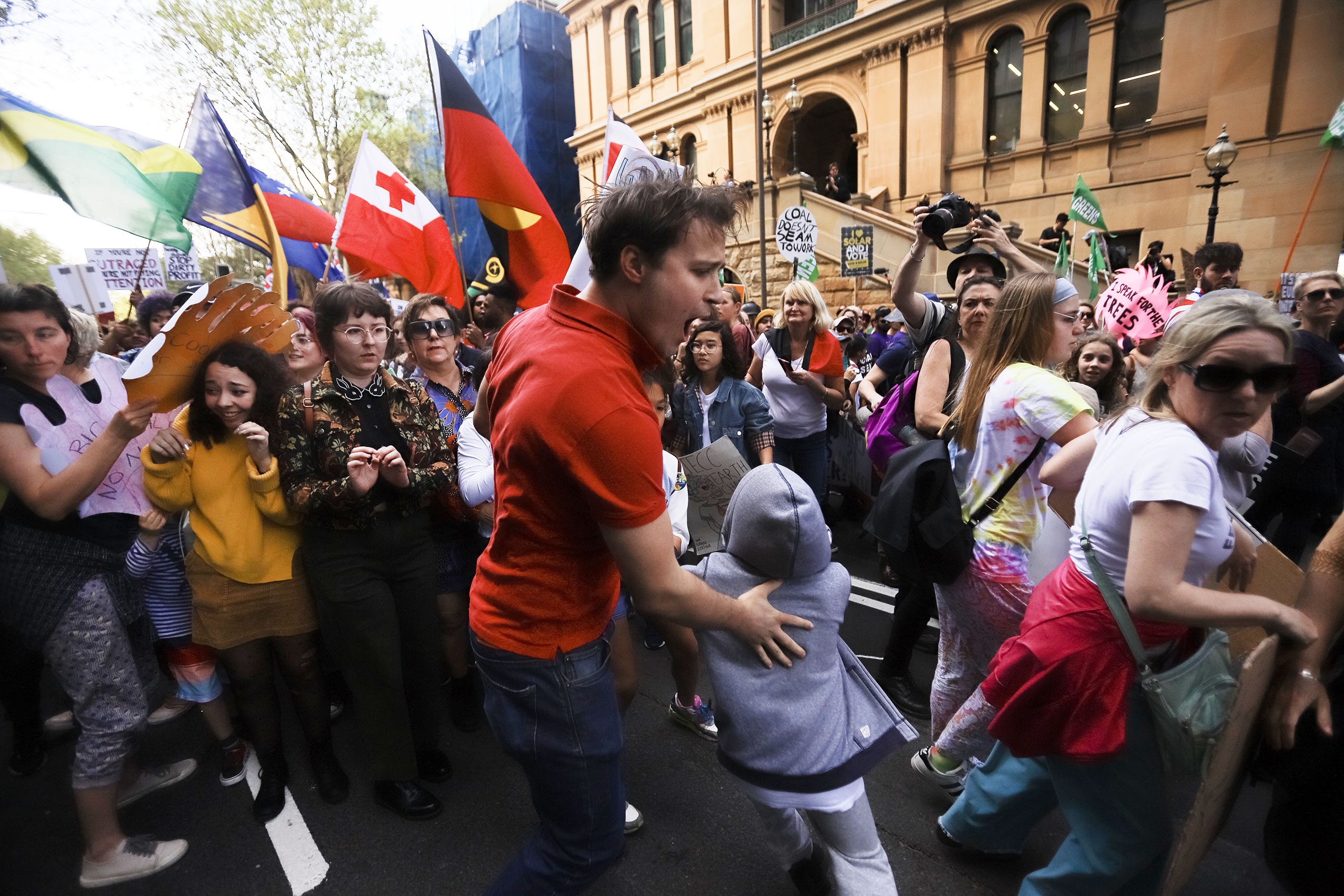
And yet, a whole swathe of Australians have been politicised since 2018. On the left, by the school strikes for climate, the Black Lives Matter movement, the women’s March4Justice, and mobilisation against the mandatory detention of people seeking asylum and in support of Palestinians. On the right, by the anti-lockdown protests and the more recent anti-immigration March for Australia rallies.
Australia is not alone. Among OECD members, an increase in turnout at elections is evidence of this increased politicisation. The 2016 Brexit vote was the biggest democratic vote in British history. A record turnout elected Joe Biden US president in 2020. With Australia’s compulsory voting system, other metrics must be sought. The Australian Election Study, or AES, reports that only 2 per cent of its respondents either attended a political meeting or rally, or contributed financially to a campaign, during any election in the late 1990s, both measures rising to 6 per cent in 2025.
Politics is also everywhere, and yet also nowhere, across anglophone and European countries. Historian Anton Jäger suggests we understand this current moment as “hyperpolitics,” the title of his new book. The Oxford political historian makes no reference to Australia in Hyperpolitics, yet its arguments help us to understand our present moment.
Laid on top of Australia’s recent past, Jäger’s historical periodisations go something like this.
Mass politics dominated the twentieth century, with high rates of politicisation and institutionalisation — that is, high membership numbers among political parties, trade unions and other voluntary organisations. Australia experienced its peak expression in the 1930s and 1940s, when even the Communist Party totalled about 23,000 members, and in the early 1970s, with a period of trade union shop-floor militancy and considerable social movement mobilisation. The 1970 Vietnam moratorium, for example, attracted around 200,000 people nationwide. During this period, political engagement had a discernible impact on policy: land rights, equal pay and superannuation, to name a few.
The fall of the Berlin Wall ushered in what Jäger calls a period of “postpolitics” — the 1990s and 2000s, a time of depoliticisation and “collective amnesia.” In Australia, too, we had seemingly reached the end of history. A Labor treasurer embedded economic rationalism (known today as neoliberalism) and announced “the recession Australia had to have.” Society grew increasingly individualised, with Andrew Leigh recording a decline in membership of voluntary organisations in his study of civic engagement.
In culture, it was a golden era, but there was disquiet too; the turn of the millennium saw anti-globalisation protests against the World Economic Forum meeting in Melbourne and the well-attended Walk for Reconciliation with Australia’s Indigenous population. Demonstrations against the Iraq war followed. But, unbelievably by today’s standards, people were pretty happy with politics: 86 per cent were “satisfied with democracy” on the eve of the 2008 financial crash, reported the AES.
That figure fell to 60 per cent by 2016. For Jäger, the global financial crisis marked a turning point as OECD countries entered a period of “antipolitics” (which, of course, was really a form of politics). It seemed that history had not in fact ended, and political engagement surged.
At this point, Jäger’s periodisation fits less neatly into Australia’s recent past. Perhaps because this country avoided a recession following the financial crisis, the clearest manifestations of antipolitics — the rise of Trump and Sanders in the United States, Podemos in Spain, Syriza in Greece, and Corbyn and Johnson in Britain — passed us by. Aside from a small Occupy movement in 2011, Australia was politically quiet as Labor leaders played the hokey pokey. Perhaps the “long 90s” era of postpolitics persisted longer here. Elsewhere, Jäger argues, the antipolitics era of high politicisation and low institutionalisation “mutated” around 2020 into hyperpolitics.
Regardless of when this occurred in Australia, hyperpolitics defines our current political moment. Perhaps it began in Australia with the student climate strikes in 2018, with the Black Lives Matter rallies not long after. Both have contributed to a shift in public opinion on climate change and racial equality but, at least in the minds of those involved, little material change. On the right, hyperpolitics found early expression during the pandemic during the anti-vaccination and anti-lockdown protests in Melbourne.
Demonstrations across Australia in support of Palestine from late October 2023 provide the most recent manifestation of hyperpolitics. In the twenty-three months following the Hamas attack, Australians organised more than 900 pro-Palestine protests, placing Australia ninth globally for pro-Palestine activity, and fourth among non-Muslim majority countries.
And the protests were big. Over that same period, Australia ranked second only to Yemen when counting protests attracting more than 10,000 people. In early August 2025, an independent expert estimated that more than 225,000 people marched across the Sydney Harbour Bridge. A few weeks later, after UN experts declared Gaza was experiencing a “man-made” famine, a day of action was organised in forty locations across the country.
Given Australia’s prescription as a “low protest country,” this activity is significant. But very little of that political energy has been converted into building sustainable institutions, as it was in the era of “mass politics.”
Hyperpolitics afflicts the right too. Australia ranked sixth globally for its thirty-four pro-Israel protests in the twenty-three months following 7 October. But this too lacked institutional foundations. One Nation claims to have more than 60,000 members, which would make it Australia’s largest political party, and yet it remains a shell of an organisation, struggling to control its newly established branches and reliant on its leader for brand recognition. Its supporters, one in four Australians according to latest polling, might have similar Facebook algorithms, and some of them gathered against “mass immigration” at the recent March for Australia rallies, but the right suffers as much as the left from low institutionalisation of political engagement.
Jäger is a Marxist, or at least that, he says, is the “easiest thing… to call myself.” Naturally and intentionally, then, his book is a contribution to the debate on the left’s current strategy. Where postpolitics “first split politics from policy,” hyperpolitics has widened this gulf, he explains. Current political engagement on the left has become shallow: “low-commitment, low-cost, and all too often, low-value.” It is easy to attend a march or to fashion a Palestine flag on your laptop. It’s even easier not to attend another march, or to remove that sticker. The “price of membership” to engage in politics today is low, “the costs of exit even lower.” People are highly politicised without their activity contributing to the building of any enduring institutions.
Jäger, only thirty-two himself, is not simply nostalgic for a well-organised labour movement: “Today’s impasse can hardly be undone by a voluntaristic act of will, simply because a young Belgian historian [Jäger is Belgian] exhorts citizens to join a local party branch or take out a union card.”
But let’s indulge in nostalgia for a second. The left in Australia sought to curb the decline of institutionalised political activity at the onset of the postpolitics era. Over an Easter weekend in 1986, socialists, communists, environmentalists, feminists, Indigenous rights activists, peace activists, trade unionists, Labor politicians, and even a minister in Hawke’s government met in Sydney for the Broad Left Conference. They faced the same problem progressives face today: they were all politically active but not necessarily working strategically for a common goal. As Brian Howe, soon to be the country’s deputy prime minister, put it to the opening session, a strong, united left was “critical to keeping Labor governments honest — and in power.”
The tide of history towards an era of postpolitics was too strong for the conference delegates to resist. That our current moment requires the “reinstitutionalisation of political engagement,” Jäger is certain. What form would this take? Perhaps Jäger will reveal this in a sequel, given that he makes only brief suggestions of what is to be done in the book’s final few pages.
An obvious criticism, but nonetheless one worth making, is that Jäger’s thesis focuses only on (some) OECD countries, mentioning the Arab Spring, for example, only in passing. In a feature article for the Guardian, he admits that “I don’t have the linguistic and cultural reach to fully tell this story globally.”
Nor is Jäger’s thesis wholly original. He admits as much, referring to his intellectual influences in the book. Where his book differs is in the presentation, style and tone. It will seem to some, particularly fellow academics, a superficial point, but it matters. The cover is an eye-catching bright yellow clad with photographer Wolfgang Tillmans’s Love (Hands in Hair) (1989). Young (and yes, perhaps vain) progressives will be happy to be seen reading it in their favourite coffee shop. Importantly, though, the book challenges the performative nature of high politicisation. Its simple title and relatively simple thesis challenges readers’ preconception of what political engagement is, and provides them with the means to historicise, understand, and articulate our current moment. The book is doing politics. Minds are being changed.
Hyperpolitics has been “devoured by the left” in Britain, and yet has received limited coverage in Australia, perhaps because the publishers only sent a small initial shipment. With bookstores reportedly receiving a much larger shipment later this year, its broader pickup by Australian progressives might be delayed but could have a similar impact. It will come as One Nation faces a key electoral test and Labor seeks an unprecedented fourth term at the Victorian election.
Might Jäger’s book itself fall victim to hyperpolitics? It is easy enough to consume Jäger’s core argument by watching a sixty-second “critical theory” TikTok, listening to the author on your favourite podcast or even reading, as here, a short review. If you read the full 128 pages, Jäger can escort you through his periodisations. The journey might challenge and expand what you consider to be your own engagement in Australian politics. Is it of low-value and low-commitment? You might well find yourself seeking more meaningful and more effective sites of engagement. Hyperpolitics is essential reading for any Australian who has a growing sense that their political activity is futile — that they are engaged in, to echo the book’s subtitle, “extreme politicisation without political consequences.” •
Hyperpolitics
By Anton Jäger | Verso | $26.99 | 128 pages