What might have been. The poet Wystan Hugh Auden was fond of writing librettos, at first alone, later with his long-term partner Chester Kallman. Just a handful of their operas made it to the stage during Auden’s lifetime. Only The Rake’s Progress, with a score by Igor Stravinsky, surfaces still in contemporary repertoire. It is programmed for La Scala next year.
Then came the opportunity. Auden’s schoolboy friend Christopher Isherwood believed his novel Goodbye to Berlin would make a great musical. Isherwood and Auden lived in Berlin during the Weimar Republic, revelling in nightclubs, avant garde art and sexual freedom unknown in Britain. Isherwood’s novels explored a historic moment both men experienced, recalled characters each knew. So would Auden write a script about this city of their shared youth?
Unhappily, Isherwood found Auden distracted and unfocused; talking with him about the musical proved “futile.” So Isherwood accepted an approach by playwright John Van Druten. The result, I Am A Camera, eventually became Cabaret, winning eight Tony awards and becoming a staple of musical theatre.
In Auden, Peter Ackroyd’s new biography, we learn that the poet spent much of his life worrying about money. A Broadway hit would have helped. But then Ackroyd isn’t describing a happy life: the Auden who emerges is simultaneously shy and domineering, sensitive to landscape but uncaring about his immediate surroundings, celebrated for his radical departure from Victorian poetic customs yet increasingly conservative. A man caught early by ageing, resenting those tedious speaking tours necessary to pay the bills, increasingly isolated, frustrated and lonely.
This is a portrait of the artist, not principally a discussion of the work. Ackroyd traces Auden’s privileged middle-class family, the boy who liked to sing in a choir. A short-sighted and anxious teenager. A student at Christ Church Oxford who attended classes by the young Professor Tolkien and formed a life-long attachment to the rhythms of Anglo-Saxon verse. A homosexual from his youth, though with a sense of sin, narrow tastes and much attendant despondency. “The poet’s heart was made to be broken,” concludes Ackroyd.
Though much identified with the left, the young Auden was more interested in poetry than politics. He needed to write every day, and his shifting interests — or “magpie scholarship” in Ackroyd’s phrase — play out in verse often “difficult, compressed and convoluted.” After that post-Oxford gap year in Berlin, he travelled widely through the disturbed and increasingly dark 1930s. He spent time in civil war–era Spain, and later China, as “an observer with vaguely socialist sympathies.”
Celebrated as the voice of his generation, Auden won praise early and often; aged just thirty he was presented with the King’s Gold Medal for Poetry by George VI at Buckingham Palace. Yet Britain seemed constraining and the outbreak of the second world war famously found Auden in a bar on 52nd Street in New York, uncertain and afraid, “as the clever hopes expire/ of a low dishonest decade.”
America would remain his primary home in the decades ahead, teaching first in schools and then at various liberal arts colleges when necessity required. Late in life he spent each summer in the Austrian village of Kirchstetten, enjoying singing in the local church. The laneway leading to his former house is now Audenstraße.
Wherever he was based he would work on his lectures, poems and reviews, shuffling through the streets in carpet slippers because of corns and bunions, smoking heavily, addicted to Benzedrine since his thirties and drinking heavily from his forties until the end of his life. One observer found him “an aloof, reclusive personality, at the centre of which was massive loneliness.” A man ill at ease in the world, he often failed to bathe and wore the same clothes. Stravinsky described him as “the dirtiest man I have ever liked.”
Here lies the challenge for the biographer — separating a difficult and sometimes tragic character from the work. On this (as on most things) Auden held strong views. The writer, he asserted, is irrelevant to the poetry. It doesn’t matter who wrote the lines — a poem converts private experience into a public form, and in doing so becomes an impersonal, public object.
Yet sometimes Auden decided his published poetry was no longer acceptable and must be withdrawn. He would criticise a line, or even a whole work, as mawkish or lacking conviction and strike it from his collected works. As Ian Sansom documents in 1 September 1939, the memorable poem of that title became anathema to its author, principally because of its closing line “we must love one another or die.” As Auden later decided, the line was “a damned lie! We must die anyway.” First he changed the line, then he removed the offending stanza, and finally he banned the entire poem from anthologies.
For a poet who wrote that “poetry makes nothing happen,” words clearly mattered. Over decades Auden tried and mastered many different poetic forms, from numerous comic poems to a late obsession with haiku. He could laugh at himself too; “my face looks like a wedding cake left out in the rain” he said at a sixtieth birthday party in 1967, inspiring Jimmy Webb to write the hit song MacArthur Park.
In a life already overshadowed by sadness, Auden endured further disappointments in his final years. Elected professor of poetry at Oxford, he looked forward to a convivial life in college. The reality he encountered had profoundly changed since his undergraduate years: engaging dinner conversation in hall was cut short when scholars retreated early to their research.
Stooped and out of breath, telling the same stories over and over, Auden described himself as “an old fogey” while still in his fifties. By then his interest in politics had faded. Though claiming to be an atheist, he quietly returned to the Church of England, becoming devout, even dogmatic, about his faith and less engaged in current events. He was always living in his own moment; as Stephen Spender observed, the poet “made a cult of whatever he happens to be doing.”
In September 1973 Auden caught a train from Kirchstetten to Vienna for a poetry reading before returning to Oxford. It was not a success. He was so wheezy he could hardly speak, and his presentation lasted little more than fifteen minutes. He waved away supper and headed to his hotel. When Chester Kallman called by in the morning, Auden was dead, a half bottle of vodka and sleeping pills by his bed.
A paragraph later Kallman is dead at fifty-four and the book ends abruptly. No reflection on the life, no tracing the journey in Auden’s poems, no assessment of where Auden’s oeuvre stands today.
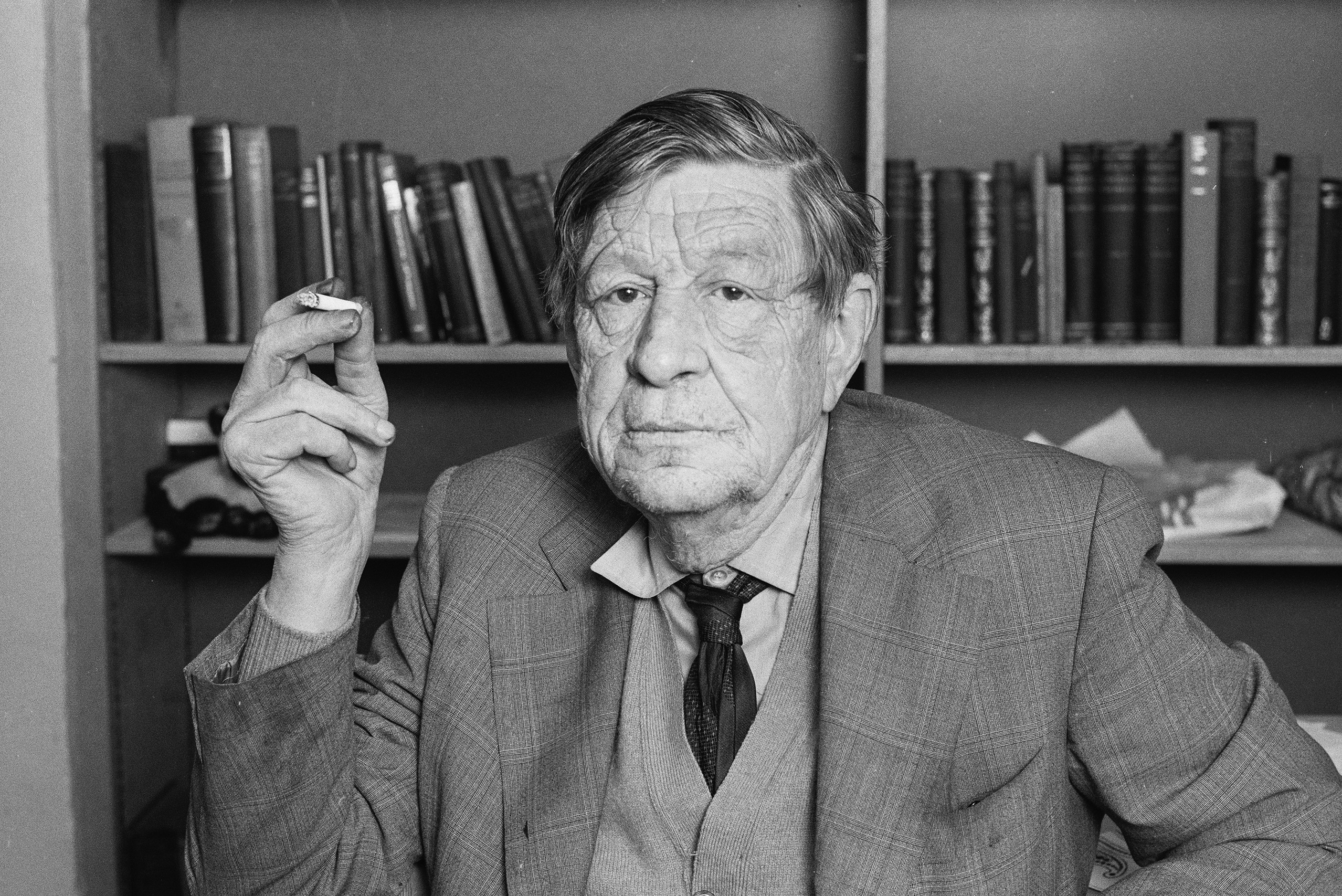
A handful of reviewers have criticised Peter Ackroyd’s Auden as too focused on the life. The familiar introduction, footnotes and scholarly discussion of previous studies are largely absent. But this is a biography, not literary criticism. Its portrayal of the poet is complex, detailed and sometimes confronting. From behind that crumpled face emerges a real person, his chaotic appearance a sharp contrast with the disciplined writer and deeply knowledgeable lecturer on poetry.
Ackroyd stresses Auden’s astonishing ability to master new and demanding rhythms, his grasp of English poetic forms, his unexpected contributions to liturgical verse. This was an artist who ranged across theatre, opera and criticism alongside a lifelong commitment to poetry, who wrote perceptively about the work of others and obsessed about his own. A melancholy narrative contrasts with the tone even of Auden’s final poems — grateful for friends, for life and place, even for those loved who didn’t love back. Words as consolation, words through which one poet made sense of a shambolic but sometimes transcendent existence. •
Auden
By Peter Ackroyd | Reaktion Books | $39.99 | 400 pages