Everyone said I shouldn’t go. Friends and family — even my preternaturally understanding husband — were all against it. They thought there was no way I’d make it through the border.
They got me to check my social media. Close to the top: incriminating comments about the re-election of Donald Trump at the Australian Institute of International Affairs.
I had to admit they had a point. The Australian government’s Smartraveller makes it clear that US border authorities can refuse you entry for essentially any reason, including calling the president capricious and meretricious. It links to a helpful list of everything that authorities might ask to see, up to and including your bank account. To top it all, you can be held in a detention facility while US authorities arrange your return, meaning it could be a long trip for worse than nothing.
But I stubbornly wanted to get to Boston for a thirtieth anniversary reunion. When I studied there, I thought my work would take me back often, but I don’t get back there much. Like Australian foreign policy, most of my work focuses on the Asia-Pacific. I’ve made the effort to get to the tenth and twentieth reunions not just for the social aspect, but to get a sense of currents in American defence and foreign policy.
I found it hard to believe that Boston wouldn’t still be Boston. My friends and family seemed to expect a smouldering ruin.
I decided to go to see who was right.
To make it more likely that I’d be allowed through the border I organised to give talks at the US Naval War College in Rhode Island and the National Foreign Service Training Center in Virginia. I set up meetings at the Australian embassy in Washington.
It would mean a busy week taking Amtrak from Newport to Boston to Washington. But if it worked, I’d get valuable impressions of what has changed in Trump’s America. It would still be only a slice of a very large country, but it’s the area I know best to compare.
It’s also an area that includes much of importance in foreign and security policy. On the train route, I would even be able to see bits of the submarines Australia hopes to secure through AUKUS, with the two key companies that produce the Virginia class in Newport and Connecticut.
I carefully gathered a portfolio confirming every meeting, every train ticket and every hotel booking. I prepared myself to answer detailed questions to the satisfaction of the relevant border official. I steeled myself for awkward conversations.
All of which proved unnecessary. I was waved through at Dallas Fort Worth with the words, “Enjoy your class reunion.” So it is fitting that the image that has stayed with me from my travels in Trump’s America is from the reunion.
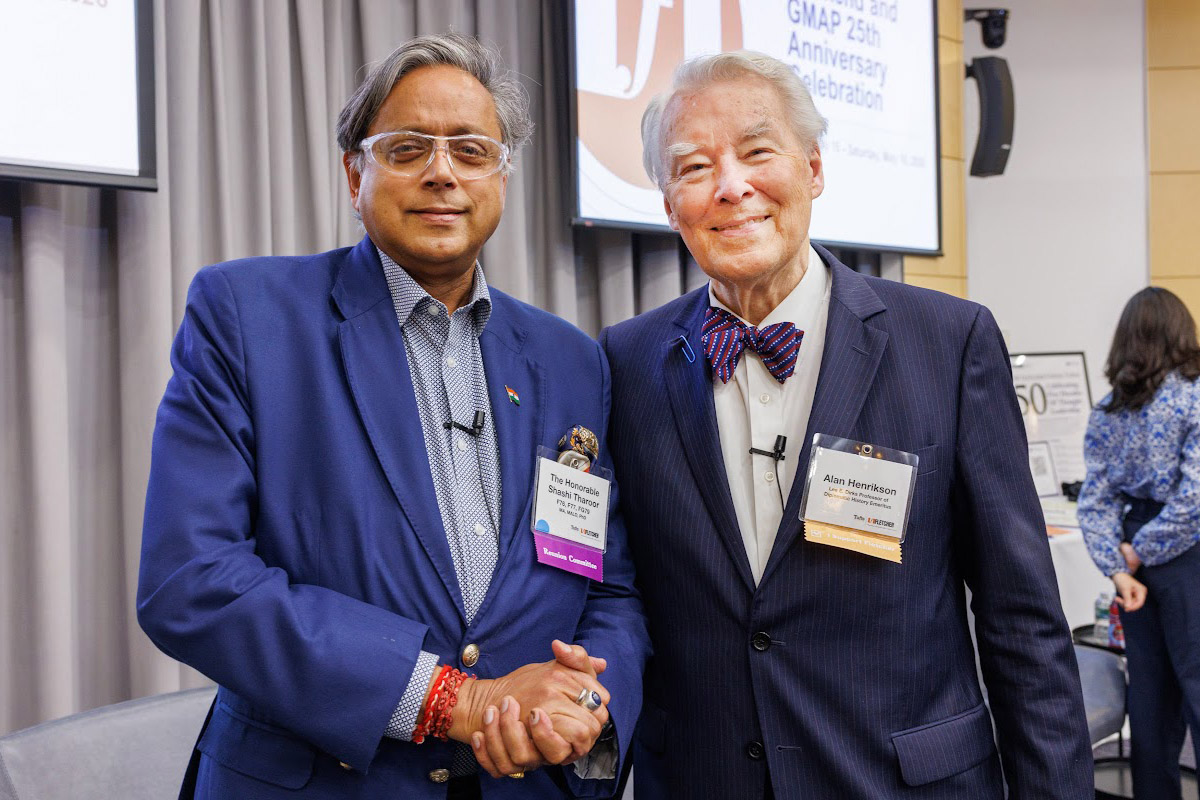
It’s a blue paperclip. Specifically, a blue paperclip on the lapel of a tailored suit, set off by a crisp white shirt and a patriotic bow tie in red, white and blue.
This ensemble was sported by a tall, white-haired gentleman of impeccable manners. You might be thinking Uncle Sam, but the wearer is a very real emeritus professor of diplomatic history, Alan Henrikson.
During a panel discussion with the appropriate title “Interdependence Without Trust,” he explained the origin of the paperclip as a symbol of resistance worn by those who believe in democracy: “The Norwegians in World War II — in opposition to the German occupiers and the Quisling Government — wore paperclips to represent a commitment to the preservation of democracy and defence of their rights and freedoms.
“There is a paperclip resistance movement in the United States now,” he went on. “Resistance is for a purpose… Opposition is really important in defence of something. And you realise what you are defending something for if you’re engaged in the fight.”
To hear these words from such a figure in such a setting was shocking. The Fletcher School of Law and Diplomacy has spent ninety-three years training top diplomats, military strategists, UN officials, international business executives and civil society leaders. It is one of the key training grounds for the American military, business and foreign policy elite.
Institutions like Fletcher are imbued with a deep seriousness about US relations with the world and, crucially, inculcate in students a lifetime’s devotion to an area of expertise. This idea — that you can’t just wing it when you’re dealing with war and diplomacy — is anathema to Trump’s worldview.
It felt like America’s past talking back to its present.
Travelling in Trump’s America, you can tell a story about what hasn’t changed. But another story talks about what has. The most interesting story traces the blue paperclip of resistance between these two and thinks about how the rest of the world should be responding.
On the list of things that haven’t visibly changed I’d put cities like Boston, Providence and New York — places with a lot of history and confidence in their identity.
What I saw when I walked out of Boston’s South Station was a farmers’ market and a lunchtime concert outside the public library, “built by the people and dedicated to the advancement of learning.” It was hard to square with the news out of America I see at home. When I go to see the baseball, the cultural experience seems timeless.
But then I’m travelling on a beautiful new tramline and the woman with multi-coloured hair next to me tells me she’s on her way to an interview to test her language skills so she can emigrate. She’s nervous; she’s clearly an English native speaker but seems to think the Canadians will demands higher standards. I asked her why she is leaving the US and got a single word answer: “Trump.”
Or when the woman next to me at a Broadway show hears my accent and apologises for what the US is doing in the world. An American apologising for America? She hastens to tell me that Americans don’t all agree with Trump. I could probably have got that from some of the jokes that have been added to Chess, the cold war musical we’re watching, about whether any US President would be crazy enough to launch a nuclear attack. Cue a meaningful look at the audience.
Washington is where I see the change most. The train that takes me there is painted in huge letters with the names of the president and his transportation secretary, as part of the Freedom 250 campaign to mark the 250th anniversary of the United States. Walking out of the station, my view to the Capitol — that famous view — is blocked by a sign saying “Thank you President Trump.” I see another thanking him for the national parks. A Washington Post columnist says these “signs appearing around the capital twist appreciation and patriotism into an authoritarian knot”.
I see National Guards everywhere, some of the thousands from nearly two dozen states deployed after Trump declared a public safety emergency last year. I believe the operation is called the DC Safe and Beautiful Task Force. It feels more like an occupation. Taxi drivers either claim they’re apolitical — the very first time I’ve encountered this — or are volubly pro-Trump.
I’m conscious when I speak to people like me who work in foreign policy and security that I am careful about what I ask and they are careful about what they say in return.
If I’m impolite enough to ask, I can get a sense of how difficult things are for a certain type of people in Trump’s America. Much of this is on the public record.
Before I visit the US Naval War College I can see online the significant changes in its staff and a purge of books from its library. On the radio in DC I hear an advertisement offering “support for people in the National Capital Region impacted by the Administration,” including help with networks and careers. Life is different in a system where the Executive argues it is not constrained by law.
When I listen to Fletcher’s State of the School report I learn about the headwinds it faces. The Trump administration has cut federal research funding, for example on issues like migration and climate change. State Department and Military Fellows programs have been terminated. International students are being discouraged by new visa restrictions and federal loan caps.
In response, the Fletcher School has established an international student loan program and is finding other creative ways to pursue its mission. Its dean, Kelly Sims Gallagher, talks about the importance of Fletcher’s work in maintaining international relationships, “knitting at the social and individual levels.” She says, “These really are tough times. Thank you for all you are doing.”
Clearly it isn’t easy. Reunion organisers said that this was the lowest-ever attendance by international students. But the challenging environment isn’t evident in the program. There are panels about geopolitical competition and interdependence without trust. Speakers offer advice on how the US should manage its relationship with Europe.
Leafing through the latest issue of the Fletcher Forum of World Affairs I find articles arguing for peace diplomacy, human rights and the clean energy transition. One article outlines the impact of the abrupt shuttering of USAID and documents nearly 600,000 deaths over the next eight months, countering secretary of state Marco Rubio’s testimony to the House Foreign Affairs Committee that no one has died because of these cuts. The authors’ lament could stand for many current issues: “Is it wise to devolve toward naked transactionalism amid the rise of collective challenges?”
Once I start looking, the blue paperclip is not the only sign of resistance.
When I stock up on lip balm at the Australian chain Lush in Boston I notice signs in the window that aren’t just for products: “EVERYONE has constitutional rights, citizens and non-citizens alike” and “ICE Free Zone.”
A current Fletcher student sends me examples she’s been collecting. There are “No Kings,” “Refuse Fascism” and “Resist Tyranny” signs on rubbish bins and traffic bollards. A cut-out of the Statue of Liberty on a front porch with the word “Defend”. One favourite (although the rudest) is “F*** ICE” written in the snow.
I see different parts of America resisting. It might be a church flying a sign saying “Trans Folks are Beloved” or “Black Lives Matter” or calling for a “Racial and Eco-Justice.” It might be a community group calling for “The Fall of the Trump Fascist Regime.” Or a museum advertising an exhibition on “Patriots of Color,” reminding us of the diversity that has always existed in America’s armed forces.
All are small acts of defiance. The question we will all be watching is how much effect are they having?
No one I spoke to during the week had anything positive to say about the Iran war, and polling was showing just how unpopular it has been. Americans say how deeply they are concerned by the cost of living. Perhaps they are now making the connection and blaming this on Trump.
Insiders believed that Trump would stop the Iran war at the exact time domestic politics requires so that the war is not top of mind when Americans vote in the upcoming midterms. But it’s clear he is finding it hard to end the war with Iran in a way that he can convincingly call a victory. Perhaps listening to experts, such as those the Fletcher School has trained since the 1930s, might have helped.
I’m glad I went, not just for me but for the people I met. The last thing they need is to feel isolated.
That doesn’t mean sugar-coating anything. When I spoke at the National Foreign Service Training Center I presented factual information on how the Australian public views the United States. Currently only 31 per cent of Australian trust the US to act responsibly in the world, the lowest level ever recorded. This is information that can be used to argue for a different approach.
One person I spoke to suggested the world needs to show the US more grace at a genuinely difficult time of generational transition. Others talked about the ebb and flow in democracies and the self-correction mechanisms in the US political system. I was warned not to expect a coherent US foreign policy until this takes place.
That moment which stayed with me from the reunion also gave me a sense of how rigidly partisan the United States is today. A young woman who teaches a global decolonisation course gets cheers from the audience when she talks about reconceptualising “legacies of imperialism and inequality in the international system — both economic, cultural, racial and gender” while a white man with a blue paperclip doesn’t. I see an audience fractured into tribes, polarised like the rest of the country.
People of goodwill are working on bridging these divides. One of the most positive conversations I had was next door to the Fletcher School at the campus Hillel Jewish life centre. Talking with a student and his family there to see his graduation, I learned that his extracurricular activity hadn’t been sport or drama — but how to learn to talk about difficult topics. A Building Bridges initiative brings students together for conversations across religious and political divides along with a specific dialogue on Israel/Palestine for students committed to shared learning in a space respectful toward diverse voices.
I read that 50 per cent of Americans don’t want the erosion of trust in the US that is happening in the world. And I wonder whether discouraging travel might partly be about isolating these Americans who want a different future for their country.
If you can, it is worth going. To support what has survived. To see America go through its process of cultural and political revolution. We will see what comes out the other side. •