Christian Swegal’s Sovereign (Amazon Prime) moves with quiet inevitability towards a terrible conclusion. Tense, difficult and deeply confronting, it is an emotionally precise film. This is tragedy rendered in muted colour palettes and a perfectly calibrated soundscape that conveys anxiety, dread and the heavy, crushing weight of American precarity.
With the recent Porepunkah shootings, Sovereign will resonate for Australian audiences. If nothing else, it is perhaps the most accurate cultural expression of the pseudolaw phenomenon to date.
Sovereign is based on the true story of a deadly encounter between Jerry and Joseph Kane, a father and son, and West Memphis police officers in Arkansas. Swegal’s film concludes more or less where the real timeline ends, but it is everything leading up to that moment that gives the closing scenes their devastating impact.
As a story about sovereign citizens and pseudolaw told through the lens of fathers and sons, the film frames sovereign ideology as more than a series of legal claims. It is something lived, presenting familial paternalism as the analogue of governmental paternalism. Told in this way, sovereign-citizen belief is a drama of care, abandonment and control.
The first act introduces Joseph (Jacob Tremblay), a lonely teenager who quietly accepts foreclosure papers when the county sheriff delivers them. But Jerry (Nick Offerman), returning home, declares that nothing has been “delivered” to him and the bank must “follow the proper channels.” In sovereign lore, documents delivered to a house are not delivered to the “flesh-and-blood” person unless physically accepted. “They’re going to auction the house in thirty days,” Joseph says. “Thirty days on whose contract?” Jerry shoots back, “Theirs or mine? Because if it’s mine, fuck it.”
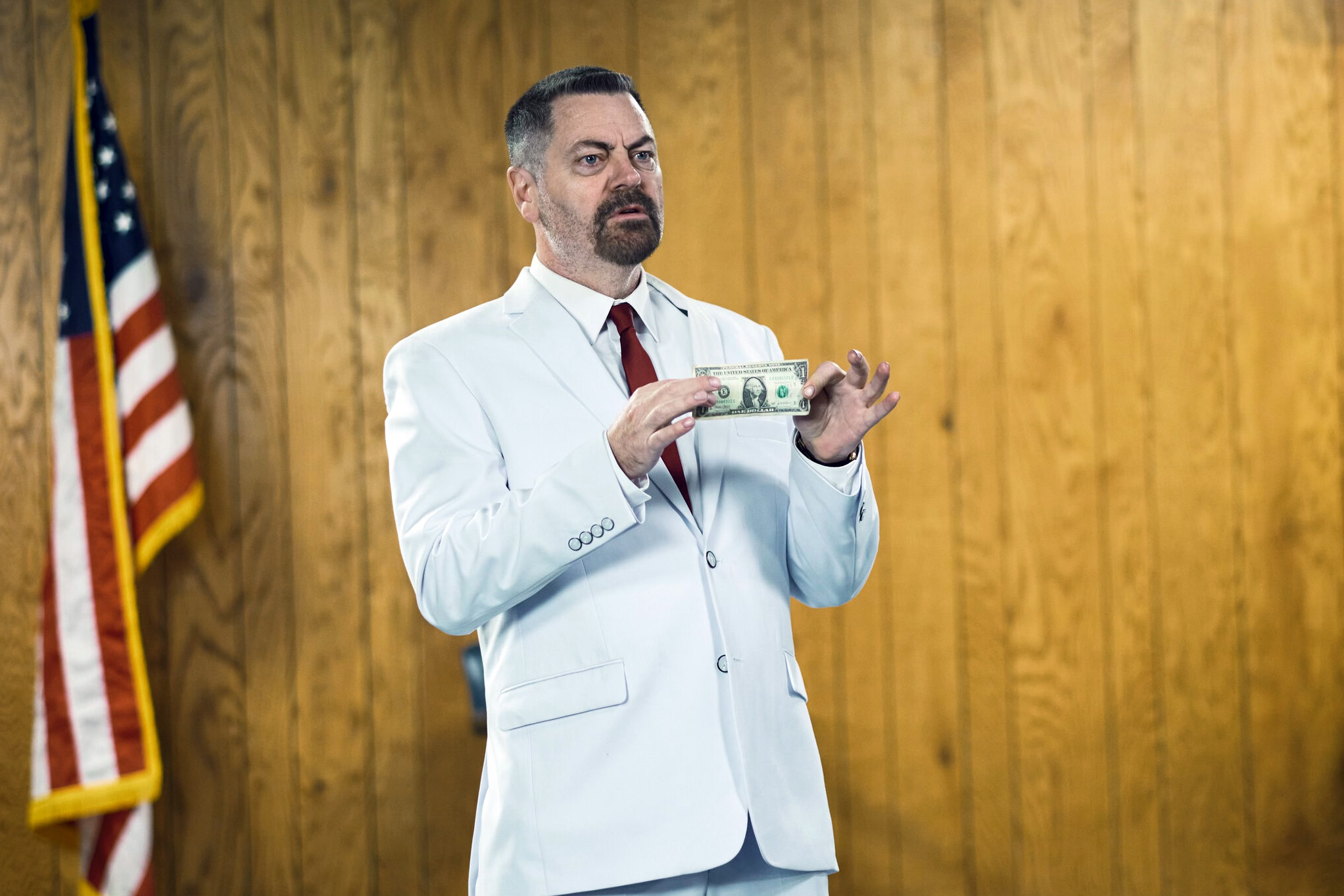
Offerman — no longer Ron Swanson from Parks and Recreation — bears an uncanny resemblance to the real Jerry Kane, whose videos remain online. He plays Jerry empathetically, but also mercurially, wounded and paranoid. Kane has been “dealt a shitty hand,” as Offerman himself has noted. He is caring and nurturing in flashes, harsh and dismissive in others. His love for Joseph is real but, like everything he touches, fatherhood is tangled with his sovereign ideology.
Swegal creates a vivid sense of sovereign pseudolaw. Jerry calls into radio shows as an expert on “foreclosures, mortgages and deeds of trust,” explaining that his personal tragedies “turned into a job.” He claims Sun Mutual is trying to steal his home: “Today, they sent more Gestapo out here trying to defraud us under colour of law.”
Later, he corrects Joseph’s social studies homework with sovereign-citizen talking points: “If you’re a state citizen, you don’t fall under the jurisdiction of the federal government. They don’t have a contract with you, they can’t touch you. If you’re a US citizen — congratulations, you’re the property of the District of Columbia under the commercial law. You’re a subject, not a sovereign.”
This is a formal, inherited doctrine — a parent authority passing down a worldview. Jerry recounts how his own father hinted at some concealed “lie” and then refused to explain it. Jerry, unable to let the mystery go, has spent his life trying to unravel it. This generational wound becomes Joseph’s inheritance.
Jerry attempts to file a “deposition of truth” with the county recorder, taking Joseph along to film the ritual. They eat lunch afterwards, discussing sovereign distinctions between “corporate fictions” and “real people who eat burgers.” Joseph wants his father’s approval as much as he wants clarity, and Swegal uses this tension to show how sovereign ideology is sustained by a need for connection.
Joseph is also drawn to a neighbour, a young woman surrounded by friends and a church-choir, who symbolises a life he can’t have. These glimpses of “normality” underscore the central tragedy. Joseph — the protagonist — longs for connection and, despite knowing the ideology is harmful, clings desperately to his father and, ultimately, acts to protect him.
Where the first act introduces pseudolaw, the second begins to reveal the conflicts. At a traffic stop, Jerry refuses to provide identification because he is “travelling, not driving.” The encounter escalates, and he is arrested. While Joseph is taken into state care, where he begins to experience life away from his father, Jerry’s ninety-four hours in jail radicalise him further.
His rhetoric becomes explicitly violent. His conspiratorial worldview hardens. Joseph, meanwhile, sees flashes of a life of order, calm, peers and stability.
Swegal expertly embodies the paternalism of the state in police chief John Bouchart (Dennis Quaid) and his son Adam (Thomas Mann), an officer-in-training. Foils to Jerry and Joseph, they too misunderstand each other. Bouchart lectures Adam about letting his newborn “cry it out,” about discipline and duty. Adam is going through training, learning how to employ violent force. Later, his wife accuses Bouchart of “riding Adam” too hard.
The Kanes return home to find the electricity shut off. At the disastrous foreclosure hearing, Jerry’s sovereign arguments are quickly dismissed. After the judge leaves the courtroom, Jerry insists he “won” because he “claimed jurisdiction after the judge abandoned ship.”
When sheriffs arrive to enforce the eviction, Joseph opens the door and they push past him. Afterwards, Jerry explodes, blaming his son, pointing a gun at him and then at himself. It’s a terrible moment of realisation that, maybe, he has failed Joseph, though he can’t admit it. From here, as the sovereign beliefs run to the Kanes into desperation, events unfold with grim inevitability.
Sovereign offers a nuanced portrayal of sovereign-citizen pseudolaw by embedding it within intimate, painful relationships. The film’s deepest argument is that these beliefs constitute a theory of paternalism: who cares for whom, who protects, who controls, and who disappoints. Through the mirrored father–son relationships of Jerry/Joseph and Bouchart/Adam, Swegal shows that sovereign ideology is an emotional inheritance.
One father teaches resistance, and the other teaches obedience. Both believe they are protecting their sons. Both drive them towards catastrophe. But it is not all tragedy. In its final quiet scenes, the film suggests that authorities could learn to be more gentle. •