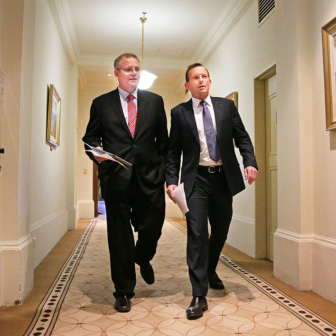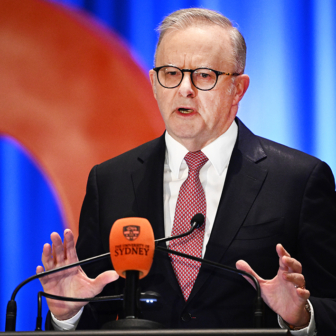
When he replied to the federal budget earlier this month, opposition leader Angus Taylor declared that a Coalition government would end “Labor’s handouts for noncitizens” by drastically cutting back eligibility for welfare payments. Only Australian citizens would have access to the NDIS and seventeen welfare programs, including JobSeeker, the youth allowance and the family tax benefit. Taxpayers would save “billions.”
What went unmentioned was the question of how different, in practice, this would be from existing policy. Nor did opposition leader mention which groups are most likely to be affected, how much the government would save by restricting the payments, or whether the change in policy would actually be fair.
Eligibility for social security payments has never been restricted to Australians citizens, but various restrictions have always applied. Especially tight were the racial provisions in the earliest social security programs, which excluded people born in Africa, Asia and the Pacific — assuming they had somehow gained residence despite the White Australia policy.
From the time they were introduced in 1908, age pensions were subject to residential waiting periods. Initially, claimants needed to demonstrate twenty-five years of continuous residence in Australia, but this was reduced to twenty years in 1909 and then, many years later in 1962, to ten years. The invalid pension (now the disability support pension), introduced in 1909, required only five years’ residence, although the claimant had to have become permanently incapacitated in Australia. The widow’s pension, introduced in 1942, also had a five-year residence requirement.
Child endowment (now known as the family tax benefit), legislated in 1941, required mother and child to either have been born in Australia or resident for the twelve months before the claim. The unemployment benefit, legislated in 1944, only required twelve or more months of continuous residence immediately before application, and even that was waived if the director-general of social services was satisfied a claimant intended to reside permanently in Australia.
But requirements started to become more restrictive in the 1990s. In 1993 the Keating government introduced a “newly arrived resident’s waiting period” for all new permanent residents, which delays eligibility for certain social security payments. Initially twenty-six weeks for unemployment and sickness payments, the waiting time for those benefits was extended by the Howard government to 104 weeks in 1997, with shorter waits for other working-age support.
Further modifications came in 1999 and 2000, with the next major change in 2019, when the Morrison government extended the waiting period for unemployment payments to 208 weeks and extended waiting periods for supplementary payments. For the first time, a waiting period was applied to the family tax benefit.
The Morrison government also attempted to extend to four years the waiting time for a variety of other payments and concession cards, including paid parental leave, carer payment, carer allowance and family tax benefit, but its legislation failed to pass. During the 2025 election campaign it again proposed longer waiting periods, this time a uniform five years.
The decades of change have left a patchwork of waiting times:
• The four-year waiting period, the most common, applies to income support payments, among them JobSeeker, the parenting payment(single and partnered), youth allowance, Austudy and the special benefit, as well as to supplementary payments including the Commonwealth seniors health card, the ex-carer allowance (child) health care card, the farm household allowance, the low income health care card, the mobility allowance, the pensioner education supplement and the tertiary access payment.
• A two-year wait applies for the carer payment and parental leave pay. Partner provisional visa-holders only qualify for parental leave pay. An Australian citizen who has only just started living in Australia for the first time faces a two-year waiting period for parenting payment (single or partnered).
• A one-year wait applies for the carer allowance and family tax benefit part A (with no wait for part B).
Some groups are exempted from these waiting periods, the most important being refugees, former refugees and family members of a refugee or humanitarian migrant.
People can also qualify for the special benefit if they are in severe financial hardship, have become homeless or are at risk of becoming homeless, are experiencing family violence or a decline in health, or their visa sponsor is no longer able to support them. But while most people receiving special benefit were born overseas, fewer than 6000 people receive the payment.
Vital to considering the impact of Angus Taylor’s plan is an accurate tally of the overseas-born people who actually receive income support. Department of Social Services, or DSS, figures for the top twenty-five birth countries of social security recipients reveal that the largest number receive the age pension and the third-largest receive the disability support pension; as of June 2025 those two payments accounted for 71 per cent of all benefits claimed by overseas-born people. Both payments already have longer residence requirements and aren’t among the seventeen payments covered by the opposition’s proposed citizenship requirement.
Data from the Australian Bureau of Statistics and the DSS allows us to calculate the share of the population receiving income support according to country of birth. As the chart below shows, about 10.5 per cent of the working-age population receive these payments, comprising 12 per cent of people born in Australia and around 7 per cent of people born overseas. The share receiving payments ranges from 1.8 per cent of the Indian-born population and 4.4 per cent of the Chinese-born to around a third of Afghan-born residents, 39 per cent of Iraqi-born and 46 per cent of Syrian-born.
To assess the impact of the Coalition’s citizenship plan, we also need to know how rates of citizenship vary between different birthplace groups. Of the permanent migrants who arrived in Australia between 2000 and 2021, 1.8 million or 59 per cent are now Australian citizens. Broken down by visa, 64 per cent of those on skilled visas had taken out citizenship, as had 47 per cent of those on family visas and 61 per cent on humanitarian visas.
The chart below shows the top ten countries of birth for permanent migrants who took out Australian citizenship between 2000 and 2021. The proportion with Australian citizenship ranged from a little over a third of Chinese-born to more than 60 per cent of those born in Vietnam, India, England, the Philippines and Sri Lanka, and nearly three-quarters of those born in South Africa.
This second chart also shows whether migrants’ countries of origin allow dual citizenship. If they don’t, migrants will have to renounce their original citizenship in order to take out Australian citizenship. In general, migrants from countries that allow dual citizenship have higher rates of Australian citizenship.
India is an exception. Although it doesn’t allow dual citizenship, a relatively high proportion of Indian-born people take out Australian citizenship anyway. Along with China, it is the largest birthplace of migrant arrivals over this period, but both groups are much less likely to seek income support than other overseas-born Australians or Australian-born citizens.
No breakdown of NDIS participants by country of birth appears to be available, but data is available on the number of participants from culturally and linguistically diverse, or CALD, backgrounds.
In 2025–26, there were 66,600 from CALD backgrounds in the NDIS, or 8.7 per cent of all participants. Payments made to these groups were higher than the overall average, adding up to 10.5 per cent of total NDIS expenditure. With an estimated 23 per cent of the Australian population speaking a language other than English at home, CALD people appear to be underrepresented in the scheme.
Access to the NDIS requires either citizenship, permanent residence or a humanitarian visa. No data on the breakdown by citizenship status appears to have been published. It also needs to be borne in mind that all visa applicants need to meet health requirements, including passing the “significant cost threshold” for estimated healthcare of $86,000. For permanent visa applicants, these costs are generally projected over five years, though applicants with “a permanent or ongoing condition with a reasonably predictable course” can be assessed over a ten-year period. This seems likely to preclude entry to Australia for people with existing disabilities.
What does this patchwork of payments, conditions and waiting times mean for Angus Taylor’s proposed changes?
To apply for citizenship, a person must have lived in Australia for four years on a valid visa (including at least twelve months as a permanent resident). The process then takes a median time of eighteen months up until the citizenship ceremony. On the basis of these figures, the citizenship requirement would be similar to increasing the waiting period for social security payments to about five years and six months, with the number of people affected and the budgetary savings dependent on the number of new citizens and their subsequent need, if any, for income support.
When the Liberal Party proposed increasing seventeen waiting periods to five years during the 2025 election, the Parliamentary Budget Office estimated it would improve the federal government’s fiscal balance by $2.6 billion over the five years 2025–29. But it also noted that “the financial implications of this proposal are uncertain and sensitive to the assumed eligible population, which in turn is sensitive to the assumptions around the population of eligible visa holders and their interaction with the social security system.”
Crucially, the PBO assumed the eligible population “would access social security payments at the same rate as the overall population of Australia.” But — as the first chart above shows very clearly — different birthplace groups don’t access social security at the same rate as the overall population.
Given that the largest groups of recent immigrants — those from India and China — have much lower rates of social security support than people born in Australia, the PBO’s costings probably overestimate the savings from the measure. If more people were prompted to apply for citizenship then projected savings would also fall.
Importantly, the birthplaces with the highest level of income support are people born in Afghanistan, Iraq or Syria, who are highly likely to have arrived in Australia on humanitarian visas. The Coalition’s 2018–19 budget specified that humanitarian migrants “will remain exempt from all waiting periods, and hardship provisions will remain in place.” If the same policy applies in the event of a Coalition government, these birthplace groups would not be affected.
Replying to the federal budget, Angus Taylor declared, “We’ll remove Labor’s handouts for noncitizens.” Given what we know of existing waiting periods and patterns of payment, the impact of his proposal (which is already attracting controversy within his own party) would be nowhere near as simple as that.
On the one hand, the humanitarian and refugee groups most likely to receive social security payments because of their deep disadvantage are exempted from the proposal. On the other, the largest birthplace groups among the most recent permanent residents are unlikely to need payments. Combined, these two facts suggest the budgetary savings won’t even be as high as the Parliamentary Budget Office’s estimates.
But perhaps the savings are secondary to the desire to appeal to people who might otherwise vote for One Nation, which has a policy of increasing the waiting period for both citizenship and welfare payments to eight years, as well as withdrawing from the UN Refugee Convention.
Here, it’s worth noting that the share of the working-age population receiving social security payments fell to record lows in 2023 and 2024, partly because of very high employment rates among skilled migrants. Those rates translate into a very strong net contribution to the federal budget. •