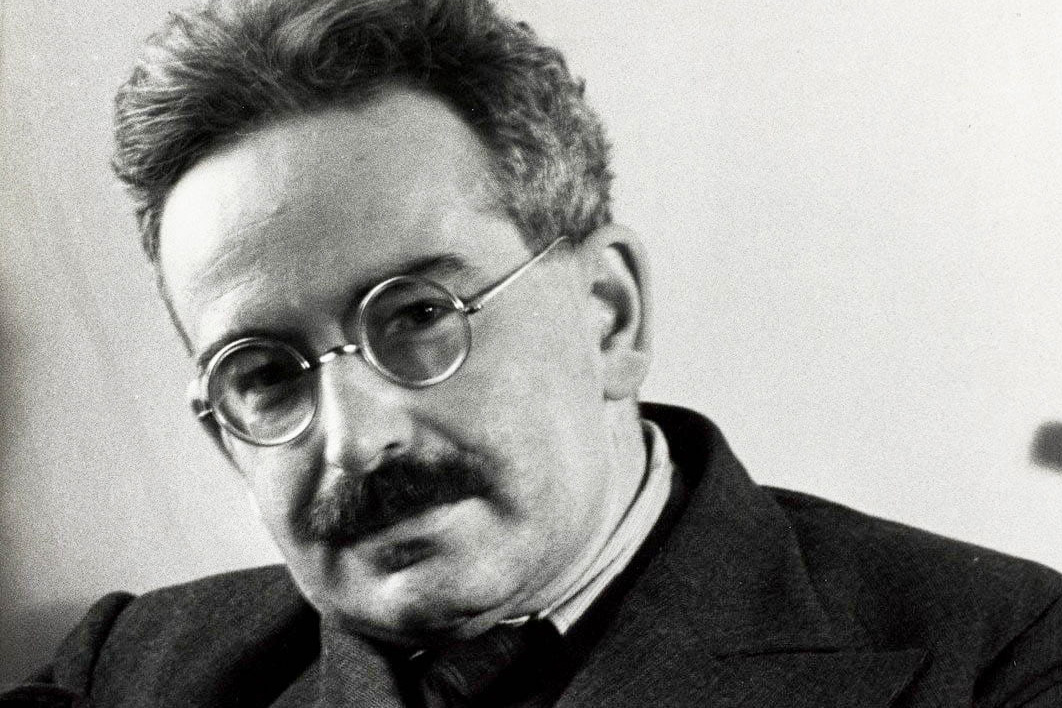
Franz Kafka and Walter Benjamin stand out among the German-language writers of the first half of the twentieth century, not least because their observations, while often enigmatic, are as striking today as they were during their lifetime. Perhaps more than any of their contemporaries, Kafka and Benjamin are able to speak to, and dislodge our preconceptions of, our present.
They had much in common. Born only nine years apart — Kafka in 1883 in Prague and Benjamin 1892 in Berlin — they died in their forties. Both grew up in well-to-do households. Both were the children of assimilated German Jews. For the Nazis, the qualifier was irrelevant: Benjamin’s brother and Kafka’s three sisters were murdered in 1942 and 1943.
A recurrent melancholia afflicted both men and affected their work. Their writing was influenced by the emergence of a new technology, the projection of moving images. They were loners, but the women they loved left a large mark: Felice Bauer and Milena Jesenská in Kafka’s case and, in Benjamin’s, his wife Dora and his lover Asja Lācis.
At the time, close friends and some fellow writers considered Benjamin and Kafka exceptionally talented, but while they were still alive, they weren’t well known to a broader public. That’s also because many of their texts were published only posthumously.
Kafka wrote only three books of short prose and Benjamin published four titles: his doctoral and postdoctoral dissertations; Deutsche Menschen, an edited anthology of letters published under a pseudonym in 1936 in Switzerland; and One-Way Street, a collection of philosophical-literary miniatures that appeared in 1928, albeit as a brochure rather than a book. (Benjamin did, however, contribute numerous articles to newspapers, magazines and radio programs.)
Their reputations grew exponentially after they died, not least due to the efforts of close friends who arranged for the posthumous publication of their writings. Kafka’s literary executor Max Brod defied his express wish to burn his manuscripts unread and published his diaries and manuscripts, including The Trial and The Castle. Hannah Arendt and Theodor W. Adorno, above all, ensured that their friend Walter Benjamin’s previously unpublished texts would find a readership.
“Posthumous fame is one of [the Roman goddess] Fama’s rarer and least desired articles,” Arendt noted drily with reference to Kafka and Benjamin. It seems “to be the lot of the unclassifiable ones, that is, those whose work neither fits the existing order nor introduces a new genre that lends itself to future classification.”
Kafka and Benjamin have been the subject of an abundance of studies by scholars, particularly in literary studies and cultural theory, and numerous biographies have shed light on all aspects of their lives. Howard Eiland and Michael W. Jennings’s 2014 opus is the most comprehensive account of Benjamin’s life and thought, covering his many intellectual pursuits and his path-breaking contributions to literary criticism, aesthetics, philosophy and cultural history. Its German edition runs to more than 1000 pages. For good reason, it has been hailed as a definitive account.
Peter E. Gordon’s recently released Walter Benjamin: The Pearl Diver is concise where Eiland and Jennings’s treatment is exhaustive. Gordon, who teaches European intellectual history at Harvard, has given us a beautifully written biography that is particularly valuable for readers not already familiar with Benjamin’s life and work but also a pleasure to read for others more conversant with his writings.
Like many books about Benjamin, this is a sympathetic account. “I have chosen not to dwell on the less palatable aspects of his character,” Gordon admits, “his gambling, his infidelities, his erratic moods, or his penchant for ruthlessly cutting off friendships when they no longer suited his needs.” But he certainly hasn’t written a hagiography — which cannot be said of all of Benjamin’s biographers.
Walter Benjamin: The Pearl Driver appears in Yale University Press’s Jewish Lives series. The question of the extent to which Benjamin was a Jewish writer provides the angle that distinguishes Gordon’s biography. I found his answers to that question the least convincing aspect of the book — if only because they sometimes read as if they were added belatedly, in response to an editor’s reminder. The need to focus on Benjamin’s interest in Judaism also seems to have led Gordon to privilege his subject’s correspondence with his close friend Gershom Scholem at the expense of other sources.
The book’s structure and Gordon’s reflections on it are a strength. Like others who have written about Benjamin, Gordon confronted the challenge of historicising the life of an intellectual who was preoccupied with history’s potential and who, “perhaps more than most professional historians, was alive to the enigma that works of the past offer more riches than the past can control.”
Gordon has therefore tried — successfully, I think — “to undo the historicist cliché by restoring some measure of contingency to a human life that, like all lives, remains forever open in its meaning.” He begins with Benjamin’s untimely suicide at Portbou, only to leave that “aside and begin anew.”
That’s particularly appropriate given the widespread morbid fascination with the last twenty-four hours of Benjamin’s life (crossing the Pyrenees on foot, clutching a briefcase that may, or may not, have contained a precious manuscript; writing a letter to his son that the woman to whom it was entrusted mysteriously destroyed). Gordon’s writing strategy is appropriate also in light of Benjamin’s afterlife as a cultural theorist of our time, which often seems to dwarf his life as a son, husband, lover, father, friend and impoverished writer.
Eiland and Jennings’s book was exceptional in paying close attention to Benjamin’s family: his parents and siblings, his wife Dora and their son Stefan. Gordon, too, is interested in Benjamin as a person rather than merely a thinker and writer, but he mentions Stefan only in passing.
Dora and Walter divorced in 1930, and four years later Dora moved to San Remo in northeastern Italy, where she opened a pensione. Stefan joined her in 1937. “But he could not stay there long,” Gordon writes. “Lacking citizenship, he was deported in 1941 from Italy to Australia; he survived the war and became an antiquarian bookseller in London, where he remained until his death in 1971.”
It wasn’t Italian citizenship that Stefan needed (and even that would not have saved him, as Italian Jews too were deported to concentration camps once Nazi Germany occupied Italy in 1943). Stefan left San Remo in 1938 and moved to London (a fact that is, to be fair, mentioned elsewhere in Gordon’s book). Dora, who had married a British national to be able to live in Britain, followed him in 1939 and again ran a guest house. Having become an enemy alien when Britain declared war on Germany, Stefan was interned on the Isle of Man and in 1940, together with more than 2500 others, shipped to Australia, where he was interned in Hay (New South Wales) and Tatura (Victoria).
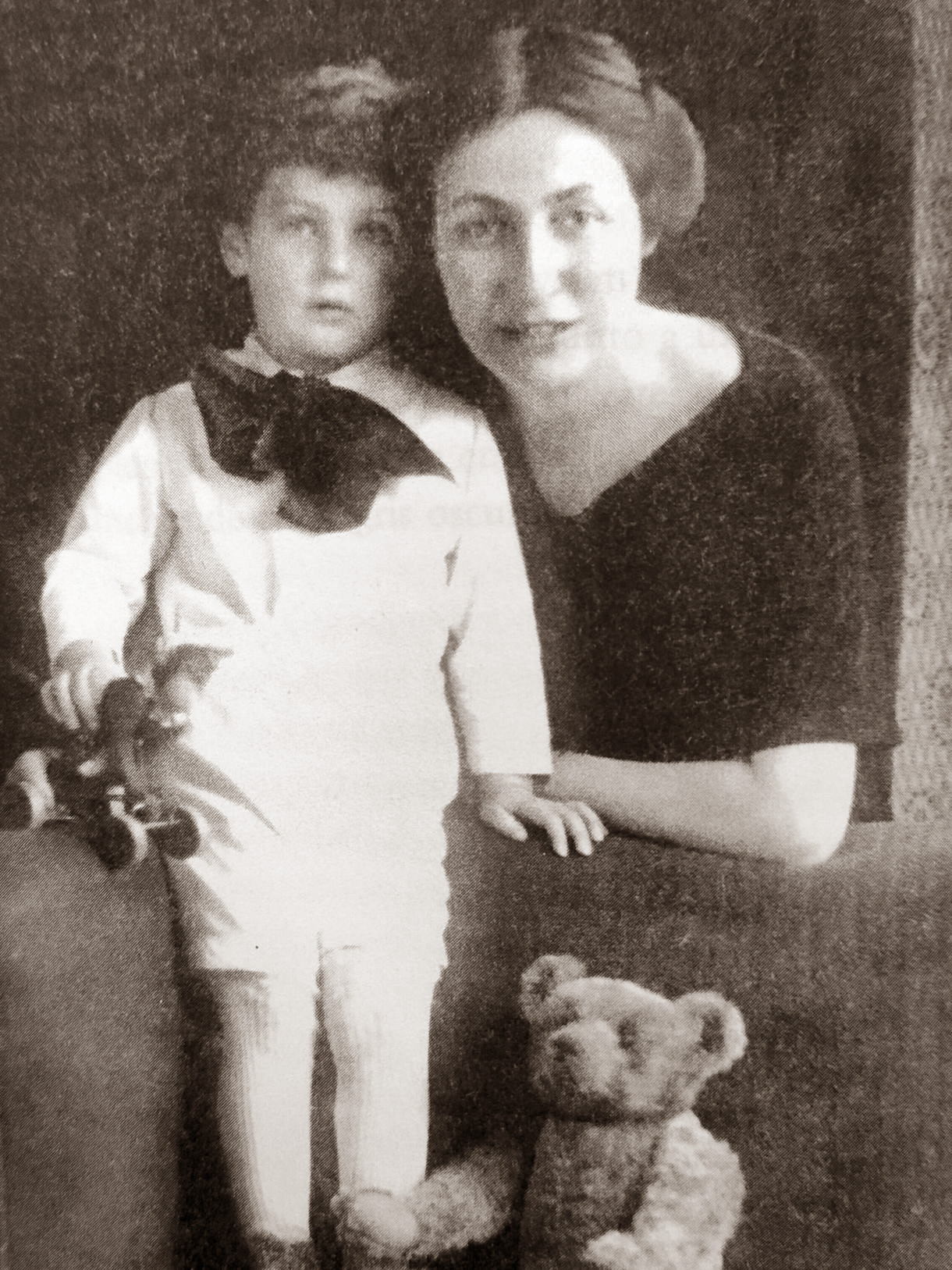
Dora Benjamin with the couple’s son Stefan, c. 1920.
Encounters and conversations during Stefan’s journey to Australia aboard the infamous Dunera occupy most of John Schad’s quirky and delightful Walter Benjamin’s Ark: A Departure in Biography, published late last year. It is a book about Stefan (called “S.”, “Steffe” or “the prince” in the book, and Stefanzerich when he was little), who has sometimes been absent from accounts of his father’s life. In an afterword, Stefan’s daughter Mona Benjamin applauds Schad for making “the footnote the story.” He turns Stefan from a mere witness to the greatness of his father’s life into a central character. But Walter Benjamin’s Ark is also a book about Stefan’s larger-than-life father (“the king”) who, in the book, is imagined to have reunited with Stefan aboard the Dunera.
Schad is a professor of modern literature at the University of Lancaster and the author of several works of experimental criticism, including The Late Walter Benjamin (2012). It’s not easy to pigeonhole his latest book. It qualifies as creative fiction but is also a piece of innovative and meticulous scholarship. It strikes me as a departure from rather than in biography. Perhaps it’s best described as an annotated novel. Or a script for a radio play.
Mind you, much of its text is not made up. Like Benjamin himself, who likened quotations in his work to “wayside robbers who leap out armed and relieve the stroller of his conviction,” Schad juggles other writers’ fragments, often deliberately out of context. Rather than expecting readers to recognise quotes, Schad italicises them, references them in footnotes, and provides introductions in which he directs his readers’ attention and provides tongue-in-cheek justifications for his selection. Unlike his father, Stefan was not a writer, but Schad quotes him at length, using notes of his utterances as a child Benjamin kept and titled “Opinions et pensées.”
The Dunera left Liverpool for Australia in July 1940. Its human cargo included some Italian and German POWs and some Nazis, but most of those on board were Austrian and German refugees who had been interned in Britain after the fall of Dunkirk. Schad’s narrative features a handful of the actual passengers, among them three men who shared the surname Wilde, the actor Sigurd Lohde and an acrobat called Zeppie.
Biographies of Benjamin, including Gordon’s, make much of Benjamin’s friendships with other intellectuals: Ernst Bloch, Bertolt Brecht, Siegfried Kracauer, Gershom Scholem, Adorno, Gretel Karplus (who in 1937 became Gretel Adorno) and others. Schad isn’t interested in such obvious interlocutors. Rather, he introduces a cast of characters most of whom never met either Stefan or Walter Benjamin but who, in Schad’s text, are also sailing on the Dunera. Virginia Woolf, Rosa Luxemburg, Hamlet, Ludwig Wittgenstein and Gertrud Kolmar — all are part of “the ship’s company” and of Benjamin’s “very own queer kingdom.”
Biographers tend to rely heavily on written sources. It’s therefore no surprise that those writing about Benjamin’s life have highlighted his relationships with people whose correspondence with him survived. Schad, however, goes much further than to rescue those of Benjamin’s acquaintances from oblivion who didn’t archive their letters (or talked to him mostly on the phone, as Schad’s Virginia Woolf does). He imagines conversations with historical figures whom Benjamin never met and who may not even have been of much concern to him.
That kind of irreverence is refreshing. (While Schad’s writing is no doubt inspired by Benjamin’s, the irreverence appears to be very much his own.) Sometimes the imagined conversations aboard the Dunera are outright funny. But the light-hearted banter characterising some of the dialogues is a thin layer over a darkness: the catastrophe of the Shoah that forms the historical backdrop to the narrative, and the loss experienced by Stefan, which becomes only more acute with his father’s appearance aboard the Dunera. Light-heartedness is entirely absent when Rosa Luxemburg, who was murdered by members of a far-right militia, her body thrown into the Landwehr Canal and retrieved not until several months later, is referred to as Mermaid.
Schad restores more than “some measure of contingency” to Benjamin’s life when he reunites Benjamin with his cousin, the poet Gertrud Kolmar, who was murdered in Auschwitz on 3 March 1943 and whose brother was on the Dunera. Her appearance is prompted by the opening of a lecture by Wittgenstein, “Suppose a story began with ‘She wore a black dress.’” She may or may not be the female counterpart of the angel in the Paul Klee painting “Angelus Novus” that was Benjamin’s most prized possession. And that angel may, or may not, have been none other than S., “the prince” and (quoting Kolmar now) “a youth with gleaming and quivering wide-spread wings” “whose countenance is sorrow.” After all, his middle name Rafael (which does not appear in the Australian internment records) came from one of the archangels.
The title of Gordon’s biography cites Hannah Arendt. In an essay published in 1968 — first in German in the literary journal Merkur and subsequently in the New Yorker and in Illuminations, an anthology of Benjamin’s writings — Arendt writes about Benjamin’s rare “gift of thinking poetically”:
Like a pearl diver who descends to the bottom of the sea, not to excavate the bottom and bring it to light but to pry loose the rich and the strange, the pearls and the coral in the depths, and to carry them to the surface, this thinking delves into the depths of the past — but not in order to resuscitate it the way it was and to contribute to the renewal of extinct ages.
Not only was Benjamin capable of thinking poetically — he was also able to convey his thinking to others. He was not only one of twentieth-century Germany’s most influential thinkers, but also one of its most elegant writers. That’s particularly evident in Benjamin’s 1928 collection of miniatures, One-Way Street, and in his memoir of sorts, Berlin Childhood Around 1900, in which he delves into his childhood to “pry loose the rich and the strange.”
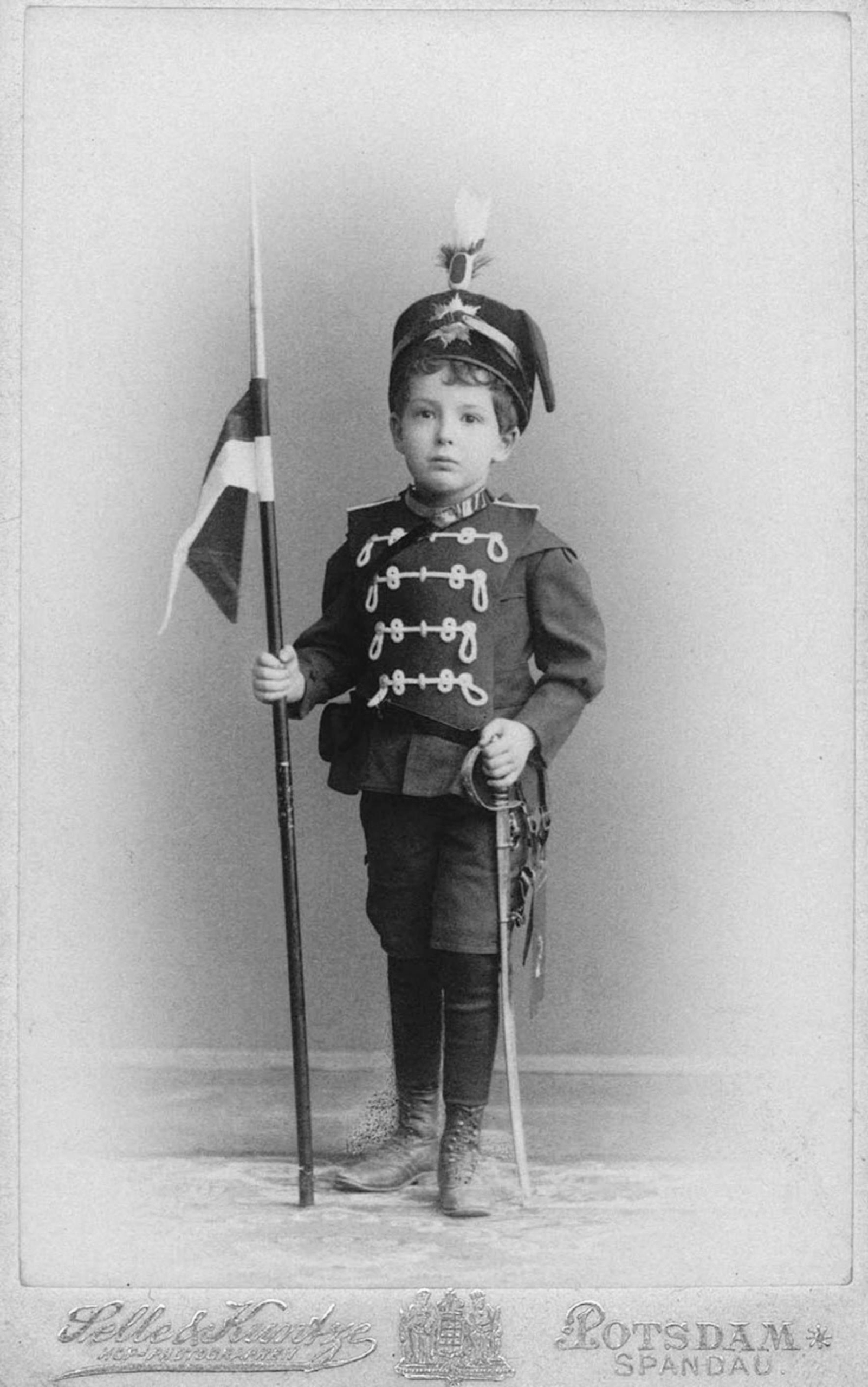
The young Walter, c. 1897–1902. Selle & Kuntze
The German publisher Suhrkamp brought out a first version of Berlin Childhood, an edition prepared and introduced by Adorno and dedicated to Stefan, in 1950. The first book of Benjamin’s writings published after his death, it received positive reviews but turned out to be Suhrkamp’s least successful title that year. Adorno blamed “the trauma that asserts itself as soon as the name Berlin is mentioned.”
Benjamin had begun working on a series of vignettes about his childhood in the second half of the 1920s. The first texts appeared in print in 1926 in a literary magazine. But it was not until six years later that he decided to write a book composed of short “expeditions into the depth of memory.” By the end of 1932 he had completed a typescript of thirty pieces.
Unlike Kafka, Benjamin tried, often desperately, to have his writings published. That was also because — unlike Kafka, who worked for an insurance company — he did not have a steady income, relied on the support of his father and later of Gretel Karplus and his ex-wife Dora among others, and tried to survive by writing for newspapers and radio.
He sold the collection of vignettes to the Frankfurter Zeitung, a liberal daily, which intended to serialise it. But the Nazis’ seizure of power in March 1933 meant those plans came to naught. Altogether, only eighteen vignettes were published, some of them under the pseudonyms Detlef Holz (which he also used for the book Deutsche Menschen) and C. Conrad to circumvent the ban against the publication of texts by Jewish authors.
Benjamin meanwhile kept revising the texts and adding to the collection. He approached publishers in Germany and Switzerland, but to no avail. By 1938, he had put together several versions, copies of which were with publishers and friends. That year, he prepared a final typescript comprising thirty-two vignettes, this time also indicating the order in which they were to appear.
When he fled Paris in 1940, he entrusted the typewritten pages, together with other manuscripts, to the philosopher and surrealist writer Georges Bataille, who hid them in the Bibliothèque nationale. The philosopher Giorgio Agamben discovered them there forty-one years later. It is this final version, the Fassung letzter Hand, translated by Shierry Weber Nicholsen, that has just been published by Verso.
In A Berlin Childhood Around 1900, Benjamin carried “the rich and the strange” to the surface, because, as he explains in a foreword, “[i]n 1932, while abroad, I began to realise that I would soon have to take a fairly long and perhaps permanent leave of the city in which I was born.” The tenor of some of these vignettes is reminiscent of Marcel Proust’s À la recherche du temps perdu, parts of which Benjamin had translated in the 1920s. But Benjamin’s remembering differs from Proust’s. He had lost “the security that had been granted his childhood” not only when he ceased being a child but also because after 1933 a return to Berlin was no longer an option.
The Berlin that Benjamin remembered and brought back to life is the comparatively affluent western part of the city, where his family lived. The vignettes feature the zoo, which must have been a frequent destination for young Walter and his nanny, his school, and the family’s summer residence near Potsdam. The backdrop for many of the vignettes, however, is the interior space of the family’s apartment, where the child’s sleep is invaded by frightful dreams and where the telephone, a seemingly innocuous apparatus, “disfigured and outcast, between the laundry hamper and the gasometer in a corner of the back corridor,” had the capacity to annihilate “all thought of my time, my intention and my duty.”
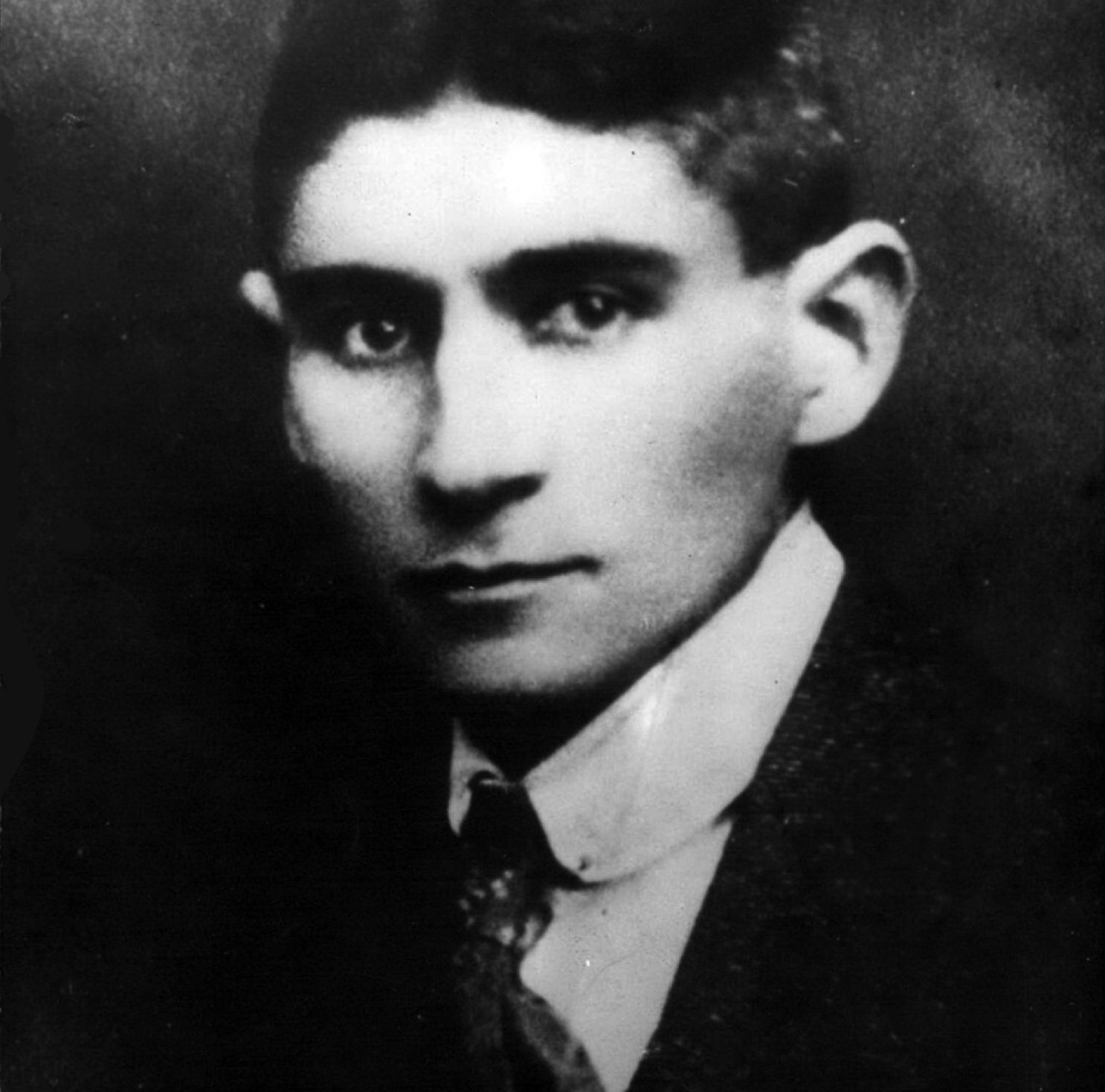
Franz Kafka, c. 1915.
The final piece in the Fassung letzter Hand is titled “Das bucklichte Männlein” (“The little humpbacked man” in Shierry Weber Nicholsen’s and “The little hunchback” in Howard Eiland’s translation). In it, Benjamin remembers peering down a shaft that provides a basement window with light and ventilation. At night in his dreams “looks that paralysed me were shot out of such basement holes.” Lines from a children’s book convince him that the looks were those of a little humpbacked man, who couldn’t be seen but who ever saw young Walter.
“He has long since abdicated,” begin the concluding lines. “Yet his voice, like the humming of the gas mantle, whispers to me across the threshold of the century: ‘Liebes Kindlein, ach ich bitt, / Bet für’s bucklicht Männlein mit!’ [Dear child, I beg of you, / Pray for the little humpbacked man too!]”
The little humpbacked man also appears in an essay Benjamin wrote about Franz Kafka, whom he recognised as a kindred spirit. “Among the images in Kafka’s stories, none is more frequent than that of the man who bows his head far down on his chest,” writes Benjamin. “It was always this way with Kafka. Compare this early diary entry: ‘In order to be as heavy as possible, which I believe to be an aid to falling asleep, I had crossed my arms and put my hands on my shoulders, so that I lay there like a soldier with his pack.’”
Like many other Dunera deportees, Stefan opted to return to Britain when he was offered the opportunity. On 12 December 1941, he left Australia aboard the Largs Bay, a passenger ship converted into a troop carrier. Via Auckland, the Panama Canal, Curaçao, Bermuda and Halifax he travelled to the UK, where he was initially reinterned, once again on the Isle of Man.
A certain Karl Kafka, a textile salesman from Vienna, blue-eyed like Stefan and, like Stefan’s father, born in July 1892, had also been taken to Australia on the Dunera. Like Stefan, he chose to return to Britain during the war. For Schad, that’s a good enough excuse for imagining conversations between Stefan (“the prince”), “the king” and “a Herr Kafka who is neither quite Franz nor indeed Karl.”
Kafka and Benjamin never met. But unlike Rosa Luxemburg, Virginia Woolf or Ludwig Wittgenstein, Kafka meant a lot to Benjamin. He was an admirer of Kafka’s writings and defended Max Brod against those who accused him of disrespecting his friend’s instructions to burn his manuscripts. Kafka was never far from Benjamin’s mind, and wrote three essays about the Prague writer, one of them a script for a radio broadcast.
In “Some reflections on Kafka,” part of a 1938 letter Benjamin’s to Scholem, he observes: “as Kafka puts it, there is an infinite amount of hope, but not for us. This statement really contains Kafka’s hope; it is the source of his radiant serenity.” “Ah yes. [Clears throat]. There is an infinity of hope —,” Schad lets Kafka (“neither quite Franz nor indeed Karl”) say, whereupon the king completes the sentence: “But not for us.”
Kafka: Exactly. Satisfied, your highness?
[The king does not reply.]
I said, is your highness satisfied that there is an infinity of hope, but not for us?
[The king does not reply. Kafka thus speaks to S.]
Sir, your father is hesitant with his reply.
Benjamin provides one possible response, all to do with an infinity of hope, and again he casts a humpbacked man in a lead role. In the first of his “On the concept of history” theses he describes a puppet-like automaton capable of playing a winning game of chess. But rather than being a precursor of a machine powered by AI, the apparatus conceals a little humpbacked man who is an expert chess player and guides the puppet’s hands by means of strings.
Benjamin, influenced by Marxism and mysticism, imagines a philosophical equivalent to this apparatus: the puppet is called “historical materialism,” and it wins if it “enlists the services of theology, which today, as we know, is wizened and has to keep out of sight.” Kafka (Franz or Karl?) may have agreed.
The king: By the way, Herr Kafka …
Kafka: Yes, sir?
The king: Would it surprise you if I tell you how enormously delighted I am to discover such a profound and spontaneous communication between our thoughts?
Kafka: No, no it would not surprise me. Not at all. For, you see, there are nothing but surprising things in the world. •
Walter Benjamin: The Pearl Diver
By Peter E. Gordon | Yale University Press | $34.95 | 224 pages
Walter Benjamin’s Ark: A Departure in Biography
By John Schad | UCL Press | £30 / open access PDF | 302 pages
Berlin Childhood Around 1900
By Walter Benjamin | Translated by Shierry Weber Nicholsen | Verso | $32.99 | 115 pages