I first came across James Morris about sixty years ago, when he was still primarily a journalist. His impressions of America, published as Coast to Coast (1962), were a snapshot of the country as perceived by an outsider — a counterpart to the image of one squeaky-clean state after another served up in the National Geographic. (The waves of mass demonstrations and riots were still to come.) Among other things, Morris picked up on the intense parochialism of the Midwest. Immediately after announcing the end of the Titanic, a newspaper there had added the reassurance, “No Des Moines People on Board.”
James Morris was born in 1926. Not long after attending a public school, he enlisted in the British army. There was nothing fem about him — he was a virile man of action. Morris served in Venice and Trieste — places that would become fixtures with him — and more exactingly in Palestine, witnessing the fighting between Jews and Arabs in the last days of the British mandate. By then an intelligence officer, the precept “watch and learn” sharpened his powers of observation. While there he discovered Charles Doughty’s classic Arabia Deserta — its idiosyncratic, highly mannered prose spoke to the young soldier, and greatly influenced his mature style. As did Kinglake’s Eothen, and, more subtly, Gibbon’s Decline and Fall of the Roman Empire.
Meanwhile the British Empire was collapsing all around him. In a matter of months, 1947 saw Britain withdraw unilaterally from Palestine before partition was effected, while in the subcontinent another, bloodier partition marked the emergence of independent India and Pakistan.
Back in civilian life, Morris returned to Oxford, where as a schoolboy he held a choral scholarship. He then determined on becoming a journalist, with the Times. Not long after, he accompanied the British expedition, which (with the aid of Tenzing Norgay) was the first to reach the summit of Mt Everest. There was much intrigue about this, with spies for Indian journalists snooping around. A code was devised to transmit messages safely; the news happened to reach London on 1 June 1953, the eve of the Queen’s coronation. Such an auspicious event — an omen — sent the press into a frenzy: the “conquest” of Everest surely signalled a “New Elizabethan Age.” Morris had almost reached the top himself: certainly he was now the world’s most famous journalist. The book he wrote about the expedition was translated into thirty languages.
The Times cramped his style — they didn’t approve of his writing assignment-based books — and so he left if for the Guardian. He was sent to Egypt, where he correctly discerned that Britain and Israel’s main objective in 1956 was not to gain full control of the Suez Canal but to overthrow Nasser, the Egyptian president. Another assignment took him to Oman, the feudal opposite; yet another to South Africa, to cover the Rivonia treason trial. This, too, occasioned a book, the rather flat South African Winter. Morris was always better at probing places than exploring issues.
This talent first came to the fore in his account of Venice (1960). Some found it too atmospheric, not linear or factual enough. It was a highly developed personal response: “getting to know Venice transformed everything for me.” A bestseller, the book enabled Morris to set himself up as an author. Money would always be tight, not only because by now he had four children, but also because he liked to live in a mildly capacious style. Somehow he managed, every year, to get to America — he loved the antidote of its shrill modernity. More characteristic was the move to an old rectory on the Thames, where he cultivated the image of a squire, buying a horse and a punt. He was deliberately living down his own social origins from a family of housepainters and labourers.
Morris continued to undertake many foreign assignments for the Guardian, until he felt out-of-joint with paper’s ethos — “fairness, modesty, and rational assessment. I liked a touch of swank.” Books continued to appear at a rapid rate — notably on Spain (the country prized for its un-American authenticity) — and Oxford, which he evoked splendidly. But gradually a larger project began to clamour for his attention.
For some time Morris had planned a book called “India and Us,” but gradually this alchemised into something else. He had, after all, been present at the lowering of the British flag in Cyprus, Nigeria, Sierra Leone, Tanganyika, Jamaica, Trinidad and Tobago, Uganda and Kenya. The idea of a Pax Britannica trilogy began to take shape, particularly since, with the advent of the Beatles and Carnaby Street, public consciousness of Empire was fading fast. (In a London secondhand bookshop at the time you might find, as a friend of mine did, E.M. Forster’s copy of a book on an Indian hill station, or a signed copy of Cromer’s Modern Egypt.)
The first of the three volumes (1968) was the centrepiece, a masterful still of the Empire at its zenith (just before jingoism was punctured by the Boer war.) Hence its full title: Pax Britannica: The Climax of an Empire. The emphasis is on how the Empire worked: systematically Morris explicates elements such as the Colonial Office, administrators, entrepreneurs, settlers, railways, the navy. Helping to clinch it together was the clever device of recording how each part of the Empire marked Queen Victoria’s Diamond Jubilee (1897). In Dublin there was a riot, culminating in the special illuminations being sabotaged. Elsewhere, a deluge of doggerel:
Hail our bright Queen in her regalia
The one foot in Canada, the other in Australia.
During the War, Morris had been horrified by the way a gentle-mannered colonel, walking companionably in Cairo streets, casually kicked an Egyptian out of the way — and how that act was seemingly ratified by the victim’s blank acceptance. Morris was aware, too, of “the long humiliations of colonialism.” But in this volume he focused on how the British themselves saw the Empire, at a time when (Ireland and South Africa excepted) there were few stirrings of colonial nationalism. (Indeed in the 1880s the impractical idea of imperial federation had enjoyed a strong following.) The book was intended to be affectionate: as one literary critic put it, “this glittering nostalgic text… doesn’t exactly hide the racism and genocidal violence of the imperial enterprise, but they’re somehow swept up in the sheer mad gusto of the narrative.” Eventually it would be translated into Mandarin.
When the second volume of the trilogy, Heaven’s Command, appeared some years later, it was in effect a back story: the Empire in the earlier nineteenth century. Quite different was the third and concluding volume, Farewell the Trumpets: An Imperial Retreat (1977). Here Morris was drawing on the insistent memories of all those flag-lowering ceremonies. The book abounds in sharp images: analysis of deeper issues are lacking, glossed over. “Gradually it occurred to them [the British] that… the very conception of one race having the right to rule another was unjust.” In Trumpets the dirge of decline is offset by some high notes, including Gandhi appearing before the King and Queen in a loincloth. Churchill later fumed at such theatrics: to think that this one-time Inner Temple lawyer would appear formally as a “half-naked fakir” was too much. But Gandhi had a ready response for reporters: “The king had enough on for both of us.”
One day in 1972 I picked up an evening London newspaper and found, deep inside, a small paragraph saying that the writer James Morris was undergoing, in Casablanca, a sex-change operation. Surely not James Morris the hardy travel writer… Must be someone else, I thought. The name would not be uncommon in England. But verily it was so. Jan she became — and does so now in this review.
The subsequent book Conundrum tells how something was nagging Morris from a very early age — that a male body did not seem quite right. Sex among boys at an English public school was light and determined nothing. As for the army, “Far from making a man of me,” Morris wrote, it “made me feel more profoundly feminine at heart.” More, “I began to detest the physique that had served me so loyally.” By his mid-thirties Morris was desperate: somehow he must transition, or die. It would be nearly twenty years, and after much medication, before that was completed.
Meanwhile Jan had found a new love: Wales. True, she had grown up in the ambiguous county of Monmouth, but her parents were English rather than Welsh. It was part of a new identity; transition eased it. Moreover, to retreat to a mountain redoubt made sense, given how “the world shrinks and uniformity presses in.” Sensing a culture in peril, she took a crash course in Welsh. Wales, Wheeler points out, replaced the tattered imperial ideal, even making her see that in a new light: “a dreadful phenomenon redeemed by its style.” She came to hope for a Welsh republic, and her contribution to the struggle was the ability to yoke a romantic vision to political goals. But the incandescence of Jan’s The Matter of Wales, wrote one reviewer, “turned the prose purple.” Even so, Jan would later remark of her very Welsh son Twm, that he had “no feeling for that stately sense of order that I like about England.”
Australia she did not like. An early article reduced Melbourne to a ramble down Collins Street, while she was appalled by what she saw as the shallowness of Sydney. An article following an ordinary guy’s day in Sydney completely missed the mark; the following book, Sydney, was not much better. Australia exposed her snobberies. When I met her here in 1988, I was struck by both the surface skittishness and the underlying steeliness.
Step by step Jan had successfully presented herself in women’s clothing. There were a few exceptions: the dedication to the Oxford Book of Oxford (1978) is to the Warden and Fellows of St Antony’s College… except one. Somebody at the high table must have given her a hard time. Her son Mark says that at one stage she tried to look like the Queen. A woman now, yes, but she wanted to be different from every other woman in the world. “I haven’t gone from one sex to the other,” Jan maintained. “I’m both now.” She still travelled and wrote: there would be some fifty books in all. The publisher Faber thought her prose, now more impressionistic, had “become girly.” But now that she was trans and therefore trendy, Jan was approached by Rolling Stone and wrote articles for them.
Morris’s ego had always been strong; now it tipped into narcissism. The silent witness of all this travel and travail had been his wife. She never wrote or spoke a word in public about such matters. “Elizabeth’s unbroken silence,” said Germaine Greer, “is the true measure of Jan Morris’s enduring masculinity.” She was utterly steadfast. For her part Jan recognised that the “union with Elizabeth has given nobility to my mostly frivolous life.” When they travelled, they now said they were sisters-in-law. Divorced at the time of transitioning, the couple — who had continued to live together all through — remarried. Amazing. Less happy were Jan’s relations with the four children. One summed it up by saying “we were introduced, but we never really got to know each other.”
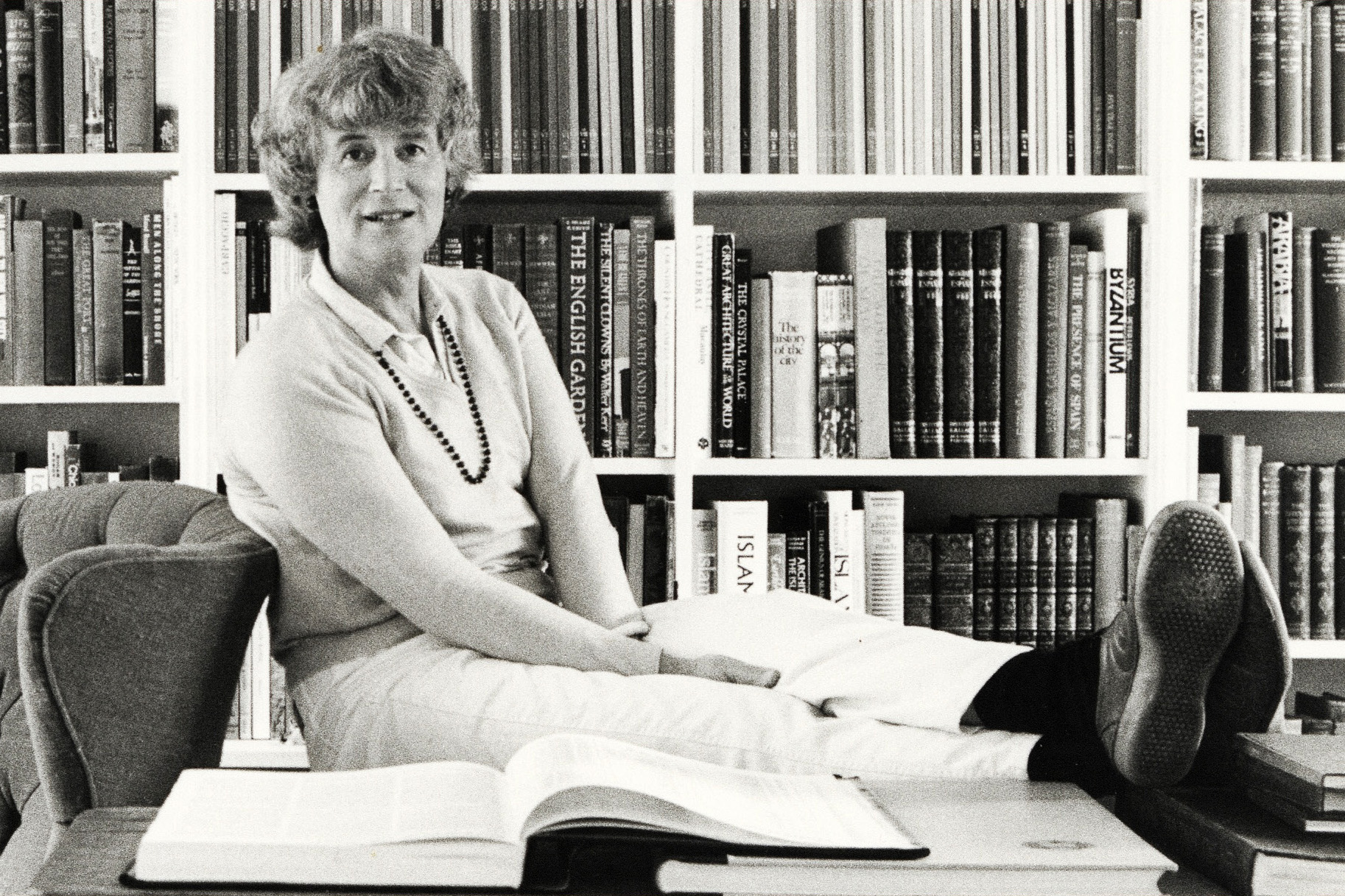
Jan Morris then has a double reputation. In 1996, The Times nominated Conundrum as one of the 100 Key Books of Our Time. It is the cornerstone of trans literature. But Morris’s masterpiece is the Pax Britannica trilogy, the author convincingly claimed by her latest biographer, Sara Wheeler, to be “one of the finest descriptive writers who ever lived.” Morris was excited by the tapestry of Empire, or rather by its moving parts: “the flashing epaulette, the gleaming gunboat and the trickle of sweat from the pith helmet…”
Wheeler herself has turned in a splendid biography. Jan Morris: A Life is superbly written and impeccably researched: she has managed to close much of the Elizabeth gap by drawing extensively on the memories of the alienated son, Mark. The book is a pleasure to read. •
Jan Morris: A Life
By Sara Wheeler | Faber | $55 | 413 pages