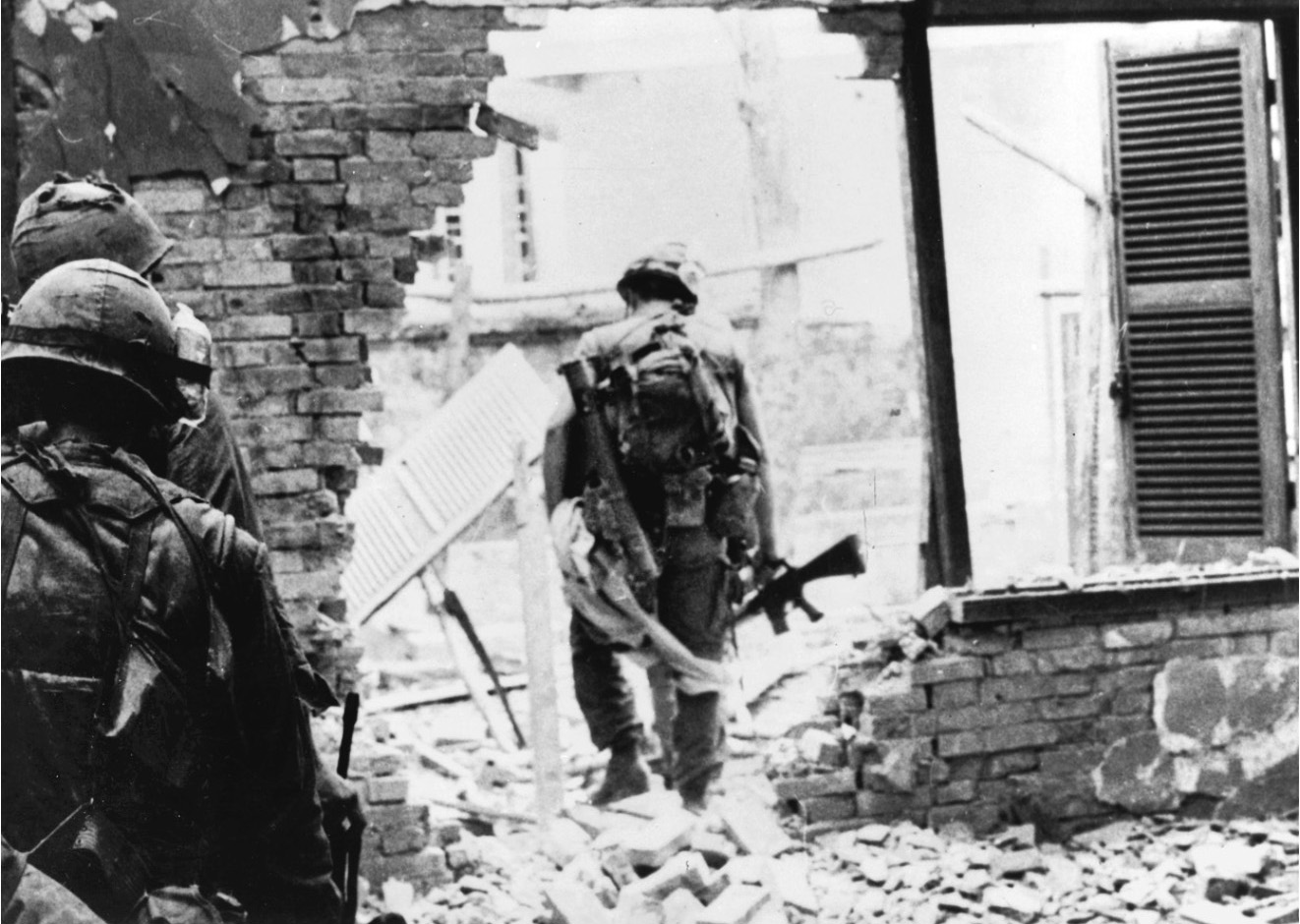
American historian Robert Brigham has written extensively about US foreign policy and the Vietnam war. In Argument Without End (1999) he collaborated with Robert S. McNamara, the 1960s defense secretary known as the “IBM machine on legs,” in a forensic analysis of the mistakes that ignited and inflamed the war. In Reckless (2018) he excoriated Henry Kissinger for his role in prolonging the carnage, with its two million civilian deaths. And now he has written a memoir that explains why he was drawn in by a conflict that ended when he was still a child.
Brigham was adopted into a working-class family in upstate New York. Feeling rootless and defective, he concocted fantasy lives for his birth parents, building a social worker’s stray comment about Vietnam into a conviction that his father fought there. From his early teens, he became consumed with the desire to find traces of his parents, poring over public records and visiting country graveyards. His search continued for decades in the face of incomprehension and resistance.
Brigham entered college keen to learn about the war, a fascination that merged with the quest for his birth father to create a career-defining white whale. College was followed by grad school, academic positions, travels to Indochina and successful books. Meanwhile, promising leads in his search for his parents kept turning into dead ends. Finally, commercial DNA testing cracked open the case and Brigham discovered the identity of both parents, now sadly deceased, and the grim circumstances that brought them together.
The book is a powerful testament to the emotional dislocations that adoptees can face. According to Brigham, the 1960s were adoption’s perfect storm, a time when sexual attitudes had liberalised but attitudes to illegitimacy had not. Vast numbers of American children were given up for adoption in that decade, and many had difficult lives, shuttled between neglectful and abusive foster homes or often, in rural areas, treated as unpaid farm labourers. Brigham claims that half of America’s homeless people have experienced foster care.
Writing of his own experience, he identifies adoption as a “primal wound.” As a child he feels shame and abandonment and a hunger for an ancestral identity, vividly imagining the “Ghost Kingdom” of his missing family. He is impatient with the frequent suggestion that he should be grateful for landing in a caring adoptive family. This view centres the perspective of the adoptive parents and mythologises the sacrifice of the birth mother, he argues, while dismissing the experience of the child. Even so, he acknowledges his experience is not universal: his adopted sister Jane doesn’t share his need to clarify her origins.
For Brigham, however, the search for a lineage is obsessive. Preoccupied with finding family resemblances, he writes off possible relatives for having body shapes dissimilar to his own but is then surprised when actual relatives look different. The urgent need for what he calls “genetic mirroring” produces a kind of essentialism. When he learns that an ancestor of his birth mother had migrated from the Shetland Islands 160 years earlier, he declares himself a Scot, observes that he too loves the sea, and hunts down island namesakes. Although the passing of generations has diluted any meaningful genetic connection, a rock-solid ancestral base has been found in a sea of uncertainty.
This is a True War Story has a satisfying arc. Brigham finds the family connection he longed for and loses some of the unsettled desperation that roughened his edges during his years of searching. There is a striking coincidence at the root of the book — that the combat photographer Bruce Atwell, whose work Brigham first wrote about in college, turns out to be his father — and it offers an emotional resolution when it is revealed. Like his father, he has become a storyteller of the war. Unfortunately, that revelation comes with almost a third of the book still to run. It drags a little as the author recounts the process of connecting with a large extended family.
Brigham makes extensive use of reconstructed dialogue that can sometimes sound forced. Children speak with maturity and perspective that belies their years and adults offer plainspoken wisdom straight from a country pulpit. Permeating everything is a folksy earnestness that may seem jarring to Australian readers. Brigham teaches at an elite college, but he is channelling the experience of the rural poor, who disproportionately struggle financially, die young, and serve in foreign wars. Urban irony and self-distancing are not central to their experience.
This is a True War Story mixes factual reporting with generous descriptions of family, friends and colleagues and occasional discussions of politics. Brigham’s story speaks to the intergenerational impact of social class in a country that “fights its battles on the backs of the poor.” His birth parents’ experiences of poverty and foster care made it more likely that he would experience them too. Breaking the cycle is a challenge, but the book presents an uplifting story of how it happened in one tenacious man’s life. •
This is a True War Story: My Improbable History with Vietnam
By Robert K. Brigham | University of Chicago Press | $45.99 | 264 pages