A huge statue of a horse stands on the shore, waves lapping around it. By rights it should be a towering figure, reared up on its hind legs, but it is half buried in sand, seemingly abandoned to the elements. In The Odyssey, writer-director Christopher Nolan returns insistently to the statue and what it represents for the central character, his journey and his reckoning with himself and others.
Within moments of the opening scene, Nolan takes us elsewhere, to a rowdy banquet where a bard, played by rapper Travis Scott, beats a rhythm with his staff while he spits out the tale of “a man… a thought… a trick… a trick to break the walls of Troy and burn it screaming to the ground.” This is The Odyssey as a work in progress, its subject already the stuff of legend and myth-making, set in a crucial location we will return to several times.
Given Nolan’s established taste for narrative folded within narrative, it’s not surprising The Odyssey scrambles its chronology. From the very beginning, there are stories within stories, shifts of time and point of view, moments of clarifying repetition. This is also, after all, a feature of Nolan’s original source, Homer’s epic poem The Odyssey. The story of the Trojan horse, fleetingly referenced in Homer, is a story filmgoers will know, the tale of a trick that has given a name to many kinds of infiltration, including a type of computer malware. Greek soldiers are hidden in the belly of the beast; once the Trojans have hauled it into the city, the soldiers will emerge by stealth and open the gates to their comrades waiting outside.
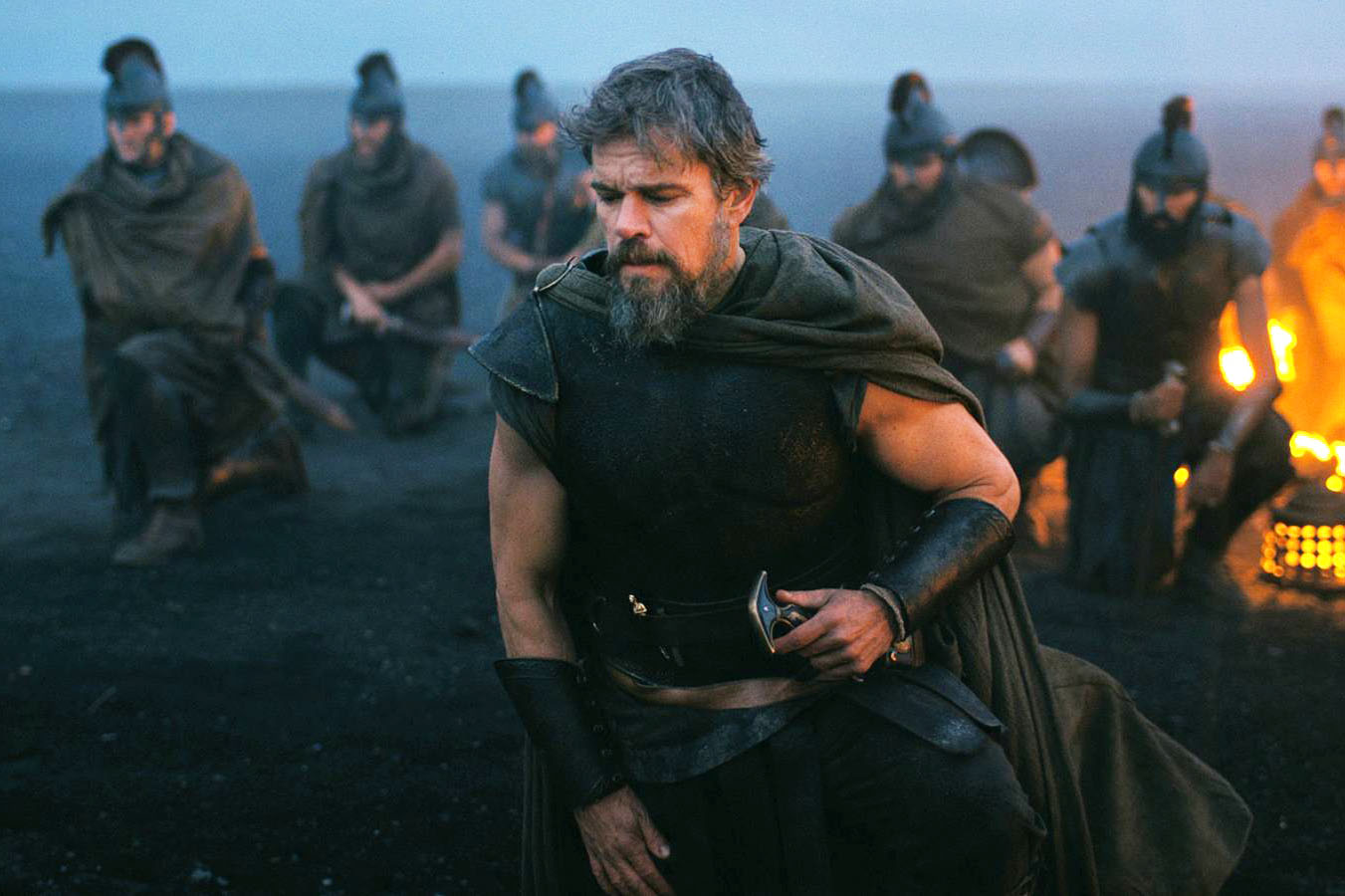
After the ten-year siege of Troy, Odysseus, played by Matt Damon, will spend another ten years on a meandering, perilous journey home. This is also, in part, the story of those he had left behind: his son Telemachus (Tom Holland), whom he last saw as a baby, and his wife Penelope (Anne Hathaway), who waits for him even as an increasingly restless crowd of suitors occupies the palace and threatens to force the issue, insisting that Odysseus by now must surely be dead.
Holland’s Telemachus is boyish and eager and not much more. As Penelope, Hathaway brings an imperious, forceful energy, chafing at the vulnerability of her position. As Antinous, the most visible and odious of the suitors, Robert Pattinson gives a sleek, knowing performance, full of relish. Among his fellow-suitors, he’s a bully; speaking to Penelope, he is manipulative and ingratiating, playing on her isolation, promising to answer to “her needs.”
When it comes to the journey, Nolan mostly follows the trajectory of Homer’s narrative, making omissions, additions and adjustments along the way. Odysseus leaves Troy with scores of soldiers, setting sail with three ships, choosing an unfamiliar route. There are perils at sea and on land, and a succession of encounters chiefly with women and monsters (categories that sometimes overlap). Gradually, his men succumb to these dangers; by the end, he is alone.
Women have the power to detain him, although in ways that are somewhat different from Homer’s version. The enchanter Circe is reimagined by Nolan to serve a particular didactic purpose. This is one of the most striking sequences of the film, in no small part thanks to the performance of Samantha Morton. Then there is the nymph Calypso, played by Charlize Theron, with whom Odysseus spends seven years. In Nolan’s version, Odysseus’s time with her is almost up; he is exhausted, burnt out, barely remembering who he is or was, dosed up on Calypso’s lotus flowers of forgetfulness.
Nolan is not particularly interested in his central character as a sexual or sensual figure; it is one element of Homer’s Odyssey he doesn’t care to engage with. This shapes the way he imagines Circe and Calypso, and is perhaps why he chose to omit one of Homer’s female characters, the young princess Nausicaa, who finds a naked Odysseus washed up on the beach.
At sea, however, there are female monsters; and here, in the realm of spectacle, Nolan is more assured. He finds an inventive way to convey to his audience the threat of the sirens, whose song lures sailors onto the rocks. And he vividly depicts the double menace of Scylla and Charybdis, a whirlpool and a sea monster, both gendered female in Greek mythology.
Athena (played by Zendaya) is the only god portrayed in the film; she appears to Odysseus, unseen by others, to counsel him at various stages of his journey. The others are conspicuously distant, generally possessing a punitive or prescriptive force and wielding an implied power over the lives of mortals. The likes of Poseidon and Apollo will take revenge on mortals who disobey their edicts, violate their property or harm their offspring. By the end, Odysseus’s men have had enough of gods and divine mandates: given a choice between respecting a god’s prohibition and starving to death, they make the obvious choice.
For Nolan, the most gods’ significant impact seems to be the much-referenced “Zeus’s law,” the obligation of hospitality, the need to welcome strangers, even beggars, lest they be gods in disguise. Odysseus gradually comes to believe that by dreaming up the strategy of the Trojan horse, a deadly weapon masquerading as a gift, he has committed the ultimate violation of that law.
Nolan is playing down one of Odysseus’s most celebrated aspects, his devious trickster side. Nolan envisages him, and Damon plays him, as more of a resourceful, quick-witted figure, a rationaliser. His men, at different times, beg him to be allowed to bury with honour the comrades they lose along the way, but he brushes them off. At his most cynical, he says of one man: “He died trying to help us to escape. We’ll honour him by escaping.”
In his emphasis on the Trojan horse, Nolan is drawing on other texts; Virgil’s Aeneid most famously provides much of the detail of the plan and its execution. It feels almost too obvious to suggest that in this film, Odysseus is a version of Nolan’s Oppenheimer, a man brooding over the consequences of his action and the devastation that comes in its wake. Not just the ruse that violated Zeus’s law of hospitality; there is also the question of what followed when Greek soldiers breach the gates of Troy and rampaged through the city. They brought with them, he suggests, “ten years of rage.”
Nolan is cautious about what he is prepared to show when it comes to this rage, however. One of his strategies is to use the enchanter Circe to represent the brutality of men. She is portrayed as a powerful yet traumatised figure who fears for her safety when Odysseus’s soldiers land on her island and seek her help. She is convinced they mean her harm; Morton’s performance suggests the grim experiences that lie behind her fear. Telling Odysseus why she has chosen to act as she has, she says, “This is who they are, they raped and pillaged their way across the world for you.”
Nolan also invokes a generalised, ubiquitous anxiety Odysseus encounters wherever he lands: the fear of “the people from the sea,” a contagious, undermining dread that seems connected to the film’s notion of a collapsing order of things. When it comes to Odysseus’s return, Nolan’s vision is more conventional and more confined. Here, too, he is careful about the violence he presents. It’s a tale of vengeance that waters down considerably the intensity and grimness of Homer.
Nolan’s Odyssey is an expansive vision in many ways. He has been able to exercise his imagination fully, command a budget that allowed him to shoot entirely on IMAX, unprecedented for a feature film. He has travelled to locations including Morocco, Iceland, Greece and Scotland, and built sets that feel tactile and tangible. Vivid, creative scenes have blockbuster energy and emotional directness. The confrontation with the Cyclops, the devouring giant who seems to exist somewhere between a golem and Goya’s Saturn, is unnerving and tense. Odysseus’s visit to Hades to speaks to the dead is a melancholy, sharply imagined encounter.
Where the film falls away, however, is in its conception of the figure at the centre; it is as if all the contradiction, intensity and excess of the character has shrunk into a symbolic figure of earnestness and atonement, given more weight to carry than he can bear. •