Allies, friends and clients of the United States grasp at a three-tier strategy to deal with a rogue American president running an incoherent government.
The first tier is hold on hard, so as to cope with a bumpy ride while clinging to as much as possible in the US relationship. The second is to hedge and hide from all the horrors being hurled around by Donald Trump. And third is help! Help yourself while seeking support from others facing the same horror.
Hold, hedge and help are responses to a US president operating on a strange mix of instinct, grievance and ego.
Foreign Affairs magazine asks: “How Much Abuse Can America’s Allies Take?” A Washington Post op-ed headline declares: “America Has Become a Rogue Nation. US Allies Are Looking Elsewhere.” While the Post has bowed to Trump (to protect the business interests of its owner Jeff Bezos) the “rogue” headline won’t bring White House retribution — it’ll be taken as praise.
The Indo-Pacific is scrambling to adjust to a great and powerful ally spewing a cornucopia of self-harm, doing serious damage to itself and its “friends.”
After seeing Trump kicking at Ukraine in favour of Russia, Taiwan thinks the unthinkable: how to resist China without America. Japan is explicit about its military support for Taiwan, and suffers Chinese diplomatic retribution without any White House backing. South Korea and Japan seek to overcome the scars of their history, exchanging quiet doubts on what their great ally will deliver. India, which had been drawing closer to the US for a decade, is reshaping its foreign policy after Trump bullying.
The opening move in handling Trump is to hold on hard: lavish gifts and praise on the distractible king. Try not to provoke. Expect offbeat monologues and verbal zaps rather than reasoned debate. On this metric, Anthony Albanese’s October visit to Washington worked well, with only a passing zap at Australia’s ambassador.
Traditional alliance responses — such as hosting more US military personnel and facilities in Australia — get little credit from Trump. Rather than seeing an ally acting in partnership, the transactional president rails against freeloaders extracting military benefits from America.
A better hold tactic is simply to hand over cash. Seek the best deal on American tariffs but don’t scream too loud. Australia’s pledge to pump US$3 billion into America’s shipbuilding industry as part of the AUKUS submarine deal fits the Trump pay-to-play version of the alliance.
“America First” is the guiding vision of Trump’s National Security Strategy, released on 4 December. Under the headline “Burden-Sharing and Burden-Shifting,” it declares: “The days of the United States propping up the entire world order like Atlas are over.” Allies and partners “must assume primary responsibility for their regions and contribute far more to our collective defence.” Expect much shifting and not much sharing.
At what point does America First become America Only? An arbitrary and unpredictable leader means the question has no real answer. Trump shreds Henry Kissinger’s dictum that “the essence of foreign policy is precisely the ability to accumulate nuances in pursuit of long-range goals.”
Understanding that the US may no longer be reliable drives the pivot to hedge and hide. Traditional diplomatic hedging is about keeping options open to minimise risk. The Trump risks leave no option but to hedge. And the major winner of the moment is the other big player — China. Everyone turns towards China. A rogue US makes it hard to know where the balance point lies between the two superpowers; that uncertainty serves China, unsettles the Indo-Pacific, and hurts America.
A symbolic expression of hedging comes from America’s long-time ally Thailand, whose king visited Beijing last month — the first Thai monarch to go to China since the two countries established diplomatic ties fifty years ago. The Middle Kingdom always appreciates tribute, especially conveyed by a royal.
Hedging will be more than a temporary tactic. Nations must shift to adjust to big structural changes. Trump’s long-term damage to the multilateral system may be as influential as his remaking of the Republican Party and polarisation of American politics. The destruction of USAID will cause a dramatic restructuring of the international aid system. And the distrust of the United Nations that Trump has driven even deeper into American thinking may be as consequential as the loathing of the European Union Margaret Thatcher bestowed on British politics.
Hedging is conducted softly. It is Trump who forces the hide. Nothing must be done to attract the president’s angry attention, because that is what causes tantrums, threats and tariffs.
The Hide imperative is to avoid a role in the Trump soap opera. The “soap” analysis is offered by Australian economist, Justin Wolfers, who is professor of public policy and economics at Michigan University. In a recent interview, Wolfers diagnosed Trump in terms any Australian TV viewer could follow.
You and I could try and talk about this like it were economics or like it were international relations, but it’s not. It’s a soap opera. It’s Sons and Daughters. It’s Home and Away. It’s Neighbours. And it’s going to be a soap opera that goes on and on for the next three-and-a half years. And just like sometimes Madge would get a little cranky in Neighbours, we are seeing the same thing happen here. Not a lot of rhyme or reason.
What we see, though, is the spotlight is relentlessly around the president. The thing he claims to want is “deals, deals, deals.” Look, you can’t do a deal with a bloke who halfway through the deal all of a sudden decides he’ll throw new tariffs on steel or aluminium, or that he doesn’t like something one of the [Canadian] provinces has done. Or he doesn’t understand the history of his own party and so will tax Americans as a result.
It just means the single best strategy is, in fact, the one that Australia has been following: stay out of the way. For all the people who are saying you’ve got to get more meetings with the president, the single best thing to do is make sure he forgets the name of our country.
The final tier: help! The need to help yourself is driving big increases in defence spending across the Indo-Pacific. Trump demands more military spending under that heading of “Burden-Sharing and Burden-Shifting.” The sharing and shifting language feeds doubt about what Trump will do, or demand, or fail to deliver. Uncertainty drives Asia’s new arms race. An unreliable president means nations must rely on themselves, and never look for help from Washington.
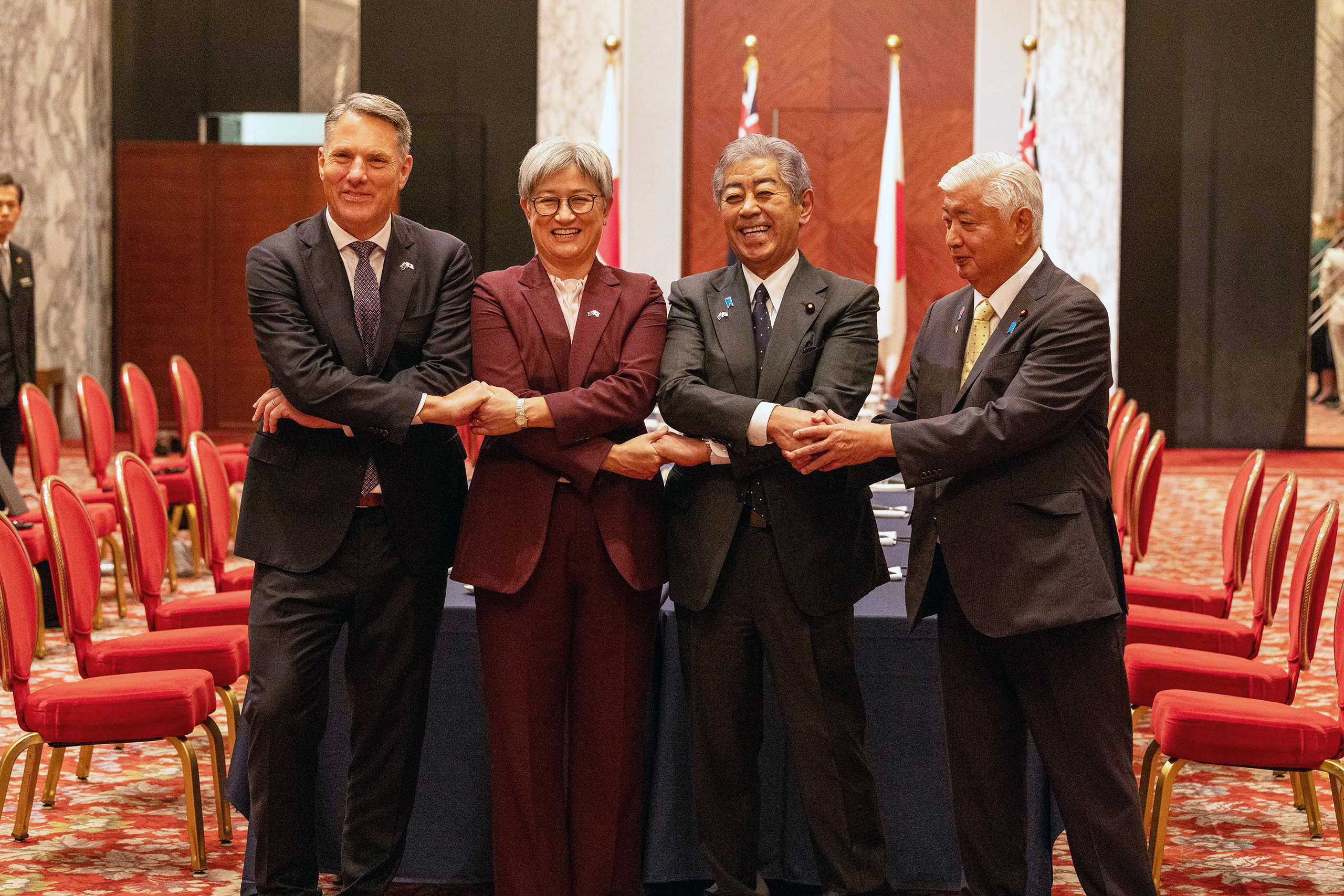
This all means that the quasi-alliance Australia has built with Japan this century enters new territory. When the Australia–Japan–US strategic dialogue was launched in 2002, its aim was to add a third leg to America’s alliances with Australia and Japan. Now Tokyo and Canberra want to help each other manage Washington and act together when Trump goes missing.
Australia and Japan signed a joint declaration on security cooperation in 2022 with the twin aims of serving their alliances with the US and the “peace and stability of the Indo-Pacific.” Canberra’s partnership with Tokyo has reached an extraordinary moment: Australia puts as much “strategic trust” in Japan as it does in the US.
At ministerial talks in Tokyo in September, deputy PM and defence minister Richard Marles declared: “There is no country with whom we have a greater strategic alignment than Japan. We’re both democracies. We both support a global rules-based order. We are both allies of the United States.”
Foreign minister Penny Wong told Japan’s foreign and defence ministers: “Our relationship has only grown stronger. We do face very difficult, challenging strategic circumstances, and as we face those circumstances, what we know is our strategic alignment and our strategic trust have never been stronger or deeper.”
The regional quest for help! is also the unspoken element in Indonesia and Australia agreeing on the terms of a new defence pact, a Treaty on Common Security, to be signed next month. Indonesia’s non-alignment means this can’t be labelled an alliance, but the two neighbours will consult on “adverse challenges to either party or to their common security interests” and consider joint actions.
Anthony Albanese calls the treaty a watershed moment that “signals a new era in the Australia-Indonesia relationship.” President Prabowo Subianto hailed “an important treaty between Australia and Indonesia, committing ourselves to close cooperation in the defence and security fields.” Prabowo said the “determination to enhance our friendship” to act as partners and neighbours would “enhance and guarantee security of both our countries.”
China and America were the twin ghosts present at the creation of the Australia–Indonesia pact; the needs of neighbourliness given urgency by Asia’s new reigning power and the other power gone rogue.
An unstable era also prompts Australia to offer fresh guarantees to the South Pacific: an alliance with Papua New Guinea, new security agreements with Nauru and Tuvalu, and similar bilateral treaties being negotiated with Fiji, Tonga and Vanuatu.
The hold, hedge and help framework is woven through the speech Penny Wong gave last month reviewing the three years of the Albanese government. Trump wasn’t mentioned by name, and Wong made only one mention of “the President.” She referred back to her assurance when Trump was elected: “Australians should be confident in our ability to navigate changes that were foreshadowed by the new administration.” In dealing with that administration, the Labor government had refused “to sprint towards a deal at any cost,” ensuring that it didn’t “bargain away what matters to Australians.”
This is classic hedge delivered with a firm hold.
Drawing on history more than the Trump experience, Wong praised American regional leadership as “indispensable” and declared, “The United States is our closest ally, and our principal economic and strategic partner. The Indo-Pacific would not have enjoyed long periods of stability and prosperity without the United States and its security guarantee to the region, as well as its leading role as an investor.”
Those words could have been lifted from any Australian foreign minister’s speech over the past eighty years. But the rest of the speech was a reflection on how “longstanding institutions and rules are undermined and broken.” Wong’s opening words were about “resilience becoming an even more critical priority, as Australia builds our future in an ever less stable world.”
“The Indo-Pacific is where the world’s future is most being shaped,” Wong observed, but “the change in the regional landscape is permanent. The disruption — the contest — is permanent. China will continue trying to reshape the region according to its own interests.”
In the help part of the speech, Wong said, “our defence, security and trade relationships with Japan, the Republic of Korea and India have reached unprecedented levels. Australia cannot afford to stand still while tectonic plates are shifting around us — because in these circumstances, that would mean going backwards.”
Permanent disruptions. Tectonic shifts. Broken rules. Uncertain world. Hold hard, hedge and hide, and help! •