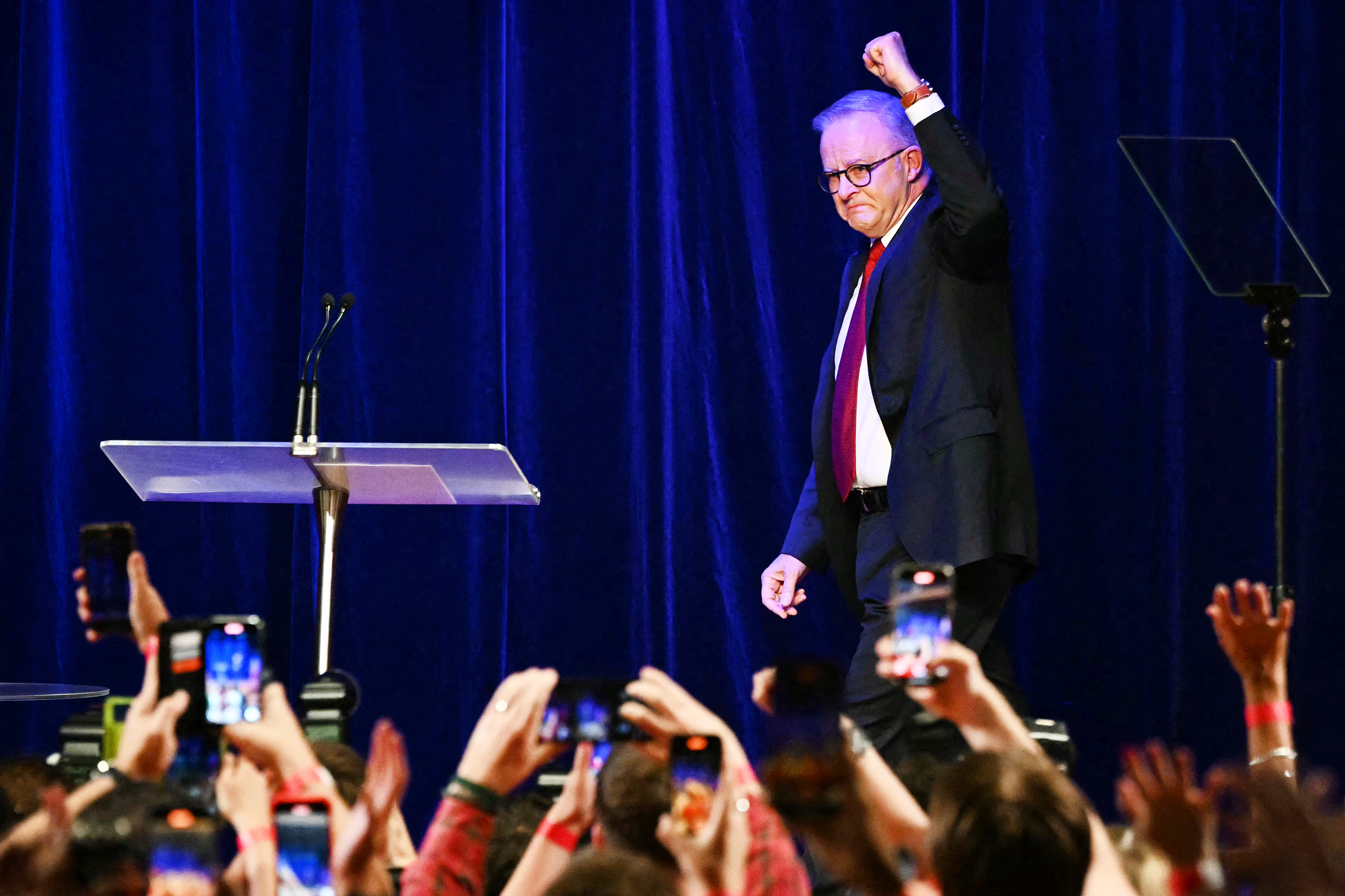
Twelve months ago, in the glow of his government’s landslide re-election, an exultant Anthony Albanese made the case for Australian exceptionalism. “Today, the Australian people have voted for Australian values,” he said. “For fairness, aspiration and opportunity for all. For the strength to show courage in adversity and kindness to those in need.” Australians, he went on, had voted for a future “built on everything that brings us together as Australians and everything that sets our nation apart from the world.”
He expanded on his theme over the following weeks by invoking the concept of “progressive patriotism” and holding out the promise that Australia could serve as a beacon of harmony: “At a time when there’s conflict in the world, where people are often divided on the basis of race or religion, here in Australia, we can be a microcosm for the world,” he told the Inside Politics podcast. It was “not just about strengthening Australia, but also being a symbol for the globe in how humanity can move forward.”
These forays into national identity were relatively novel for Albanese. The subject had been notably absent from his prime-ministerial repertoire compared to the most able of his predecessors. And that muteness was consistent with one of his conspicuous shortcomings as leader: his failure to weave a compelling narrative of his government’s mission. A year later, it is evident that re-election did not remedy that weakness. Albanese has not gone on to develop the inchoate theme of “progressive patriotism.” He has gone quiet on it.
In parallel and of greater moment, the outpouring of confident assertions about Australia’s distinctive democratic resilience has all but dried up during the past twelve months. What was celebrated at the time as a watershed repudiation of an ugly politics of fear and division — a decisive rejection of the Coalition’s efforts to shrink Australia into a mean-spirited country — is now rendered by recent commentary as merely a temporary respite. Right-wing populism has regrouped and, if anything, its threat has grown more menacing. We have regressed to the anxiety and resentment that stalked the land after the defeat of the Indigenous Voice referendum in October 2023 and through 2024 into early 2025.
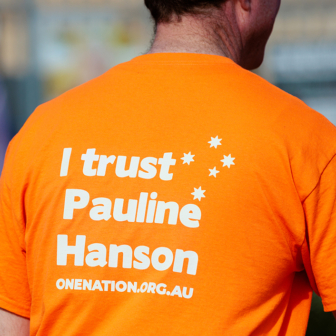
It is not hard to identify the reasons for a darkening of mood and pessimism about the state of the nation. There was the trauma of the Bondi massacre of December 2025, which battered claims that Australia is a nirvana of social cohesion — a setback rendered worse by the poisonous blame game that erupted in its wake. There has been the disturbing surge in the polls of the grievance-driven and xenophobic One Nation, which began before Bondi but accelerated afterwards. There has been the Coalition’s seemingly inexorable march to the right (and electoral irrelevancy). And, of course, there has been the roiling of global international relations and the world economy by the grotesque US administration of Donald Trump, as exemplified by the reckless attack on Iran.
But even allowing for these factors, how do we reconcile what the election result of May 2025 suggested about Australia’s political character with the country in which we apparently find ourselves a year on? Which better represents the true nature of the nation’s soul?
One way to begin answering these questions is to revisit the run-up to last year’s election. Since the Peter Dutton–led Coalition’s swingeing defeat, it has been easy to lose sight of how different the political environment appeared during much of the preceding two years.
By the second half of 2023, the first-term Albanese government looked to be in trouble. Against the backdrop of the meandering and doomed campaign for a constitutionally enshrined Indigenous Voice to Parliament and worsening cost-of-living pressures, opinion polls showed the government’s primary vote had dipped to the low thirties. Disapproval of the prime minister’s performance was outstripping approval; trust in government and satisfaction with democracy, having risen early in Albanese’s term, were sagging.
Australia seemed to be spiralling back into the cycle that had plagued the country for the previous decade and a half: precipitous loss of support for national governments and widespread public disenchantment with how politics worked.
The drubbing of the Yes side in October 2023’s Voice referendum only seemed to confirm a souring national mood. Albanese’s final recourse had been to characterise a Yes vote as an act of kindness by non-Indigenous Australia — an outstretched hand to First Nations peoples. When 60 per cent of the electorate responded by voting No and the referendum was beaten in every state, it was easy to assume a collective stoniness of heart.
This is not the place to analyse the reasons for the Voice’s decisive defeat. The contributing factors were many, among them the long-established reluctance of Australians to amend the constitution, the cruelling effects of the denial of bipartisan support, the inability of Yes proponents to effectively counter the argument that a constitutionally entrenched Voice would elevate one group of Australians above the rest, and Albanese’s deficiencies as an advocate.
This was the moment in Labor’s first term that most underlined questions about Albanese’s capacity to switch to a dynamic, galvanising prime-ministerial mode. Words, or his lack of facility with them, bedevilled him and the Voice campaign.
The referendum’s defeat upended the political battle between Albanese and Dutton. In a way that rehearsed his initial disorientation after the Bondi massacre — as betrayed by his stricken face and glassy eyes — the prime minister could not disguise his mortification. Having raised the hopes of First Nations people only for them to be cruelly crushed, he had joined a dispiritingly long line of occupants of the Lodge, Bob Hawke most prominent among them, left to rue their failure to deliver for Indigenous Australians. In the days and weeks after the vote, the prime minister was demoralised. It was as if the stuffing had been knocked out of him.
Dutton, by contrast, was emboldened. In the pattern of the referendum results, he was able to discern vindication of his strategy of seeking government through the outer suburbs and regional and rural Australia. There were doubters, of course. Andrew Gee, who had split from the Nationals over its opposition to the Voice, predicted the Liberals would eventually face the reality that campaigning against the referendum had “burned a large swathe of their supporter base” and would “ultimately be ashes in their mouths.” Noel Pearson, a chief architect of the Voice, later observed that Dutton had squandered an opportunity to soften his ingrained and politically damaging “hard-arse persona.”
When the Coalition was thrashed at the polls in May 2025, Pearson declared that Dutton too, “along with the blackfellas,” had become “victim of the failure of the Voice.” Corroboration of Pearson’s argument could be found in post-referendum research by ANU that had highlighted Dutton’s deep unpopularity in the community. The data invited the conclusion that his pitiless prosecution of the No case had been purchased at the price of a chilling of attitudes to him.
Nevertheless, for much of 2024, the impression conveyed by the opinion polls and reinforced by the bulk of political commentary was that Dutton enjoyed the upper hand over Albanese. The prime minister was dogged by the same scepticism about his leadership that had existed before the 2022 election. Columnists asserted that he was “shrinking” rather than growing in office, that he was allowing the opportunities of office to slip through his hands, and that he was sleepwalking towards taking Labor to a first-term defeat.
In early December, the eminence among columnists at the Australian Paul Kelly captured a nagging question about Albanese that had grown more insistent with the election of the disruptor-in-chief, Donald Trump, to a second presidency. Albanese’s problem is his “incrementalism in an age of transformation,” opined Kelly. A fortnight later he suggested that Dutton, who he claimed Labor had badly underestimated — just as it had John Howard, Tony Abbott and Scott Morrison — was the one clued into the zeitgeist of the times:
[Dutton is] becoming more than a Liberal leader — he is becoming a symbol for the people who feel disenfranchised, overlooked by the system, denied a voice and patronised by the elites. These “forgotten people” in 2024 constitute a growing segment of the population and every move by progressives — from backing identity politics, bagging Australia Day, championing high immigration, altering the way people live, promoting distinctions on race, sex and gender, and deploring Dutton on the flag — only boosts Dutton’s profile. The progressives don’t get it… left progressives in Australia are Dutton’s best friends.
It is worth recalling exactly what Dutton was offering to voters that caused Kelly to believe he had cracked the national political code. The Coalition’s headline policy under his leadership, unveiled in meagre detail in June 2024 after months of delay, was a plan for seven publicly owned nuclear energy plants. The policy defied expert opinion, including from the country’s chief science research agency, CSIRO, to which Dutton responded by impugning its objectivity.
The core problems identified with the policy were the time lag involved in the construction of nuclear facilities and the uncompetitive cost of nuclear-generated power compared with renewables. It was hard to avoid the conclusion that the opposition saw nuclear energy not so much as a serious solution to curbing carbon emissions but as a filibuster for delaying the transition from fossil fuels. That depressing reality was effectively confirmed when Dutton announced that the Coalition intended to scrap Labor’s legislated carbon emissions reduction target of 43 per cent by 2030 — a decision he had reportedly taken unilaterally.
Otherwise, Dutton’s statements and policy offerings during 2024 seemed principally designed to ignite xenophobic antagonisms in the community. In his budget reply speech in May, he advocated a major cut in the migration intake, ostensibly to address the nation’s housing shortage. But he did not stop there. He connected excessive migration to people in the suburbs struggling to get their children into school or childcare and to gaining access to medical care. Migrants were even at fault for road congestion.
Another familiar strongman trope in the budget reply address was Dutton’s pledge of action to counter violent crime, despite law and order lying primarily in the jurisdiction of the states. In September, during an interview with a friendly Sydney talkback radio host, he warned that international students appealing for visa extensions had become “a modern version of boat arrivals.”
The opposition leader also showed a cavalier indifference to the social tensions in the Australian community unleashed by Israel’s invasion of Gaza, which was precipitated by Hamas’s atrocities in October 2023. This was a diabolical issue for the Albanese government, both diplomatically and domestically. As with sections of the Australian media that vehemently policed a line of unfettered support for Benjamin Netanyahu’s government, the Coalition’s position on the Gaza war was bereft of nuance. It dogmatically backed Israel’s military aggression against Gaza’s population even as evidence mounted of its disproportionate and catastrophic deadliness.
Ignoring a plea for restraint from the director-general of ASIO, Dutton provocatively alleged that Labor’s security checks had been lax and demanded all visa applications by Palestinians fleeing the war zone be refused because of the threat to national security. He called for draconian measures to curb pro-Palestinian protests, even proposing deporting transgressors. Then he rounded out the year by announcing on Sky News that, if elected prime minister, he would discontinue Albanese’s practice of standing beside Aboriginal and Torres Strait Islander flags, in company with the Australian flag, at media conferences. The flags, he claimed, were “dividing our country unnecessarily.” It was all red meat for a constituency Dutton evidently believed to be baying for this stuff.
Significantly, of Liberal leaders this century, Dutton (along with Tony Abbott) came the nearest to being a Howard protégé. He was elected to the House of Representatives in November 2001, arguably the twenty-first century’s other watershed election. The so-called Tampa election, not long after the 11 September attacks, heralded a decisive shift to strongman politics built around the weaponisation of border control and an intensified securitisation of politics.
Combined with climate change scepticism, a lack of sympathy for First Nations self-determination and discomfort with multiculturalism, Howard smuggled into mainstream Australian politics a potent strand of homegrown conservative populism. In the hands of his successors, who lacked their master’s agility in application, that ideological pivot sharpened. Under Dutton, it was a distilled and noxious brew stripped not only of subtlety but also of any serious interest in economic issues. Abbott and Dutton were both conspicuous for their lack of adeptness or interest in economics.
As Australia entered 2025 commentators commonly assumed the country was headed for a close-shave election, with a real prospect that Dutton would achieve the extraordinary by dragging the Coalition back into power after just one term. The dire polls for Labor peaked in February, with one risibly reporting that the party’s primary vote had collapsed to 25 per cent. I always suspected that the picture painted by the polls was a mirage. In an essay for Inside Story in September 2024, for example, I contended that “the nation is neither as fearful nor as paranoid as Dutton is banking on, with women and young voters likely to prove major obstacles” to his prime-ministerial ambitions.
No magical powers of prescience were needed to arrive at this viewpoint. For at least a decade it had been clear that Howardism — a turning away from the forces of cultural and social modernisation doubled down on by his less capable successors — was propelling the Liberal Party towards electoral marginality.
The disintegrating support for the Coalition among young voters was especially stark and portentous. Among millennials and Gen Z voters last year, Labor attracted 64 per cent and 67 per cent of the two-party vote respectively. This loss by the Liberals of cohorts of younger Australians immersed in, and comfortable with, social and cultural pluralism shows where the Howard project had left his party.
Tellingly, the 2025 election also showed that Dutton and his fellow travellers didn’t have much more insight into the outer suburbs. These communities, which were undergoing a tsunami of growth and dramatic demographic change, were vastly and increasingly diverse. They were not defined by so-called “bogans,” as the opposition had condescendingly conceived them.
Above all, the 2025 election was a disavowal of Dutton’s dread-infused vision of the nation. The historian Frank Bongiorno wrote at the outset of the campaign that the Liberal leader’s bleakness was “in a league of its own,” even more unrelieved than that of the minatory Abbott. The Australian Election Study found Dutton to be most unpopular leader since data had been collected, bumping out Scott Morrison from its previous survey.
The result also reinforced the message the electorate had sent the Coalition three years earlier when they cast Morrison from office. Though Morrison was somewhat aberrant in the Liberal Party and Australia’s political culture because of the influence of his North America–style evangelical Christianity on his belief system and style of leadership, the 2022 and 2025 election results effectively telegraphed the same message to the Coalition, with the latter adding an exclamation mark. Indeed, just as Dutton had doubled down on his side of politics’ march to right-wing populism, voters had doubled down in rejecting it.
The unexpected scale of Labor’s victory in May last year left questions about why pundits had been misreading the political mood over the previous eighteen months. Opinion polls had begun to track a recovery in the government’s standing by about March and were tracking a widening gap between Albanese and Dutton as preferred prime minister, but the magnitude of Labor’s improvement between its nadir of February and the early May election beggared belief. This reminder of the limited predictive power of opinion polls at a distance from an election also raises questions about what they had actually been registering. Rather than providing a reliable measure of voting intention, my suspicion is that the polls might well have been acting as an instrument for the public to let off steam and stretch the government on the rack.
The emphatic repudiation in May 2025 of the Coalition’s journey to strident conservative populism also provoked an effusion of interest in the country’s political distinctiveness. Australia had bucked the trend of democratic backsliding in many other parts of the world, not least in Trump’s United States, and the associated proliferation of populist strongman leaders. Its democracy was resilient and its political centre holding.
Historians have been writing about the country’s democratic exceptionalism for many years, but suddenly in the second half of 2025 it became a subject about which every galah in every pet shop was squawking. The ABC’s 2025 Boyer Lecture orations were dedicated to the theme “Australia: A Radical Experiment in Democracy,” and a three-part television documentary on the national broadcaster, hosted by Annabel Crabb, lauded the nation’s democratic architecture.
Nor was it only at home that the country’s democratic system was winning favourable reviews. According to one of Britain’s most influential politics-watchers, Rory Stewart, “if liberal democracy has a future, it looks surprisingly Australian.” One of the ABC’s 2025 Boyer orators, Justin Wolfers, a US-based Australian who has successfully carved out a career as a scholar and economist, rhapsodised that the country’s “democratic and economic institutions” were “not just world class… [but] the world’s best.”
All this optimism came to a shuddering halt on the evening of 14 December with the killing of fifteen innocents at a Jewish festival of Hanukkah on Bondi beach by father and son Islamic State sympathisers radicalised by Israel’s bloody invasion of Gaza. That depravity immediately became a subject of partisan-fuelled blame, spearheaded by Coalition politicians, present and former, who accused the federal government of failing to rein in a burgeoning wave of antisemitism. An evidently distraught Albanese was condemned for bungling the moment, for being slow to act in the days following the massacre, and especially for his resistance to what quickly became a coordinated campaign for the appointment of a royal commission into antisemitism.
The legitimate reasons to pause before proceeding down a royal commission path were drowned out by a clamour fuelled by News Corp and Nine media. Later, the Age’s editor, in an extraordinary column puffing the virtues of the newspaper and its journalists, conceded that sometimes its coverage could be “less frantic, more considered.” This was apparently said with no self-awareness that the febrile weeks following Bondi had been just the time for sober debate and steadiness rather than — as the Age had earlier bragged — being in the vanguard of the campaign for the royal commission come hell or high water.
The shocks kept coming, most notably the joint US–Israel airstrikes on Iran in late February, disrupting global oil trade and catalysing intensifying cost-of-living pressures. One Nation’s poll figures had smashed through the 20 per cent barrier by the end of December, with the lion’s share of that vote (as Murray Goot’s trademark granular analysis for Inside Story demonstrated) hiving off the Coalition and especially the Liberal Party.
The Coalition’s answer to this existential challenge has been to move further to the right: to effectively mingle in the same space as One Nation in competition for the votes of the angry and the disaffected. Witness the new opposition leader Angus Taylor’s recent immigration announcement, with its thinly coded signal of the abandonment of the principle of a non-discriminatory intake. One of the most arresting things here is how ill-fitted Taylor is for the role. A leader who looks like he has emerged from central casting and exudes a privileged background has taken on the mission of steering the Liberal Party further towards an anti-establishment position to vie with the much more impeccably credentialled outsider, Pauline Hanson.
Two essays published during the past fortnight probe the national mood a year from the May 2025 election. One appeared in the left-leaning Monthly and the other in the Murdoch flagship, the Australian. Despite their contrasting venues, they are consistent in depicting a troubling picture.
The former is written by the respected journalist and author of an accomplished biography of Albanese, Karen Middleton, and draws on focus group findings by social researcher Rebecca Huntley and polling work by Redbridge’s Kos Samaras. Middleton writes of “a deeper change in Australia that’s been gradual but now feels sudden, like a kind of fraying in the order of things”:
People have endured wave after wave of stress from fires and floods, a pandemic, conflicts abroad, rising inflation at home, a terrorist attack and now a fuel crisis. Australians’ anxiety and exhaustion have progressed to frustration, disillusionment and rage, as people become less willing to accept orthodoxies — political, corporate, legal — and more inclined to revolt.
Not surprisingly, Middleton identifies the dramatic spike in polled support for One Nation as the most visible manifestation of the community’s disenchantment with business-as-usual political practices. She points to the powerful performance of the party in the South Australian election in March, where it captured 23 per cent of the primary vote, as evidence of the realistic threat of that populist surge. She argues the loss of faith of Australians in institutions has been a slow burn, and even harks back to the corporate excesses of the 1980s and 1990s.
Middleton quotes Labor’s federal treasurer, Jim Chalmers, referring to the period since the global financial crisis: “all of these rolling shocks for twenty years have been cumulative. And every time it feels like ordinary people are going get off the mat, something else arrives.” At the same time, she singles out the Covid-19 pandemic as “a major pivot point for Australian attitudes.” In turn, the worsening cost-of-living pressures unleashed since the pandemic are compounding the sense of a system that is not delivering for ordinary people: a situation in which hard work is no longer a guarantee of material progress or security. Huntley perceives a besieged public and a “mood of persistent despair and fragility… she hasn’t encountered in twenty-two years of field work.”
If this is grim reading, then the second essay, by retired sociologist and longtime conservative commentator John Carroll, borders on the dystopian. When he looks at contemporary Australia, Carroll sees “conditions of disunity, malaise and confusion.” This is “a demoralised nation.” Social and culture decay is everywhere, not least in the big cities as manifest in “potholed streets, graffiti-smeared buildings and precincts populated by mentally disturbed drug addicts [and] an increasing failure to address crime, notably at the hands of violent teenage gangs.”
In common with Middleton, Carroll interprets the dramatic increase in One Nation’s appeal to voters as a symptomatic of political despair. But equally suggestive of political nihilism, in Carroll’s view, is the large proportion of Gen Zs who vote “for a marginal extremist party, the Greens.” Like Middleton, Carroll regards the current crisis as having a long genesis, with the decline of Christian faith among its causes. Yet he is also alive to the effects of public policy failure, especially the lack of action to tackle declining housing affordability that has left the young condemned to “a rootless existence, an understandably insecure and anxious one, prone to deflating self-esteem and low hope.”
Depressed? My question following reading these two essays is whether we are in danger of repeating the error of 2024: to believe that Australia is ripe for picking off by an opportunist populism that foments and feeds off grievance and division — that this country is, in other words, no less susceptible to a lurch to the extreme right than the United States or Britain. Indeed, suggestive of a parallel with Britain, Middleton recites how British Labour MP Liam Byrne, in his book Why Populists Are Winning and How to Beat Them, classifies the groups of voters being seduced by the blandishments of Reform leader Nigel Farage.
To put this another way, Middleton and Carroll’s essays would lead us to think the 2025 election result was not so much a defining repudiation of the dark lands of political populism as a mere postponement.
Though not wanting to diminish the extent of disgruntlement with politics in Australia, or the serious economic pressures and social fissures in the community, or the profound public policy challenges, I believe there are grounds to be more hopeful about the nation’s political sensibility and direction. One of the most pronounced lessons of Australian political history is that the public has little time for demagoguery and a keen nose for moonshine. The loathing Morrison engendered once voters had seen through his confections is only the latest evidence of the latter instinct.
Moreover, the institutions that were extolled in the aftermath of the 2025 election for their role in buttressing the political centre have not been packed up in the twelve months since. Compulsory voting and preferential voting, well-documented as restraints against polarisation, are an entrenched part of our democratic architecture, as is that underappreciated national jewel, the independent Australian Electoral Commission.
I also doubt the levels of support for One Nation registered in opinion polls will translate into a vote of that magnitude in a federal election. The latest surveys are already giving an inkling that the party’s appeal has peaked. And, while the SA election result suggested One Nation’s support was far from a polling mirage, it is important to remember that Peter Malinauskas’s Labor government was unmistakeably on track to romp back into office, allowing voters to vent frustrations in the knowledge that a first preference for One Nation would not change who was in power.
In that context, it is pertinent to note Middleton’s citing of Huntley’s finding that most voters contemplating shifting their allegiance to Hanson’s outfit “don’t actually want it to run the country.” Support for One Nation is effectively “a cri de couer,” Huntley believes, rather than heralding the party’s conquest of government.
None of what I am saying here is an excuse for complacency. Nor is it a reason to ignore the fact that Australia’s political system is under significant strain for a complex constellation of reasons, including a radically transformed and balkanised media landscape, two decades of stasis in key policy areas, and the ongoing flight of voters from the major parties. The latter phenomenon, while an expression of disillusionment, is also a natural byproduct of an increasingly diverse and complex society. Historically, the established parties were very proficient at accommodating growing pluralism, but that ability was always destined to reach its limits.
One of my conclusions in my new book on twenty-first century prime ministers, The Alchemy of Leadership, is that two decades of mostly underwhelming political leadership, instability in high office and accompanying policy stagnation have put the country on borrowed time. One thing that has differentiated Australia from many other democracies is that the young, females and males alike, have been overwhelmingly immune to the siren song of angry resentment politics. Instead, as suggested by the 2025 two-party-preferred vote, the young are skewing heavily to the progressive end of politics. Millennials, Gen Z and the coming Gen Alpha are demographic timebombs for the Coalition.
Far from Carroll’s dyspeptic and, I suspect, elegiac outlook developed at distance from younger Australians, the experiences of these generations have conditioned them to embrace diversity and endowed them with an outward-looking perspective. But we can’t expect endless forbearance from young people faced by what the former treasury secretary Ken Henry has acidly described as “wilful acts of bastardry” in permitting intergenerational inequalities to grow unchecked in fields such as housing, tertiary education and the environment. Alienation will eventually fester unless these inequities are meaningfully tackled by government.
Another reason for my guarded optimism is that we appear to be approaching an inflection point in the Albanese government. The prime minister’s maxim for most of the past four years has been to hasten slowly: to stick firmly to a practice of orderly, modest change. Many Cassandras in 2023–24 believed that his circumspection would prove the undoing of the government — that, as Paul Kelly suggested, he had misread the times by being an agent of nip-and-tuck government in an age of disruption.
Though not without good fortune (though which successful prime minister has not enjoyed a fair share of luck?), Albanese’s approach was ultimately vindicated at the ballot box. A year later, however, he finally seems to be signalling that he appreciates the growing urgency of the moment: that the time has arrived for a shift in governing tempo and for a quickening of reform pace focused especially on addressing generational inequalities. That he is cognisant that the upheavals besetting the globe and the public’s discontent present a rare window of opportunity to shake things up. Middleton quotes the prime minister’s address to the National Press Club early last month:
Providing stability and security amidst uncertainty does not mean standing still… It means anticipating and creating change, true to Australian values and in Australia’s interests. Because if people feel like the economy is not working for them, if they’re putting in the effort but not seeing the reward… then government cannot provide stability just by keeping things as they are. There is no security in maintaining a status quo that doesn’t work for people.
This month’s federal budget is being anticipated as a litmus test of whether Albanese is really prepared to spread his wings. Movement in some areas such as the capital gains tax discount and negative gearing has already been telegraphed. The likelihood, however, is that the budget will leave many progressives underwhelmed. They ought perhaps to bear in mind what another former treasury head and ex–prime minister’s department secretary, Martin Parkinson, observed recently. While imploring the federal government to seize this moment, he conceded that not all reform boats can be launched at once.
The truth is that it is a characteristic of the progressive side of politics to devour its own: to be perennially disappointed by Labor in power only to later, once the government is fallen, view it retrospectively through more sympathetic lenses. The impact of any invigoration of the Albanese government’s reform mission will also be hindered by a deficiency in the prime minister’s makeup that I have already referred to: his limitations as a communicator-in-chief. Advocacy and explaining to the public where Labor’s busyness in office is transporting the nation is an abiding deficit in his leadership, and seems all but irresolvable.
The past twelve months has certainly confirmed that right-wing populist politics was not slain in this country last May: it is a hydra-headed beast. Yet neither ought we be spooked by its spectre nor rattled by the now habitual turbulence of politics. History shows that political excess is not a natural feature of the country’s DNA and there remain grounds for confidence that the populist threat can be kept at bay by brave and judicious leadership.
To conclude squarely on leadership: we are prone in Australia to think dimly of the quality of those who govern over us, to believe Donald Horne’s aphoristic assertion in the 1960s that this is a nation that has prospered despite the mediocrity of its governing class. This is not borne out by the historical record. Since the birth of Commonwealth, the nation has had its fair share of accomplished and effective prime ministers: Alfred Deakin and Andrew Fisher in the first decades after Federation; John Curtin, Ben Chifley and Robert Menzies in the mid-twentieth century; and Gough Whitlam, Bob Hawke, Paul Keating and John Howard in the modern era.
It is the case that this century has been far from a stellar time for prime-ministerial leadership in this country: a phenomenon I explore in my book. Yet if Albanese can discover something of the heroic within him and rise to the opportunities of this moment, it isn’t beyond the bounds of possibilities that he might one day be counted among those consequential prime ministers. •