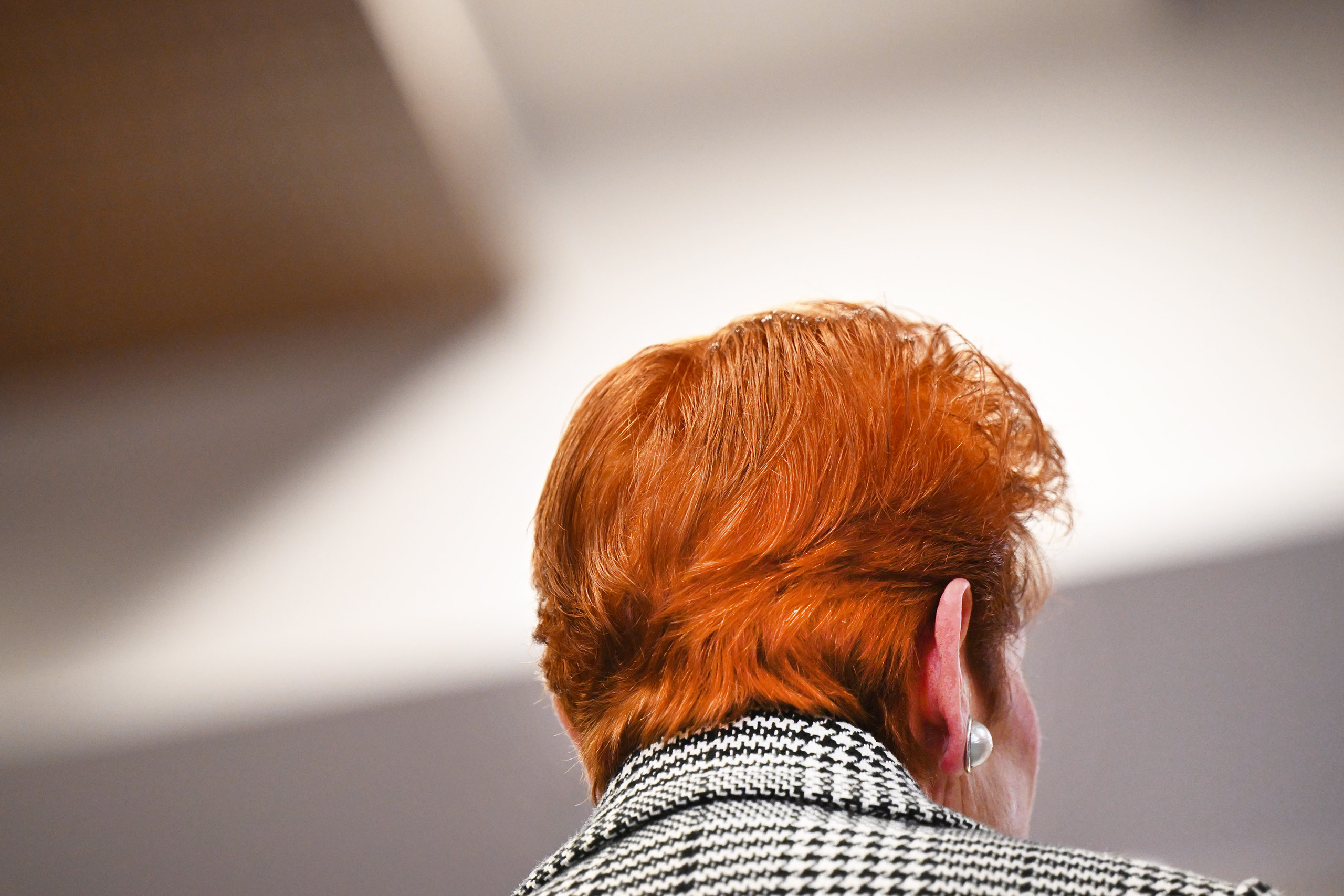
If a federal Liberal or Nationals leader had delivered Pauline Hanson’s Press Club speech on Wednesday and given the same answers to journalists’ questions, you might have declared them stark raving mad. You’d certainly conclude they’d thrown away any chance of winning a federal election due in two years, assuming they kept their job for that long.
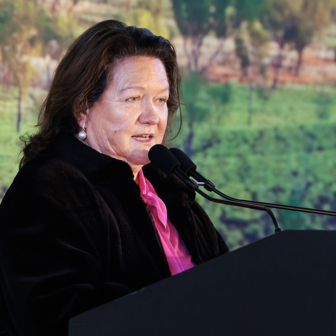
So many big targets, so many uncosted “policies.” A lot of Hanson’s sentiments could appeal to many or most voters, but others, particularly when she was answering questions (workers are “lazy,” childcare workers don’t need qualifications, her slippery views about abortion), not so much. Left unmentioned were her strong anti-vaccination views, her adoration of Donald Trump, her fellow One Nation senator Malcolm Roberts’s conspiracy theories, her backing from posh squillionaire Gina Rinehart, her attitudes to guns.
She and her team would be happy with her performance: she was confident, strong, not for turning and avoided those tricky topics. The grievance theatre — everyone’s picking on her but she keeps soldiering on — was on full show.
Hanson is the leader of an insurgent party, so the rules that apply to the Libs and the Nats don’t apply to her. But this insurgent party is suddenly leading the pollsters’ primary vote figures in a three-way contest with Labor and the Coalition.
That doesn’t mean One Nation is “ahead in the polls” any more than when, in the old days, the Coalition led in primary votes but lagged after preferences. If recent survey results were replicated at the ballot box, Labor would likely have the most seats — maybe a majority — followed by One Nation, daylight, and then the Coalition.
If One Nation’s primary support gets into the high thirties, though, a majority of seats might (depending on other parties’ support) be on the cards. Somewhere between its current thirty-ish and that scenario, a One Nation–led alliance with the Coalition becomes likely.
Comparisons with Trump are limited: he took control of the major centre-right party, and hence its place in the country, its infrastructure, its finance and its rusted-on supporters. The United States has not seen the electoral splintering that’s happened in other advanced democracies (if America still sits in that category).
In Western Europe, where most countries use proportional representation to elect their lower houses, some far-right parties have topped the vote with very low numbers. Georgia Meloni’s Brothers of Italy got 26 per cent in 2022, but along with her party’s junior centre-right partners won a majority of the Chamber of Deputies seats. (That’s the short version; the longer one includes first-past-the-post single-member districts, which members of her coalition divided between them so as not to split the vote — similar to Liberal frontbencher Tony Pasin’s recent thought bubble.)
At the other end of the range of outcomes, Austria’s Freedom Party won the most votes, 28.8 per cent, and the most seats in 2024 but remained totally out of government. In between, a few far-right parties won similarly modest vote pluralities and then entered government in some form, although not supplying the head of government.
France’s lower house’s electoral system is similar to ours: single-member districts, with its second round of voting rendering it all somewhat “preferential.” Two years ago, Marine Le Pen’s National Rally group topped the first round (like our primary vote) with 33 per cent, winning pluralities in a majority of districts. Other parties then selectively sat out the second round out to deny it victory.
In our compulsory preferential voting system, strategic non-contesting of seats (as advocated by Pasin) makes little sense, but recommending preferences to or away from other parties does. Labor always puts One Nation last on its how-to-vote cards, but at recent elections the Coalition has “preferenced” One Nation ahead of Labor everywhere, largely because most of the very conservative Liberal and Nationals memberships would strongly object, and possibly defect, if they preferenced Labor.
Hanson’s Wednesday speech devoted many words to lambasting Anthony “the Liar” Albanese and Jim Chalmers, but no Coalition members were mentioned. While One Nation casts itself as an alternative to the two-party seesaw, its strongest criticism is always directed at Labor (often with a swipe at the Greens). And yet it inflicts a lot more damage to the Coalition parties.
How much more damage?
There’s a question most pollsters ask without publishing the results. When a respondent says they’d put “1” next to a small party or an independent, the pollster asks which of the major parties they’d give their preference to on the ballot paper.
The question usually starts something like: “As you may know, you must rank either Labor ahead of the Coalition or the Coalition ahead of Labor on the ballot paper…” These words provide information people don’t get when voting, and this artificiality is one reason why these respondent-derived preferences don’t tend to stand up well against the eventual flows at elections.
But the question is brilliant for getting some idea of the (major) partisan leanings of these voters. One outfit that publishes these numbers is Redbridge/Accent, and in their last three (non-MRP) reports the results for One Nation voters averaged to 77 per cent for the Coalition and 23 for Labor. That’s a good proxy for the relative proportions the insurgent party takes from the majors.
Of course, the major parties began shedding primary votes years and decades before One Nation staged its recent revival; indeed, the revival itself is a symptom of the ongoing collapse of the two-party system. The support has to go somewhere, and at the moment it’s coalescing around this person.
As the election approaches, the prospect of a government comprising One Nation and the Coalition has the potential to push more voters, however reluctantly, to support Labor.
It’s barely a year since Peter Dutton led the Coalition to disaster, largely because he was seen as too Trumpy. But he was the epitome of sensible centrism compared with Hanson. That’s the big question about the 2028 election: will the old rules — that voters crave stability and reassurance and are risk averse — still apply? A lot will depend on how the economy is going, and whether the cost of living still feels alarming. People can take desperate measures in desperate times. •