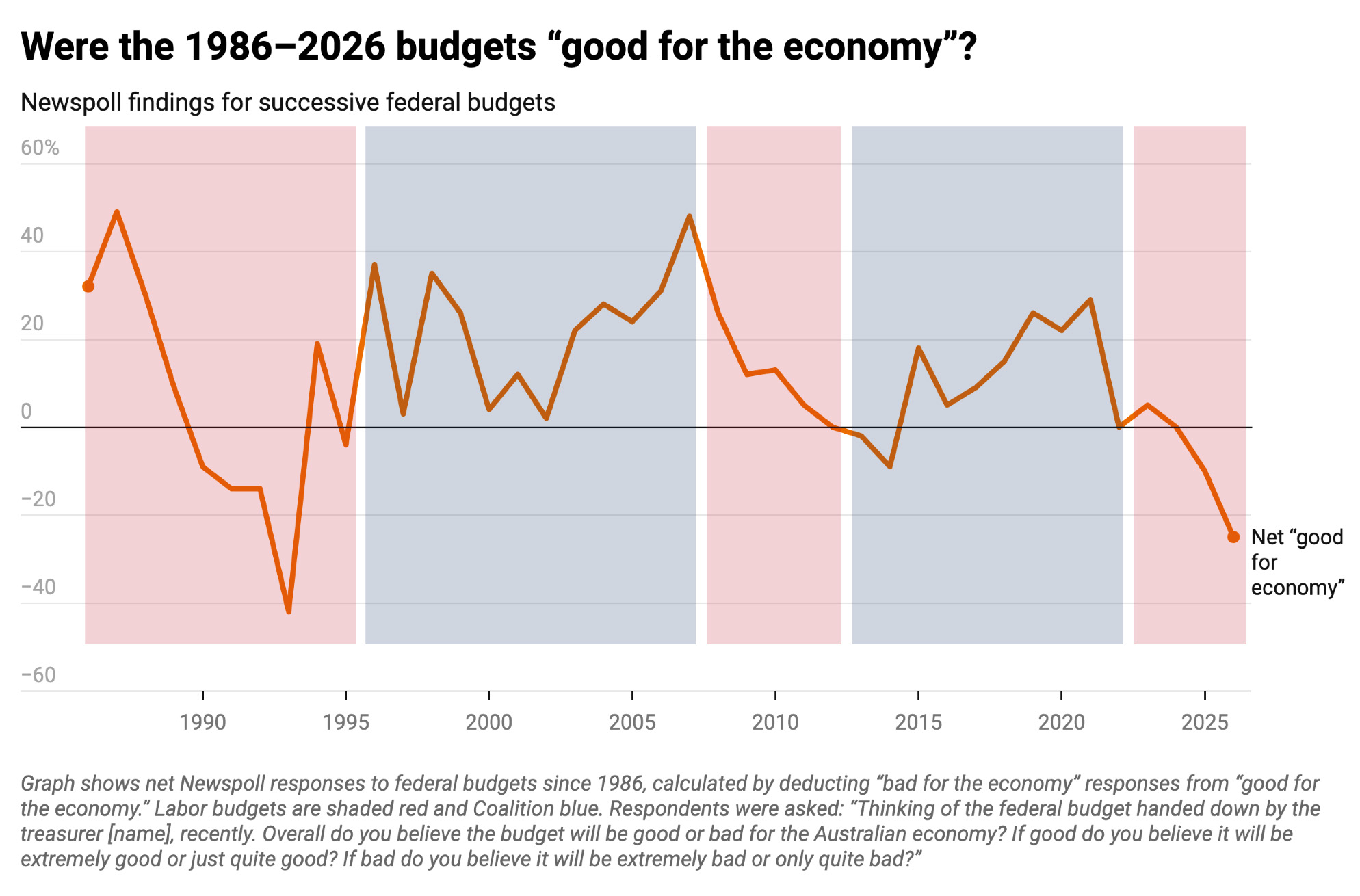
I don’t need to tell you that the 2026–27 federal budget hasn’t gone down well in voterland. The first surveys, taken within days of budget night, showed it overtaking even the Abbott government’s 2014 effort in the putridity stakes. And since then the pile-on and drama queenery has intensified, with many journalists — not just in traditionally hostile outlets — helpfully adopting the Coalition’s “death tax” moniker for one of its elements.
Many of the criticisms, of course, are beat-ups and bad faith speculation. The polls embolden the critics, whose overblown predictions in turn affect public attitudes. Welcome to policy-reform debates Australian-style. And now there’s the extra, ever-changing input from social media.
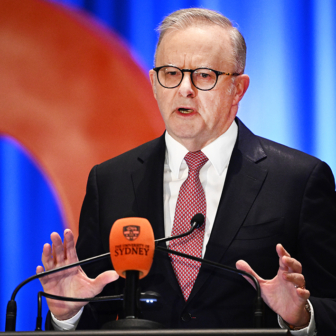
But to this not-very-finance-literate observer many of the criticisms are valid, an obvious one being the incongruity of applying the capital gains changes to forms of investment other than (established) housing when the government’s chief stated purpose is to steer investment away from property. Both Anthony Albanese and Jim Chalmers have offered nonsensical explanations for this contradiction.
Still, it’s facile and self-serving to assume, as many of the anti-government combatants seem to, that the public reaction shows how right they are and how truly dreadful the package is. Many of today’s complainers quite liked the Abbott government’s first budget, with its smorgasbord of spending cuts and broken promises. (Or they would have liked it if they’d been old enough to follow such things twelve years ago.) Voters loathed that one too.
Similarly, squeals about overturned election pledges tend to be selective. Governments pressing ahead with unpopular decisions can be cast as hopeless and out of touch with the common sense of the electorate or, alternatively, as possessing political courage, leadership and even, yes, “conviction!”
Voters’ attitudes to a budget will be influenced by many things, including general feelings about whoever’s in power. Tony Abbott and Joe Hockey no doubt believed they were replicating the Howard government’s politically successful first effort in 1996, which was similarly littered with reversed assurances (people of a certain age will remember core and non-core promises) and bitter medicine.
The spiel in 2014 was the same: our profligate predecessors left us no choice, we don’t like this any more than you do. (Bob Hawke and Paul Keating read the same script in 1983.) But it didn’t work that time, perhaps because they were inferior politicians, or perhaps because voters were getting more cynical. Those faux-Churchillian cigar-smoking snapshots didn’t help.
Or maybe Hockey’s budget was so reviled because the Abbott government and its prime minister were never well-regarded; in fact, barely two months after being elected they were consistently behind in the two-party-preferred polls, which is almost certainly unprecedented. John Howard, by contrast, was still in his election honeymoon when his government’s first budget came out in August 1996, on top of which sat the Port Arthur massacre gun buyback boost.
A chief reason we remember 2014 is that Hockey’s budget all (or mostly) came to nought, with the big, unpopular bits never getting through the Senate. Instead they were debated for months, even years, becoming more and more reviled, until they were quietly abandoned (or maybe until Abbott was deposed the following year). And Senate crossbenchers’ refusal to let the changes through must have been influenced by the public reaction.
Anthony Albanese did enjoy very high standing in his first year, but as with the uncourageous Kevin Rudd in 2008 he declined to perform the tough first-budget ritual. Now, in Labor’s second term, it’s difficult to blame painful decisions on predecessors. And these days Albanese and his government are very unloved. Their consistent (but declining) two-party-preferred leads in the polls bely their low primary-vote support, very poor approval ratings and high dissatisfaction. It’s just that the other side, or sides, seems even worse.
(It needs to be acknowledged that One Nation leader Pauline Hanson’s approval rating is higher than either Albanese’s or Liberal leader Angus Taylor’s. But the majority of voters would probably still view the prospect of her party in government with horror.)
Note that Newspoll’s most-well-regarded budget, in 1987, was another in the “this will hurt, but there’s no other option” category. In that case the Hawke government successfully laid the blame on all previous administrations, right back to 1949. And the Howard government’s second-best-received instalment came just months before it lost office.
Perhaps the closest template will turn out to not be a budget but the Gillard government’s “carbon tax broken promise.” Unveiled in February 2011, six months after the hung parliament re-election, it was immediately an object of fears that would not only hit the hip pocket ($100 roasts!) but also clobber the economy. Then, after it was introduced and no extra tax deductions appeared on payslips and nothing much else seemed to change, it subsided as an issue.
With former Jacquie Lambie Network/independent senator Tammy Tyrrell joining Labor’s caucus this month, the government plus the Greens easily have the numbers to get the budget through the upper house. Many Labor and Greens supporters celebrate this “progressive majority” and it’s certainly easier for the government than, say, the chamber the Rudd faced. But it’s still terribly stifling for them all the same. Oh, for last century’s self-consciously centrist Democrats.
Greens in formal alliance with centre-left parties in, say, New Zealand and Germany, have their policy discussions with their big-party allies mostly behind closed doors, and it’s in their interests not to make life unnecessarily difficult for the government. In Australia, by contrast, the smaller party has its own distinct political imperatives that mostly involve wresting support from Labor.
Yet the government will need to make concessions to various stakeholders, and indeed for the national economic interest, and most of that is not likely to be to the minor party’s liking. Albanese has said he wants the legislation passed in July this year and pushed off the government’s plate. But if he thinks that will end the hullabaloo, he’s mistaken.
The truly important date is 1 July 2027, when the capital gains and negative gearing changes are slated to take effect. After that, when the sky hasn’t fallen, they will be part of the furniture. By the next election the onus will be on politicians campaigning to undo them to explain where the money will come from. The Coalition and/or One Nation will find themselves taking tax policy to an election.
Those adjustments to discretionary trusts, on the other hand, aren’t planned to start until 1 July 2028. In effect, that means that even if they’re legislated this year they will be treated as a Labor campaign promise during the 2028 campaign.
It’s understandable if Labor’s brains trust expected the vast majority of Australians’ to eyes glaze over at mention of trusts, which are seen mostly as a tax minimisation tool of the wealthy. But thanks largely to lazy mainstream media picking up the Coalition’s catchy slogan (similar to the 2019 “retiree tax”) it’s already become the “death tax”: a dastardly attack (again!) on old people (or, less politely, their offspring) and possibly the thin edge of the wedge of a universal inheritance tax.
There must be reasons for its delayed implementation, but politically it would make sense to bring it forward to 2027. If that’s not possible, it would be in Labor’s interests to drop it altogether. •