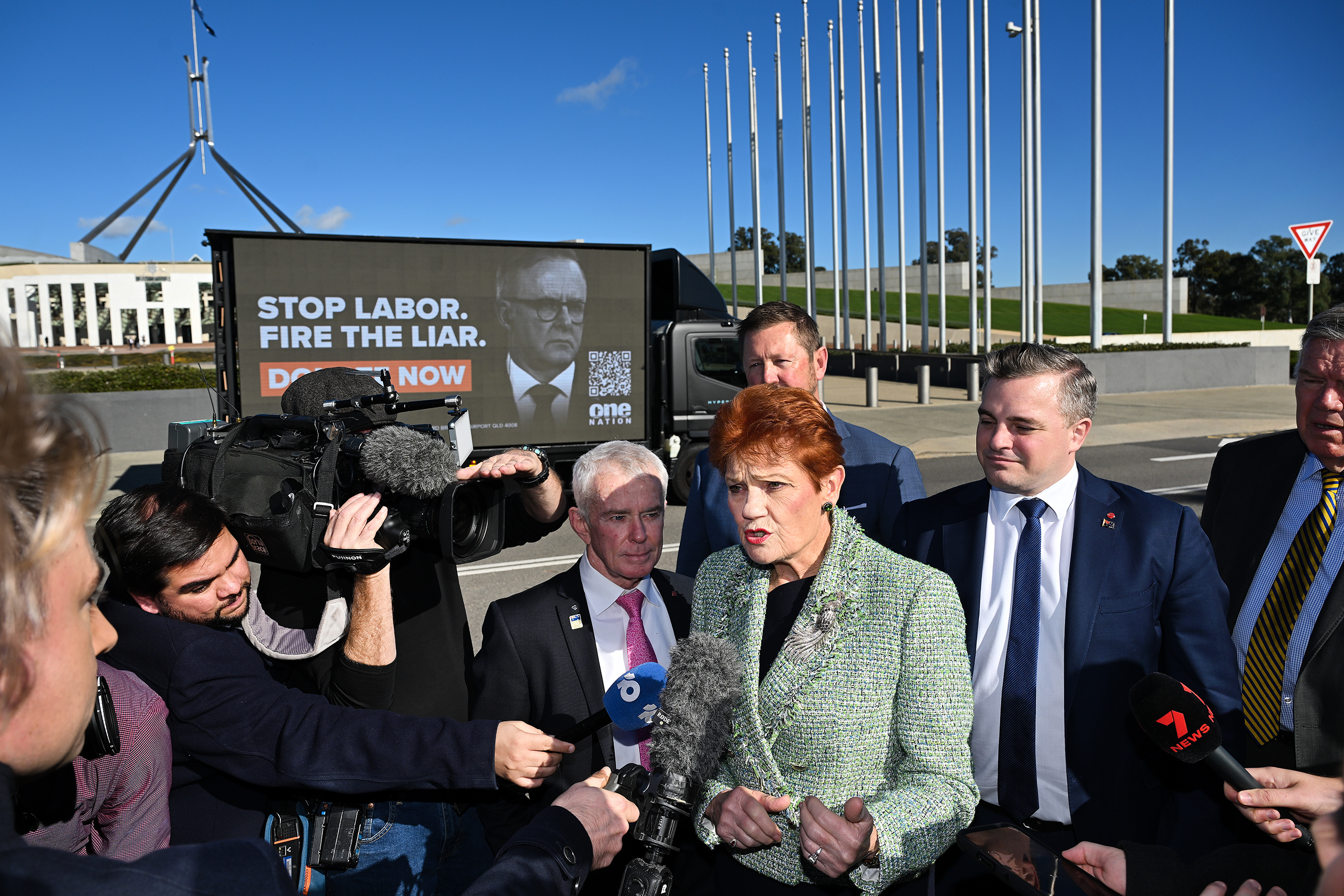
“One Nation Retakes Lead Over Labor in Latest Poll,” says the Australian Financial Review’s headline, and it’s almost right.
The latest Redbridge/Accent survey does indeed have One Nation in front on primary votes, with 31 per cent, followed by Labor on 29, the Coalition 22 and Greens 10. But we all know from decades of experience that primary votes don’t decide elections: two-party-preferred ones do, or at least two-candidate-preferred… and in fact three-candidate-preferred ones, because they decide who gets to contest the two-candidate-preferred counts.
In a lede somewhat buried, respondent-allocated preferences put the Coalition in front of Labor, 52–48. It’s not the first time a pollster has found this since the last election: a couple of Essential polls and Fox and Hedgehog (a new entrant) have reported a Coalition two-party lead in the past few months. But it’s a rarity. Redbridge/Accent’s own estimate from its primary votes, by contrast, puts it on around 50–50.
The AFR article devotes a few paragraphs to the “will they or won’t they?” question of the Coalition forming government with One Nation support. But this is moot, as are the two-party-preferred numbers above, because on this poll the former minor party would easily win more seats than the Liberals and Nationals combined, and so the Coalition would, at best, be the minor party in any government formation.
Perhaps not even that, because my very rough ballpark guesstimate from this Redbridge/Accent poll gives One Nation seventy-eight seats, a comfortable majority. My two-party-preferred estimates from the poll’s primary data land on about 50–50 between Labor and the Coalition, and 51 for Labor against One Nation’s 49. Yet One Nation wins a majority of seats. Confused? Good! It will prepare us all for election night 2028. (And indeed Victoria’s election night and the days that follow in November this year.)
(Redbridge/Accent’s respondents, when prodded for preferences between Labor and One Nation, gave Labor a bigger win, 53–47. But respondent-allocated preferences are not very reliable; in this case voters are likely unaware of Liberal and Nationals how-to-vote cards favouring One Nation over the ALP being thrust into their mitts. All estimates of preferences flows, by me and others, assume this 2025 Coalition preference strategy will be repeated in 2028.)
This time last year, when we were all still recovering from May’s shock election result, One Nation was polling in single digits, though up on its 6.4 at the election. If you visit Pollbludger’s awesome Bludgertrack, which aggregates all the polls, you can see the trajectory since then. The impact, if any, of December’s Bondi horror — when the party was in the high teens — is a known unknown; the counterfactual might or might not have been a levelling of support (my guess is not).
One Nation’s polled support kept rising until March this year, then sat on around 25 per cent for two months. Then, in mid-May, the line turned up and resumed its climb. An obvious data point is the federal budget on 12 May, particularly the changes to capital gains tax and negative gearing, and the coverage, some of it hysterical, some reality-based, in mainstream media and online.
The One Nation Express climbed for the five weeks until Hanson’s 17 June appearance at the National Press Club. Bludgertrack then shows a decline from the around 29 per cent to an eventual 26. (These are small shifts, of course, but coming from large total samples across many surveys they are meaningful.)
Australia is currently blessed (interpretation of this word is open to the reader) with many political polls, more than ever before, no doubt largely because they are cheaper to conduct. And polls using multilevel regression with post stratification, or MRP, with their larger samples and fancier statistical herbs and spices, are also more frequent. The latest of those ones comes from a quite new outfit, Demos AU, and was released last week.
The mid points of Demos’ predicted seat numbers would constitute a hung House of Representatives, with Labor holding the most spots and likely to cling on to government with the support of Greens and independents. Very messy, but then the alternative, a One Nation–Coalition “coalition,” would be too.
Note that this survey was taken from 27 May to 11 July, about three weeks either side of the aforementioned One Nation peak. Demos’s One Nation primary vote of 30 per cent seems high for that period. Now Redbridge/Accent, in its regular poll, has gone one better, with 31 per cent. Time will tell if this is the beginning of a revival.
Of particular interest, as reported in Capital Brief’s Political Capital newsletter, was Demos’s finding that One Nation support among people earning more than $200,000 a year had “peeled away from both major parties” since its last MRP in January to March. One Nation’s support among these people increased by eight points, but it “remains the only income cohort in which the Coalition leads, with 29 per cent support compared with 27 per cent for One Nation and 23 per cent for Labor.”
These high-income earners make up only around 5 per cent of the voting population and so aren’t exactly vital. And 5 per cent of Demos’s total sample of 9343 comes to about 470. (This is not to assume they surveyed exactly this number, but it contributes to the effective margin of error.) Furthermore, overall One Nation support (from everyone) jumped by three points, which lessens the Wow factor. Still, even a 5 per cent relative change is probably statistically significant.
It makes intuitive sense that high-income earners would particularly baulk at capital gains tax changes, whether or not they understand the detail. Some fleeing from Labor to the Coalition or One Nation after the budget sounds right, and others going from the Coalition to One Nation could be driven by frustration with the opposition’s inability to successfully oppose government policy.
So this, again, is one to watch for in future surveys.
It would be absurd to predict an election outcome more than eighteen month away, so don’t do that. Just enjoy the One Nation opinion poll ride if you can. •