Ben Carroll wants to convince Victorian voters he is neither Daniel Andrews nor Jacinta Allan. The new Labor premier’s first act was to call a royal commission into the construction industry, distancing himself from the crime, corruption and waste that plagues the state’s “Big Build.” And he is far less enthusiastic than his predecessors about Labor’s $34.5 billion Suburban Rail Loop, which aims to reshape Melbourne into a city of dispersed centres.
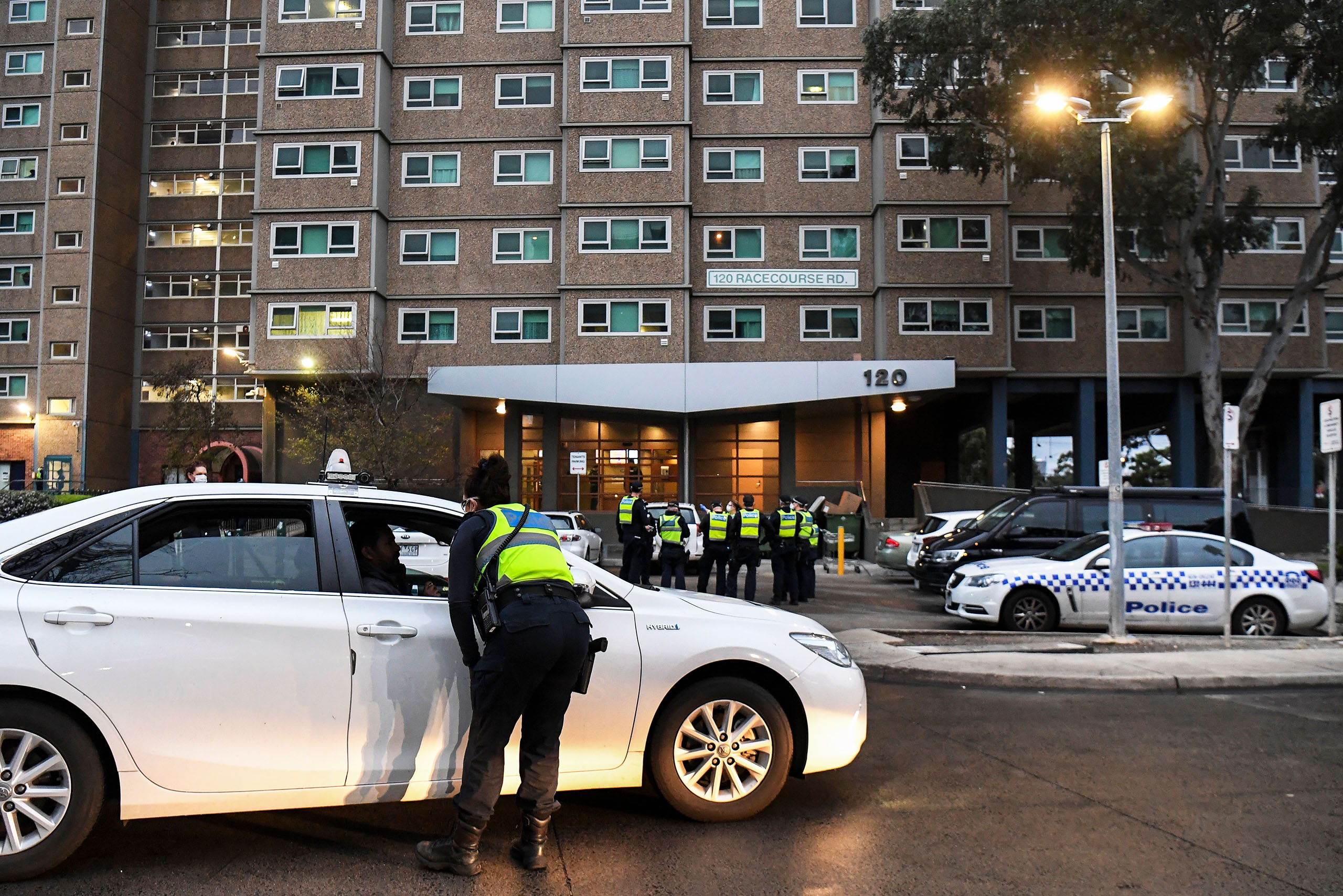
To further differentiate himself, Carroll should rethink a third problematic legacy of the Andrews–Allan era — the plan to demolish all forty-four of Melbourne’s public housing towers by 2051. Andrews announced the plan in September 2023, and the 10,000 residents set to lose their homes mostly learnt about it from the media. As former Supreme Court justice Kevin Bell told a public meeting, residents were treated without dignity, respect or humanity: “No consultation. No consent. Just orders from above.”
“They are crumbling; they need to go,” Andrews declared. Within a week, he himself was gone, but the government’s line never wavered under his successor Jacinta Allan. Housing minister Harriet Shing told a parliamentary inquiry the towers had “exceeded the lifetime for which they were originally developed”: they were no longer meeting fire safety standards, plumbing and sewerage systems were breaking down, and the concrete slabs used to build them had exceeded their forty-year lifespan.
Senior officials from Homes Victoria backed up their minister, declaring the towers failed to meet contemporary standards for noise, sustainability, ventilation, seismic load and accessibility. The parliamentary inquiry found that 95 per cent of elevators in the forty-four towers are too small to fit an ambulance stretcher.
Critics challenged the assertion that all the towers are beyond repair. The Australian Institute of Architects told the inquiry the towers vary by age and typology and should be individually assessed to see if a retrofit is viable. Various case studies have suggested some towers could be refurbished not only at lower cost but also with fewer carbon emissions and less disruption to residents.
The government’s dogged refusal to release the full technical evidence underpinning its plans makes it hard to evaluate these competing views. But excessive secrecy has fuelled a suspicion that the government, in league with developers, is making a grab for cash and land that will further gentrify Melbourne’s wealthy inner suburbs.
The debate about whether the towers should be fixed up or torn down also overshadows another question: why not build residents new homes before demolishing their current ones? There is enough land on Melbourne’s high-rise estates to build alongside the existing towers.
Though this would mean living for a time on a construction site, with reduced open space and parking, residents watching their new homes rise next door might feel more confident the government had their interests at heart. They could be engaged in designing, planning and sequencing the redevelopment and only move house once, keeping established communities together.
Britain’s experience of regenerating high-rise council housing from the same era shows how this can be done. Many towers have been torn down, though others have been upgraded and refurbished. There’s been plenty of protest and contention along the way, but outcomes are clearly better when the renewal is jointly determined by residents — the antithesis of Victoria’s top-down approach.
Public housing towers were born of optimism. As Holly Smith writes in Up In the Air, her new history of high-rise Britain, early advocates of “modern sky living” didn’t simply want to crowd more people into smaller spaces; they wanted to release the land below for parks, gardens and roads. Modernist architects were reacting to the dominant Garden City movement, which they accused of “disfiguring the landscape in every direction.”
But their vision extended beyond holding back suburbia. Multistorey apartments with shared amenities would, they hoped, foster new forms of communal life.
In the postwar years, this modernist dream — or fantasy — became necessity. Building upwards was seen as a crucial to rehousing the nation while preserving green belts around bomb-damaged cities. The plan was for mixed estates: towers to accommodate young couples, single people and the elderly alongside lower-rise homes for families with children. Financial strictures meant the vision of pleasant landscaping and improved amenities didn’t always materialise, yet flat dwellers enjoyed “unprecedented luxuries” including heating, hot water, new kitchens and indoor toilets.
Britain built almost half a million high-rise flats between 1955 and 1975. As in Australian cities, though, they didn’t become the dominant housing form. Flats made up only one in five dwellings built in Britain in the three decades after the war, and most were in blocks of four storeys or less. Still, Smith writes, high-rise tower blocks became “a highly charged symbol of twentieth-century housing.”
A troublesome legacy flowed from the “large panel systems” used to build many of them. This innovative construction technique enabled lower-skilled workers to assemble mass-produced, prefabricated concrete slabs onsite. It was a modified version of a successful Danish approach, though in Scandinavia it was only approved for buildings up to six storeys. Applying it to high-rise seemed to promise lower costs, faster construction and economies of scale.
Those gains came crashing down in the Ronan Point disaster of 1968. Residents had been living in the new twenty-two-storey block in London’s Canning Town for just two-months when a gas leak caused a small explosion that collapsed a corner of the building. Inadequate engineering, not the force of the blast, was to blame: knocking out that one wall undermined the structural integrity of the entire tower. Five people died and many more were injured, some crushed by tumbling concrete panels.
Inquiries revealed that incentive schemes had enticed workers to prioritise speed over quality, with cost-cutting causing jerry building, rushed construction and low-quality materials. Similar problems would cause the Grenfell Tower disaster almost half a century later.
Ronan Point was evacuated, patched up and reopened in 1973, but problems persisted. A decade on, residents complained of cracks between the walls of their flats and wind strong enough to lift carpets whistling through gaps. The building was evacuated again, and tenants in another eight towers on the same estate threatened a rent strike unless they were rehoused too.
Although a 1985 study found two-thirds of British council towers were sound and had a long-life expectancy, faults with large panel systems were discovered in blocks all over the country. Many residents campaigned for their towers to be torn down and replaced with lower-rise housing. When local authorities responded, demolition parties became popular weekend events, with a local child sometimes invited to trigger the detonation.
These very public structural flaws fuelled negative perceptions of council housing, reinforced by TV shows like The Bill that used estates as backdrops for “gritty dramas about poverty, delinquency and narcotics.” Deindustrialisation, mass unemployment and Margaret Thatcher’s sell-off of higher-quality homes concentrated disadvantage in high-rise estates and compounded their reputational damage. And while blowing up a tower was relatively easy, finding replacement homes was not. After Ronan Point and nearby blocks were evacuated, record numbers of tenants landed in bed and breakfasts and other temporary accommodation.
Once it became apparent that their estates would not be replaced with better social housing, residents began to fight demolition. Tenants of Ocean Estate in Tower Hamlets, for example, considered privatisation a greater threat than structural collapse and mobilised to have their buildings repaired. They didn’t want to join 10,000 households already on the London borough’s waiting list for housing.
“By the 2010s, demolition had flipped in meaning; an option once conceived as emancipatory became suffused with violence,” writes Smith. “Postwar estates, however imperfect, came to represent a foothold for working people in an expensive city, a last bastion of a fading welfare state.”
Smith presents council housing as a great achievement of local government in Britain but also its biggest failing. Innovative prefabrication enabled councils to respond rapidly to the postwar housing crisis and accommodate people in modern homes. Yet this impressive housing drive was not matched by long-term funding to maintain buildings. Tower blocks fell into disrepair, leaving residents with a Hobson’s choice — put up with dilapidated homes or lose them. Many had deep affection for their “houses in the sky” but felt “deserted and desperate.”
Similar conclusions can be drawn about Melbourne’s towers. As local architect David Vernon writes, the forty-four towers dotted around the inner suburbs represent “the best and worst of modernist urban planning and design in the mid-twentieth century.”
The towers were built by Victoria’s Housing Commission between 1962 and 1974, with all but five using a locally patented precast construction system. By 1956, this Concrete Housing Project had produced 10,000 standalone houses or walk-up flats. The technique was extended to high-rise in the 1960s after commission executives had studied developments in Europe and the United States.
This is not to suggest Melbourne’s towers are at risk of collapse like Ronan Point, where concrete panels were loaded precariously onto connecting bolts without mortar for support and steel bars and tie straps were wrongly positioned. One of Melbourne’s more architecturally significant housing estates, South Melbourne’s Park Towers, for example, has post-tensioned cables threaded through its concrete slabs to hold the walls in place. When it was completed in 1969, the thirty-storey block was thought to be the tallest building in the world to be built with precast, load-bearing concrete panels.
But even if some Melbourne towers are worthy of heritage listing, architectural value wouldn’t be a good reason to condemn residents to live in substandard housing or put up with leaking sewage and black mould.
As part of the high-rise redevelopment scheme announced by Andrews, Homes Victoria commissioned an expert assessment of the potential to retrofit its towers in North Melbourne and Flemington, estates chosen as representative of designs “replicated across the Homes Victoria portfolio.” In one of the few technical documents released by the government, engineers and architects concluded that retrofitting was possible but could not bring the apartments up to current standards. The concrete slabs that form apartment walls are key to the building’s structural integrity, and hamper reconfiguring layouts, raising ceiling heights or widening doorways.
Prefabricated panels and reuse of designs enabled Victoria’s Housing Commission to meet urgent housing needs in the 1960s with “fast, cheap and highly efficient” construction. Those same factors now detract from the towers’ contemporary performance and limit their potential adaptation.
A full structural overhaul would almost certainly require residents to move out of the towers for several years, making the disruption to established communities similar in scale to demolition. If refurbishment only extended the life of the towers for another forty or fifty years, the environmental benefits may be no greater than a complete rebuild that, done properly, could produce homes that last for centuries.
Still, as Smith writes in relation to Britain, “structural defects must not be used as a pretext for developer-led regeneration over the heads of local communities, nor for the erosion of desperately needed social housing.”
The “radical modernist architecture” of tower blocks was not matched by “radically progressive politics,” says Smith, and she is alive to the risk that today’s renewal projects replicate the top-down postwar “slum” clearances. While Britain appears to be moving on from this “fatally high-handed” approach, the same cannot be said of Victoria.
As housing policy expert David Hayward wrote in 1996, an “implicit objective” of the Victorian Housing Commission was “to improve the moral fibre and health of tenants.” The outcome “was a public housing system that had very paternalistic overtones, with systems being put in place that carefully monitored the behaviour of tenants, and severely restricted tenants’ ability to shape their houses in their own image.”
In 2021, as part of its just-announced “Big Housing Build,” the Victorian government asked Hayward to chair a review of social housing regulation in the state. Its report took aim at the pattern of paternalism Hayward had identified a quarter of a century earlier and called for the voices of tenants to be placed “at the centre of the system.”
If Daniel Andrews received this advice, he paid it no heed. His demolition announcement continued the autocratic approach that had locked down towers without warning during the Covid pandemic, denying residents’ rights. Strong social bonds, mutual support and community resilience in Melbourne’s towers go unrecognised, even though ample evidence exists for those who pay attention.
Of course there are problems on the estates, mostly arising from the decades-long neglect of public housing, and policies that allocate homes to tenants with the highest needs — an understandable priority, but one that concentrates disadvantage. Demolishing the towers, replacing them with new buildings, and mixing public housing tenants in with wealthier homeowners and renters is assumed to magically fix such issues, but little evidence exists to support this belief.
More than 57,000 households are waiting on housing from Homes Victoria, yet the twenty-five-year tower redevelopment project will increase the number of social homes by only 10 per cent. An extra 700 dwellings across forty-four estates seems a poor return. In Sydney, by contrast, the redevelopment of just one site, Waterloo South, added 250 social homes and 600 “affordable” dwellings.
It isn’t too late for Victoria’s new premier to rebuild the government’s relationship with its public housing tenants. If he’s looking for ideas, a Churchill Fellowship report by a former Homes Victoria official is a good place to start.
Urban designer Kate Cavanough was a project manager on the Victoria’s high-rise redevelopment program when she travelled to Britain to investigate best practice in the renewal of social housing estates. Her thirty-two case studies are a catalogue of the good, the bad and the mixed, but her findings leave no doubt that Dan Andrews set Victoria’s program off on entirely the wrong foot.
“When residents are meaningfully involved from the beginning, the benefits are clear and far-reaching,” she writes. “In short, authentic resident engagement — rich with trust, respect, and genuine power-sharing — leads to smoother planning, stronger communities, and positive change that lasts.”
Otherwise, she adds, projects are beset by “conflict, fatigue, and missed opportunities for genuine renewal, while residents themselves bear the brunt of uncertainty and upheaval.” That’s an apt description of the current state of play in Victoria. In London, by contrast, any project that seeks municipal funding must hold a ballot of residents before social homes can be demolished.
Ballots can be problematic, of course. When residents of London’s Juniper Crescent were asked to vote in 2020 on a proposal to replace their 120 social homes with 478 “high-quality, energy-efficient” dwellings in a mix of social rent, affordable rent and market sales, they were warned that if they voted no then their homes would only receive “essential maintenance” in future. Despite this, ninety-one residents voted against demolition and sixty-six in favour. That was not the end of the matter: consultations continued, fuelled by glossy brochures, free pizza and live music. Two-and-a-half years later, in a re-run of the ballot, residents supported demolition seventy-three to forty-three. One can only guess at the effect this process had on neighbourly relations.
But while ballots can be divisive and prone to manipulation, they at least force proponents to set out a transparent plan for regeneration. The London mayor’s best practice guide also requires that residents are engaged in shaping the vision and design. All social tenants must be offered the option to return to suitable accommodation in the same location at social rent, but the gold standard is “single-move relocations,” when residents aren’t forced to move out of their old homes until they can move into new ones nearby.
The significance of this standard can’t be overstated, since once residents leave neighbourhoods their “right to return” becomes theoretical. As project timelines drag out, multiple moves become more likely, often ending in resettlement outside the original community. A University of Melbourne study found that renewal of the Kensington estate in Melbourne resulted in the loss of 260 public housing units. Only one in five of the original residents eventually returned.
Preserving social ties and support networks allows residents to “adapt together rather than being scattered,” writes Cavanough. That means “stronger resident satisfaction, greater social stability, and enhanced overall wellbeing.” She also found that governments could temper the “bare bones” blight that often attends long-term regeneration and signal commitment to existing communities by “early phasing of public amenities, such as parks, play areas, schools, GP practices, and shops.” This fosters liveability and helps anchor new and returning populations.
In Britain, as in Australia, public and not-for-profit housing agencies face two compounding challenges: an urgent need to build more social homes and a need to generate revenue. Estate regeneration often tries for both goals — by using income from private sector developments to subsidise new social housing builds, for example, as planned for London’s Juniper Estate, Melbourne’s towers and Sydney’s Waterloo South. But, says Cavanough, these objectives can sometimes conflict, and “models relying solely on land sales or speculation often cause gentrification, displacement, and insufficient affordable housing.”
What emerges most clearly from Holly Smith’s stories of Britain’s high rise is “a persistent demand for public housing to be reformed but protected.” The rallying cry across the decades is “democratisation and devolution of management.” This chimes with David Hayward’s call for a system where social housing tenants can “communicate their interests and shape the services they receive.” Kate Cavanough’s Churchill fellowship shows the potential for “a profound reorientation towards how places are made and remade with residents, not just for them.”
If Victoria’s new premier wants to break with the past, he should listen. •